

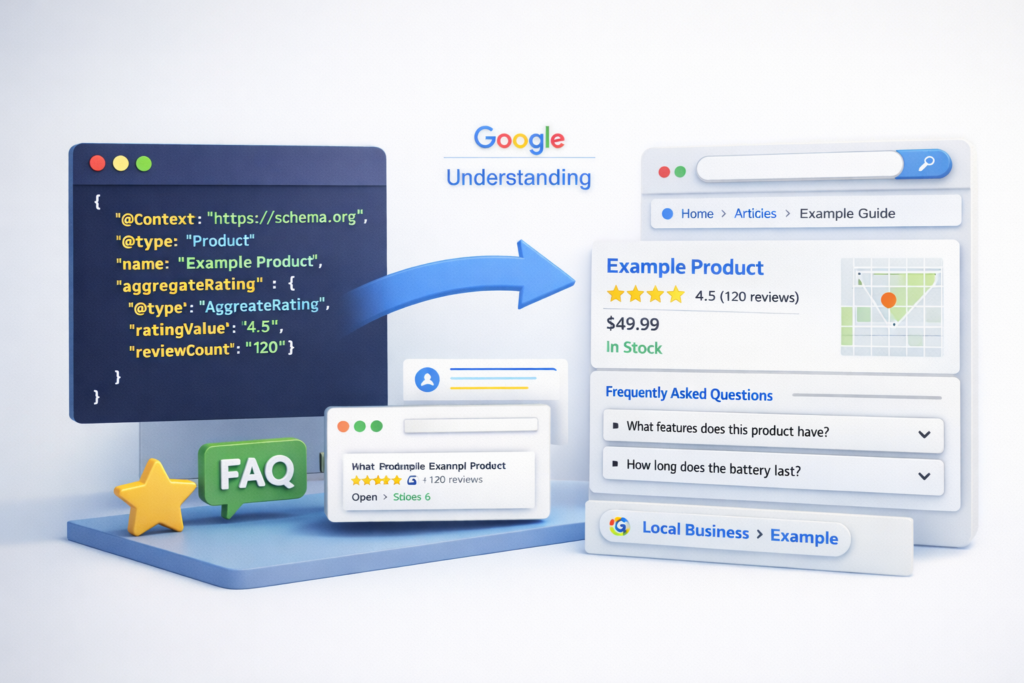
If you’ve seen Google results showing FAQs, star ratings, product prices, or breadcrumbs — that’s powered by structured data (schema markup).
But here’s the problem: most websites either don’t use it or use it incorrectly, which means they miss extra visibility and lose clicks even when they rank — why your pages get impressions but no clicks (and how to fix it)
In this guide, you’ll learn what structured data (schema markup) really is, how it works in SEO, and how to use it to get more clicks in 2026.
Clear definition:
Structured data (schema markup) is standardized, machine-readable code added to a webpage that describes what the content means — helping search engines interpret context and present enhanced results.
In 2026, this is increasingly critical. Search results now include expandable FAQs, product cards, review stars, how-to panels, knowledge panels, and AI-assisted summaries. Structured data is one of the primary structured signals that feed these features.
Structured Data vs Schema vs JSON-LD (important distinction)
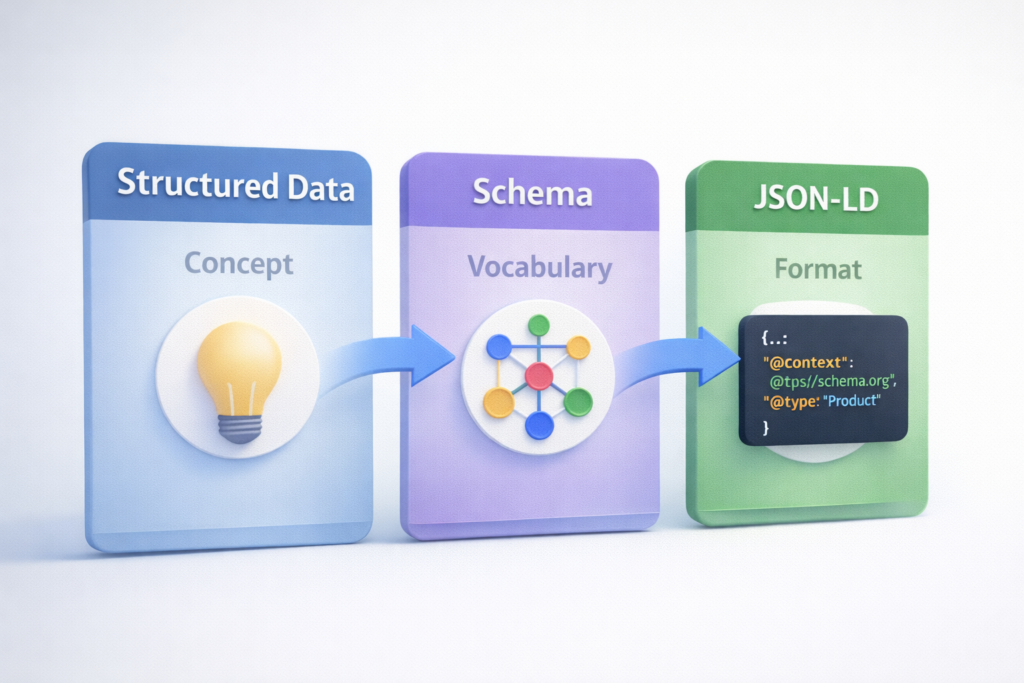
These three terms are often mixed up, but they are not the same:
- Structured data = the concept of organizing information in a machine-readable way.
- Schema (Schema.org) = the vocabulary that defines entities like Article, Product, FAQ, or LocalBusiness.
- JSON-LD = the format most commonly used to implement schema on a page.
For the most accurate, up-to-date guidance on how structured data actually behaves in search results, reference the official Google Structured Data introduction and implementation documentation.
Understanding this distinction makes it much easier to implement structured data schema markup correctly across your site.
In short: Structured data is the idea, Schema is the language, and JSON-LD is the delivery format.
Why structured data schema markup matters in 2026 (real outcomes)
Most people think schema is only about rankings. That is incomplete. Its real impact is on visibility, clarity, and click performance.
When implemented correctly, structured data schema markup improves how search engines interpret your pages and present them in rich results.
When structured data is implemented correctly, you typically see:
- Eligibility for rich results (reviews, prices, FAQs, breadcrumbs, how-to steps, event details, image previews).
- More clicks without changing rankings, because the result is clearer and more attractive.
- Better differentiation between similar pages (for example: review vs comparison vs product).
- Cleaner interpretation of complex pages such as eCommerce, tutorials, local businesses, and tool pages.
- Stronger alignment with AI-driven search surfaces that rely on structured signals.
A practical way to think about it:
Content tells users what you mean. Schema tells search engines what you mean.
This also ties directly to Crawl Budget: What It Is and How to Optimize It, because clearer structured signals help Google prioritize important pages more efficiently.
To maximize visibility, you also need the right linking structure — how many internal links per page is optimal for SEO
How structured data actually works
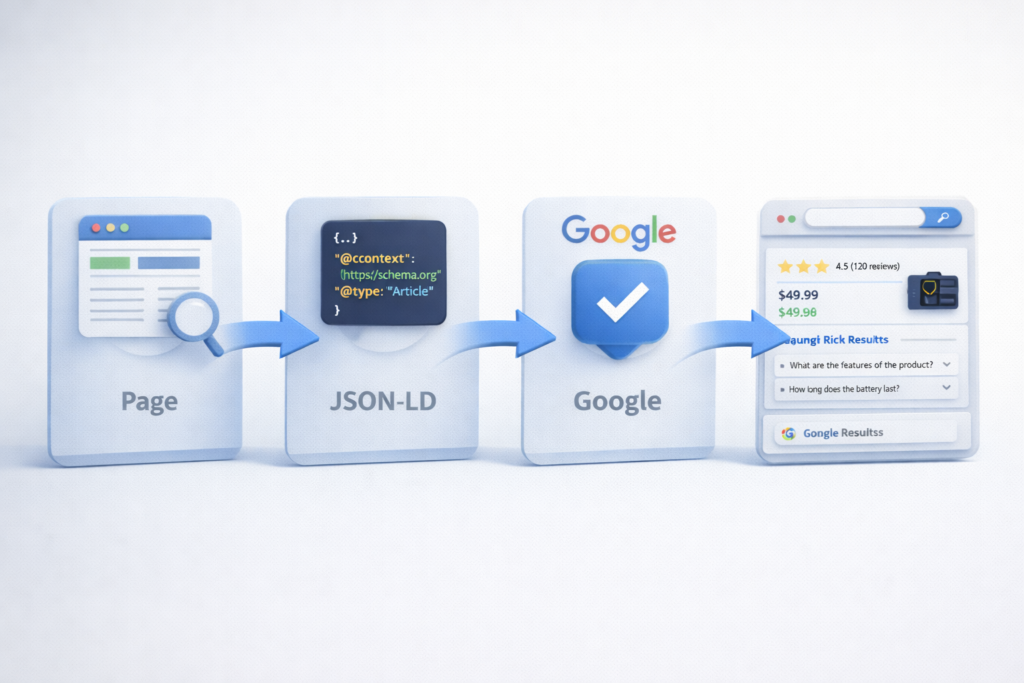
- Structured data (usually JSON-LD) is added to the page.
- Search engines crawl both the visible content and the schema.
- They verify whether the schema matches what users actually see.
- If valid and eligible, the page may appear with enhanced features in search results.
- Over time, consistent structured data helps search engines better model your site’s entities and structure.
This works best when your site is properly discoverable, which is why XML Sitemap: Ultimate Guide for SEO is closely connected to structured data eligibility.
Non-negotiable rule: schema must accurately reflect what is visible on the page — not exaggerate or invent details.
Why JSON-LD is the standard in 2026
You can technically write schema using Microdata or RDFa, but in practice JSON-LD dominates because:
- It is separate from your HTML, so it does not affect layout or design.
- It scales better for large sites.
- It is easier to debug and update.
- It is explicitly recommended by major search engines.
This is one of the main reasons structured data schema markup is most commonly deployed in JSON-LD format today.
If a site still relies heavily on inline schema formats in 2026, it is behind modern best practices.
Common types of schema (with real purpose)
Choosing the correct schema type matters. Wrong schema can be worse than no schema.
Article schema
Used for blog posts, guides, and editorial content. It clarifies authorship, publication date, and content type — which supports eligibility for Discover and enhanced listings.
Product schema
Essential for eCommerce. It can display:
- Star ratings
- Price
- Availability
- Offer details
This often improves trust and click-through rate even at the same ranking.
FAQ schema
Allows real, visible questions and answers to expand directly in search results — one of the strongest formats for informational content.
If you want to structure this properly, follow the principles in SEO-Friendly FAQ Page: Best Practice Guide so your FAQs are both user-friendly and schema-ready.
Breadcrumb schema
Replaces messy URLs with clean breadcrumb trails in search results, improving clarity and credibility.
LocalBusiness schema
Helps search engines correctly display address, hours, contact details, and service areas in local search.
Three realistic ways to implement structured data
Option 1 — Manual coding (developers)
Full control, but slow and error-prone without technical expertise.
Option 2 — SEO plugins
Fast and convenient, but often too generic for complex pages.
Option 3 — Dedicated schema generators (best for most users)
Produce clean, page-specific JSON-LD with fewer mistakes and faster deployment.
Before publishing, you can also use the Robots.txt Generator Tool to confirm search engines are allowed to crawl your structured pages.
Regardless of method, validation is mandatory before publishing.
Validation workflow that actually works
Before validating the schema, you must ensure Google can actually access the page — this is why Robots.txt Complete Guide for SEO is a critical technical foundation.
Most sites fail to get rich results because they skip proper validation. A reliable process is:
- Write or generate the schema.
- Test it with a structured data validator.
- Fix errors and warnings.
- Re-test before publishing.
- Monitor performance and enhancements in Search Console after indexing.
If a page is not indexed, schema issues are irrelevant — first check if your page is indexed in Google
Google Discover and reprocess structured data changes faster — but timing matters, as explained in how fast Google reindexes updated pages in 2026.
Common structured data mistakes (and how to avoid them)
The most frequent problems are:
- Using the wrong schema type for the page.
- Marking up content users cannot see.
- Copying generic schema without customization.
- Broken JSON syntax (missing brackets, commas, or quotes).
- Conflicting schema from multiple plugins.
- Schema that does not match the actual page content.
Simple rule: If a human cannot see it, do not mark it up.
How this plays out in real scenarios

Blog post
With Article schema, search engines receive clear signals about content type, author, and publication date — improving eligibility for enhanced listings.
Product page
With Product schema, listings can display ratings, price, and availability — increasing trust and clicks.
FAQ page
With valid FAQ schema, questions can expand directly in search results, giving users immediate answers and drawing more attention to the listing.
Structured data vs traditional SEO
Traditional SEO focuses on:
- Keywords
- Content quality
- Backlinks
- Site performance
Structured data focuses on:
- Clarity
- Machine understanding
- Search result presentation
The best-performing sites use both together.
Do you need schema on every page?
No. Use it strategically where it adds clear value:
- Blog articles
- Product pages
- Local business pages
- FAQs
- Reviews
- How-to content
Avoid adding schema to thin or low-value pages.
FAQs (high-intent questions)
What is structured data (schema markup) in SEO?
Structured data (schema markup) is code added to a page to help search engines understand content and show rich results like FAQs, ratings, and breadcrumbs.
Does structured data improve SEO rankings?
Structured data does not directly increase rankings, but it improves visibility, click-through rate (CTR), and eligibility for rich results, which can lead to more traffic.
What are examples of structured data?
Common examples include FAQ schema, product schema, review schema, breadcrumb schema, and article schema used to enhance search result appearance.
How do I add schema markup to my website?
You can add schema using JSON-LD code manually, SEO plugins, or schema generator tools, then test it using Google’s Rich Results Test.
What is JSON-LD in schema markup?
JSON-LD is the most recommended format for structured data. It allows you to add schema without changing your page layout.
Why is structured data important in 2026 SEO?
Structured data is critical because it powers rich results, improves SERP visibility, and helps search engines better understand your content.