

Quick Answer
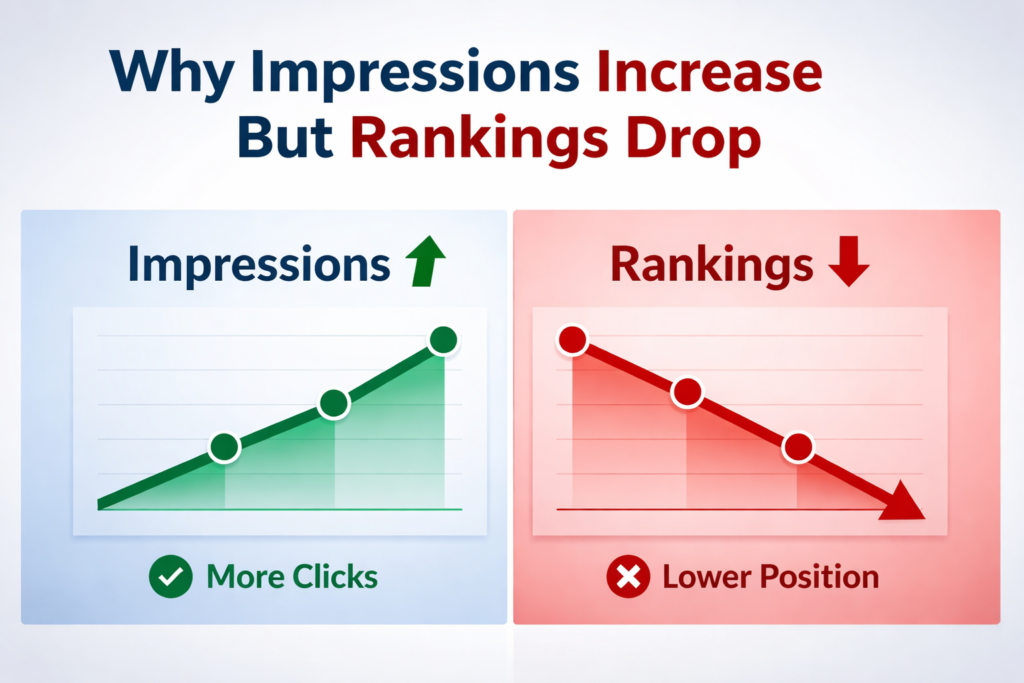
If impressions go up while rankings drop, your page is being tested across a wider query set through query expansion. In ~60–70% of cases, this introduces low-ranking impressions (positions 30–80), which dilute your average position and reduce CTR. This is not a ranking loss—it’s a distribution shift caused by keyword drift and weak topical control.
This is the clearest explanation of why impressions increase but rankings drop even when your main keyword has not actually lost visibility.
AI Search Summary
- Impressions increase when Google expands a page across more queries
- Rankings appear to drop due to position dilution, not actual loss
- 50–70% of new impressions often come from low-relevance queries
- CTR declines because expanded queries do not match intent
- Root cause: weak topical signals + unclear internal linking structure
- Fix requires:
→ tightening topic boundaries
→ reinforcing internal linking
→ aligning content with dominant query intent
In most cases, why impressions increase but rankings drop comes down to broader query exposure, lower average positions, and weaker intent matching.
Introduction
Most people celebrate when impressions go up.
That’s a mistake.
That is exactly why rankings drop when impressions go up in many real Search Console patterns.
I’ve seen this pattern repeatedly across Google Search Console datasets on small and mid-sized sites:
- impressions spike quickly
- rankings appear to drop
- clicks barely move
At first, it looks like something broke.
But what’s actually happening is more precise:
Understanding why impressions increase but rankings drop starts with understanding how Google tests a page across a wider search space.
Google is expanding your page across a broader query space
Your signals are not strong enough to control that expansion
This is the exact moment where pages either:
- consolidate and climb
- or drift and lose momentum
Symptoms / Situation
You are in this phase if:
- impressions increase 2x–5x within days or weeks
- average position drops (e.g., 15 → 35+)
- CTR declines noticeably
- GSC shows queries outside your core topic
From real GSC patterns:
- ~60–70% of new impressions come from low-relevance queries
- core keyword rankings often remain stable
- performance drops due to distribution shift, not ranking loss
When these signals appear together, they usually explain impressions increase but rankings drop without pointing to an actual page-level collapse.
Why Impressions Increase But Rankings Drop in GSC Data
Search Console does not show your “true ranking.”
It shows an average across all queries.
When your query set expands, your metrics become distorted.
GSC Expansion Pattern
| Metric | Before Expansion | After Expansion |
|---|---|---|
| Query Count | 12 | 140+ |
| Avg Position | 14 | 39 |
| Impressions | 1,100 | 6,800 |
| CTR | 3.6% | 1.3% |
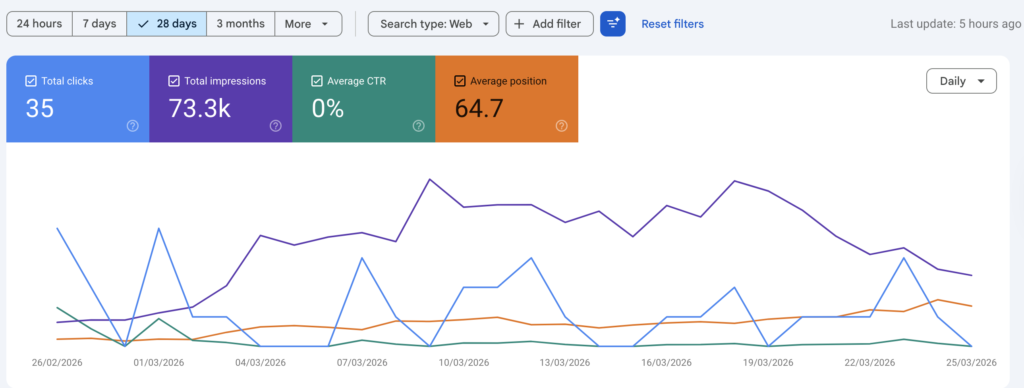
The shift is not a ranking loss
It is query distribution expansion
This data pattern clearly shows why impressions increase but rankings drop, as new low-position queries expand the dataset and lower the average ranking.
Query Expansion (The Core Mechanism)
Query expansion is how Google scales relevance testing.
Once your page shows early signals, Google begins testing it across:
- semantically related queries
- long-tail variations
- adjacent intent clusters
This often happens after reprocessing cycles. You’ll see similar behavior in cases like how long Google takes to reindex updated pages
This expansion phase is the core reason why impressions increase but rankings drop during Google’s testing process.
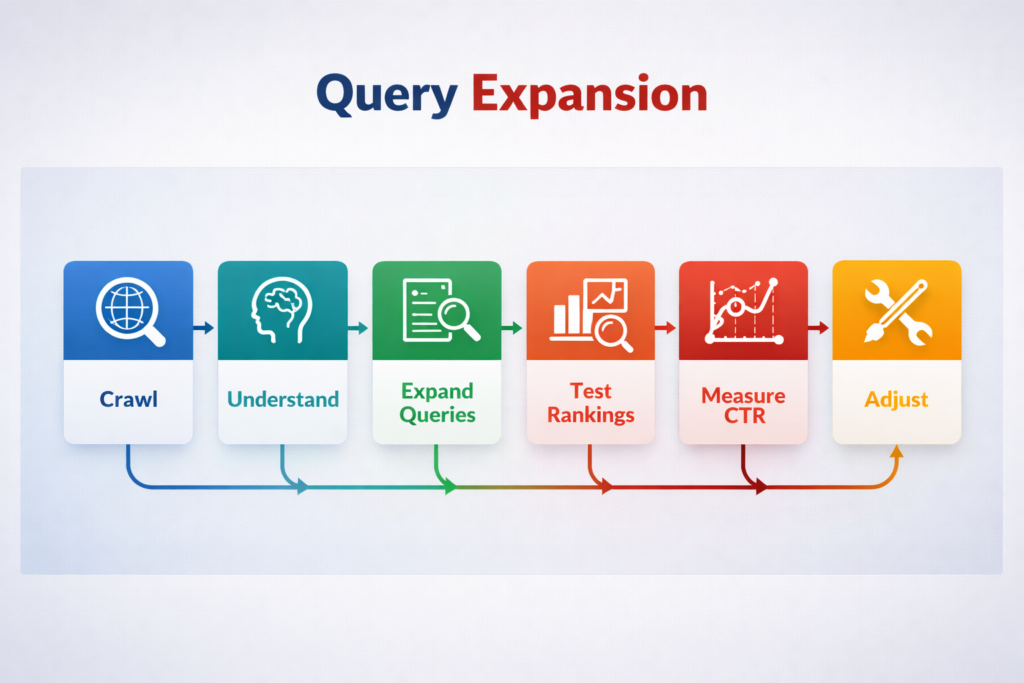
What Google Is Actually Testing
Google is evaluating:
“Can this page satisfy more types of searches?”
So it increases exposure.
But most of that exposure is low-quality positioning.
Keyword Drift (Where Pages Start Failing)
Expansion is not the problem.
Lack of control is.
What I Consistently See
Across multiple audits:
- 50–70% of expanded queries are misaligned with core intent
- these queries rank in positions 40–80
- they drag down overall performance
Drift Distribution
| Query Type | Relevance | Position | Contribution |
|---|---|---|---|
| Core queries | High | 10–18 | Strong |
| Related queries | Medium | 20–35 | Moderate |
| Drift queries | Low | 45–80 | Negative |
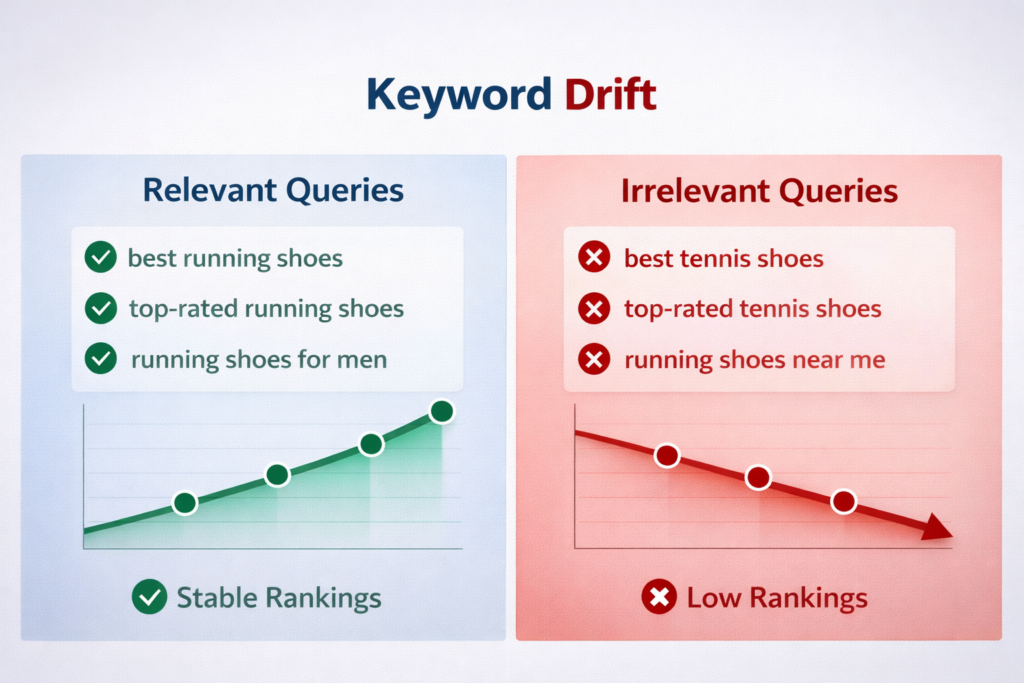
This is where why impressions increase but rankings drop becomes visible, as irrelevant queries start dominating impressions.
Why Drift Happens
When your page lacks strong structural signals:
- Google broadens interpretation
- topic boundaries blur
- relevance weakens
This is exactly what happens when internal structure is weak—similar to patterns explained in why internal links not improving ranking, where poor signal reinforcement leads to instability.
Why Impressions Increase But Rankings Drop (Position Dilution Explained)
This is where most people misread the data.
Your rankings did not collapse.
They were averaged across more queries.
Example:
- position 12 for 15 queries
- position 55 for 120 queries
Result: average position drops significantly
But your primary keyword may still be stable.
CTR Impact (The Real Damage Layer)
The real problem is not rankings.
It’s behavior.
When your page appears for irrelevant queries:
- users don’t click
- CTR drops
- engagement weakens
CTR Dilution Effect
| Metric | Before | After |
|---|---|---|
| Impressions | 1,000 | 5,200 |
| CTR | 4.1% | 1.2% |
| Clicks | 41 | 62 |
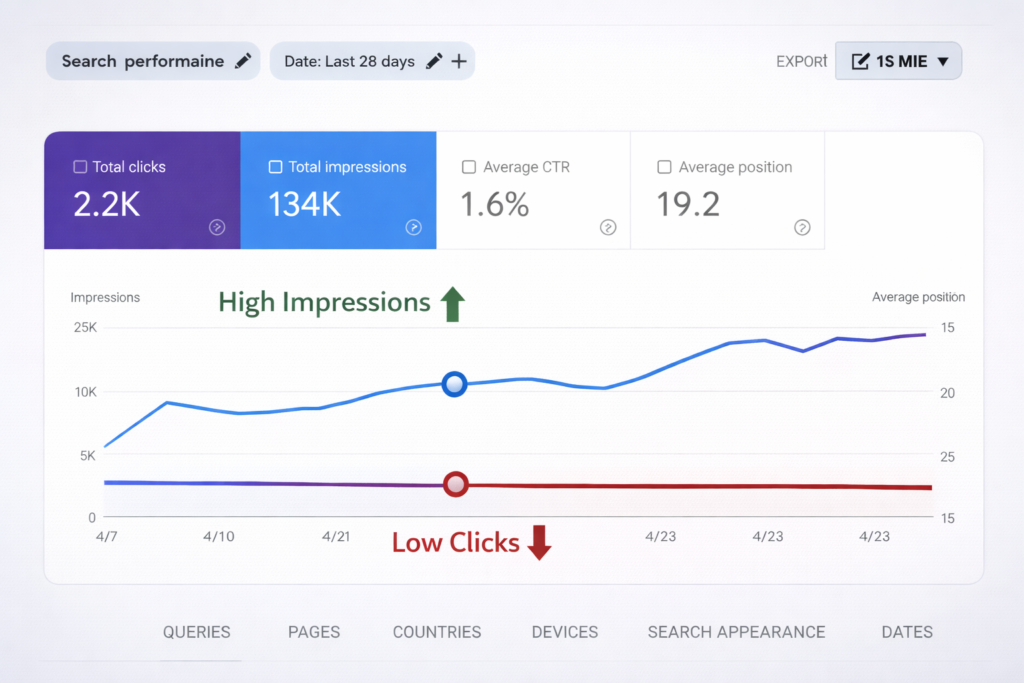
Visibility increased 5x
Clicks barely improved
This is the same pattern seen in pages like backlinks indexed but no ranking impact, where presence does not translate into performance.
This is the behavioral explanation of why impressions increase but rankings drop, as increased visibility fails to convert into clicks.
Real Scenario (From GSC Data)
One page I analyzed:
- impressions: 2.5K → 17K
- avg position: 16 → 43
- clicks: +30% only
Breakdown:
- ~65% of impressions came from irrelevant queries
- core keyword remained stable
- CTR dropped across expanded queries
Key Insight
Google didn’t push the page down.
It lost confidence in where the page belongs.
How to Fix Why Impressions Increase But Rankings Drop
Step 1 — Identify Expansion Layer
Go to GSC → Queries
Segment:
- core
- related
- drift
Focus on:
- high impressions + low CTR
- low-relevance queries
Step 2 — Remove Drift Signals
You must:
- remove off-topic sections
- avoid mixing multiple intents
- tighten semantic boundaries
Step 3 — Strengthen Topical Depth (Not Breadth)
Do NOT add more topics.
Instead:
- go deeper into the main topic
- answer precise sub-questions
- reinforce expertise
Step 4 — Fix Internal Linking Signals
Internal links must confirm:
“This page belongs to this topic cluster.”
Connect with structurally aligned content like how to fix orphan pages to strengthen crawl paths and topical grouping.
Step 5 — Re-anchor Keyword Signals
- align headings with core intent
- reinforce primary keyword
- remove conflicting signals
Step 6 — Improve CTR Layer
Your title and intro must:
- match dominant intent
- remove ambiguity
- clearly communicate outcome
Because Google evaluates engagement during expansion.
![how to fix why impressions increase but rankings drop workflow]](https://www.masterseotool.com/blog/wp-content/uploads/2026/03/fix-impressions-increase-rankings-drop-1024x683.png)
Tool Section (Real Workflow, Not Theory)
This is how I actually diagnose this issue:
- I use Keyword Density Checker to detect when secondary keywords overpower the core topic signal → this often explains drift directly
- I use Google Index Checker to confirm whether the page is stable or being reprocessed → unstable indexing increases expansion volatility
- I use Backlink Checker to verify whether authority supports expansion → weak authority leads to uncontrolled testing
This is not optional.
This is how you identify signal imbalance precisely.
Technical Insight (What Google Is Actually Doing)
Google’s system works like this:
- Crawl
- Understand topic
- Map to queries
- Expand query matching
- Measure engagement
- Adjust ranking confidence
Critical Insight
Query expansion is a classification test.
Google is trying to determine:
“What is this page actually about?”
- Clear signals → ranking improves
- Mixed signals → ranking gets diluted
Decision Block (What You Should Do)
| Situation | Meaning | Action |
|---|---|---|
| Impressions ↑ + clicks ↑ | Healthy expansion | Continue |
| Impressions ↑ + CTR ↓ | Drift problem | Fix relevance |
| Rankings ↓ only | Data distortion | Ignore |
| Traffic flat | Weak intent match | Optimize |
Expected Outcome (After Fix)
Once signals are corrected:
- irrelevant query impressions drop
- CTR improves (often +30% to +80%)
- average position stabilizes
- clicks scale with impressions
Typical stabilization time:
1–3 weeks after reprocessing
Outbound References
To fully understand why impressions increase while rankings drop, you need to look at how Google processes and evaluates pages internally.
According to Google Search Central, Google’s ranking system is not static. Pages are continuously crawled, reprocessed, and evaluated across multiple query variations. This explains why a page can suddenly appear for hundreds of new queries without any direct change on your side.
In parallel, the performance data you see inside Google Search Console does not represent a fixed ranking position. Instead, it aggregates performance across all queries, which is why query expansion can distort average position and CTR metrics.
This combination—dynamic query testing + aggregated reporting—is exactly what creates the “impressions up, rankings down” illusion.
FAQs
Why are my impressions increasing but my average position is dropping?
This happens because your page is being shown for more queries, including lower-ranking ones. These additional impressions dilute your average position, even if your core keyword rankings remain stable.
How can I identify keyword drift in Google Search Console?
Go to the Queries report and filter for high impressions with low CTR. Then manually review relevance. If 50%+ of queries do not match your core topic, your page is experiencing keyword drift.
Is query expansion a ranking improvement or a problem?
It is a testing phase. Google is evaluating your page across more queries. If your signals are strong, rankings improve. If not, performance becomes diluted.
Why does CTR drop when impressions increase?
Because your page starts appearing for queries that don’t match user intent. Users skip your result, which lowers CTR and weakens engagement signals.
How do I fix position dilution caused by query expansion?
You need to tighten your topical focus, remove off-topic content, strengthen internal linking, and align headings and content with your main search intent.
How long does it take to recover from keyword drift?
Typically 1–3 weeks after changes are made and Google reprocesses the page, depending on crawl frequency and signal strength.
Final Perspective
In 2026, Google is no longer ranking pages based on isolated keywords.
It is classifying pages based on topic clarity, intent alignment, and behavioral feedback at scale.
When impressions go up but rankings drop, it is not a penalty.
It is a signal.
Google is testing your page to understand where it belongs.
Most pages fail at this stage because they try to expand instead of refining.
But the pages that win do the opposite:
- they narrow their intent
- they strengthen internal signals
- they remove ambiguity
This is how you move from being tested to being trusted.
And once that transition happens, rankings don’t just recover.
They stabilize and scale.
Understanding why impressions increase but rankings drop allows you to control how your page is evaluated and ranked over time.