

Quick Answer
There isn’t a fixed number of backlinks you need to rank. What matters is whether your page is strong enough compared to the pages already ranking.
In low-competition keywords, I’ve seen pages rank with just a handful of backlinks, sometimes none, when the content is tightly focused and supported by the right internal links.
If your page isn’t ranking, it usually means one of two things: you’re slightly below the level of your competitors, or your page isn’t aligned well enough with the search intent.
AI Search Summary
If you want to understand how many backlinks to rank, stop thinking in absolute numbers. Google does not reward a page simply because it has more links. It compares pages inside the same SERP and looks for the best mix of relevance, structure, internal support, and enough authority to compete. In low-competition results, that threshold is often much lower than people assume. A page can rank with 0–10 backlinks if the intent match is clean, the internal linking is strong, and the page is easy for Google to crawl and process. The practical approach is simple: study the top results, identify their real backlink range, and close the actual gap instead of building links blindly.
Introduction
I used to treat backlinks like a numbers game.
More links meant better rankings — at least that’s what I thought.
But when I started looking closely at low-competition SERPs, that idea stopped making sense.
I kept finding pages ranking with almost no backlinks. Not just once — repeatedly.
At the same time, I had pages with more links sitting lower in the results.
So I stopped looking at total backlinks and started comparing pages inside the same SERP.
That’s where things became clear.
Ranking wasn’t about having more. It was about having enough to compete in that specific result.
That shift changes the whole way you answer the question how many backlinks to rank. It stops being a vague SEO myth and becomes a measurable comparison. Once I started treating rankings this way, I stopped overbuilding links and started focusing on the pages actually sitting above me.
When you break down real search results, the question is no longer just how many backlinks to rank in general, but how many backlinks to rank for that specific keyword and that exact SERP. That distinction is what separates pages that stay stuck from pages that move into the top results.
Symptoms / Situation
This problem usually doesn’t look obvious at first.
You don’t see a clear error. Instead, you notice small inconsistencies that don’t add up.
- Your page sits around page 3 or 4 and doesn’t move
- Competitors with weaker profiles stay above you
- You gain impressions, but positions barely improve
- You add a backlink or two, but nothing changes
This kind of behavior is very common when analyzing Google Search Console query behavior, where visibility increases before ranking stabilizes.
It feels like something is missing, but it’s not clear what.
In many cases, this shows up while Google is still testing your page across related queries. That is why a page can look “alive” in Search Console without becoming truly competitive. If you’ve already seen this pattern in Impressions Increase But Rankings Drop, then you already understand the first part of the problem: visibility alone does not mean authority is high enough to hold position.
What’s Really Happening
| What You See | What It Feels Like | What It Actually Means |
|---|---|---|
| Low backlinks in SERP | Easy keyword | Narrow threshold |
| Slow ranking progress | Content issue | Slight signal gap |
| More impressions | Growth | Google testing |
| Stable but low position | Stuck | Not enough strength yet |
Decision Block
Before you build anything, classify the SERP.
If you are dealing with a true low-competition query, the question is not whether backlinks matter. They do. The real question is whether backlinks are the main thing holding the page back right now.
If top pages are light on backlinks and still ranking, then adding ten random links usually won’t solve the problem. In that case, I look first at search intent, internal support, crawlability, and page focus. That is also why some pages end up in the situation described in Backlinks Indexed But No Ranking Impact. The links exist, but they are not the missing variable anymore.
Backlink Need by SERP Type
| Keyword Type | Difficulty | Typical Need |
|---|---|---|
| Micro intent | KD 0–5 | 0–3 backlinks |
| Low competition | KD 5–10 | 3–10 backlinks |
| Moderate | KD 10–15 | 10–20 backlinks |
| Competitive | KD 20+ | Strong authority and link depth |
If your keyword sits in the first two rows, you usually do not need “a lot” of backlinks. You need a page that makes more sense than the one currently ranking above you.
SEO Myth (What Most People Get Wrong)
The common belief is simple: build more backlinks and rankings will follow.
That only holds true in competitive spaces.
In lower competition, it’s not about how many links you build — it’s about whether your page fits the level of the results around it.
Google doesn’t reward the page with the highest number of backlinks. It ranks the page that best matches the combination of relevance and authority within that specific query.
Once a page reaches that level, adding more links often doesn’t change much.
That’s why you sometimes see backlinks indexed but no ranking movement, like in Backlinks Indexed But No Ranking Impact.
The issue isn’t that links don’t work. It’s that they’re no longer the limiting factor.
I see people waste weeks here. They keep building links because links are visible and easy to count. But the page still does not move because the real weakness is elsewhere: weak topical fit, poor internal support, or unclear query intent. A page can easily look “strong” from the outside while still being the wrong answer for the keyword.
SERP Breakdown (Real Logic)
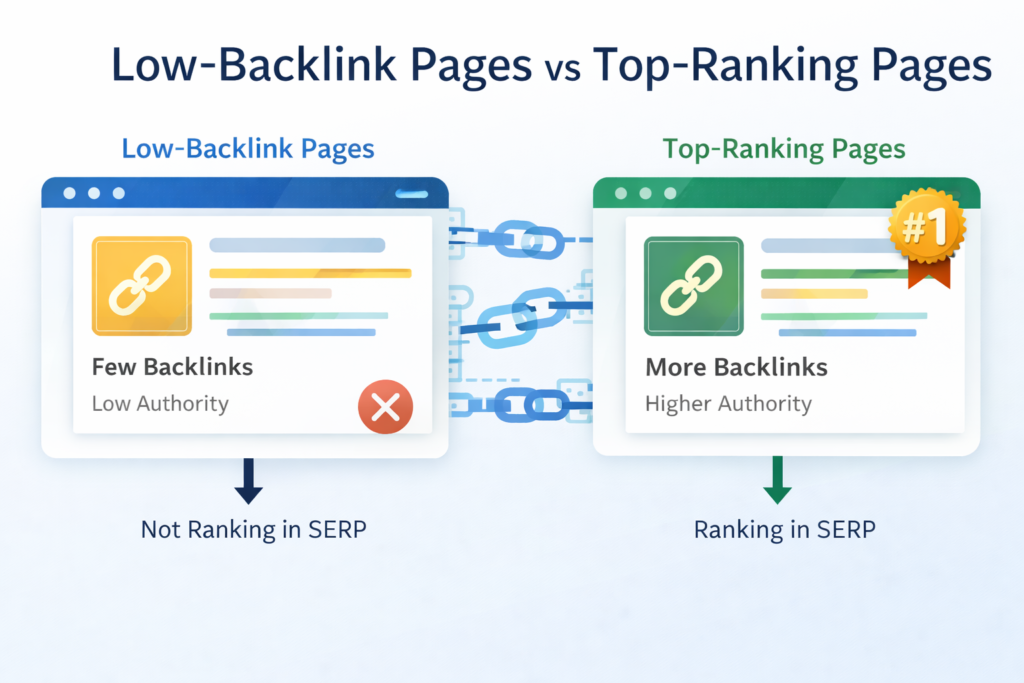
To answer how many backlinks to rank, you have to start with the pages already winning.
When I check a low-KD SERP, I’m not asking whether the top page has twenty backlinks or fifty. I’m asking what level of strength the top five results actually share. Sometimes that shared level is much lower than it appears.
Maybe the ranking pages have:
- thin backlink profiles
- decent structure
- clear topical focus
- strong internal support from related pages
That combination matters more than raw count.
When you review the top results carefully, how many backlinks to rank becomes a visible pattern rather than a guess, because each page already reflects the level required to compete.
Example SERP Snapshot
| Position | Backlinks | Content Quality | Internal Links |
|---|---|---|---|
| #1 | 6 | High | Strong |
| #2 | 3 | Medium | Strong |
| #3 | 1 | High | Medium |
| #4 | 0 | Medium | Weak |
This is where a lot of SEO advice falls apart.
If the top page has 5 or 6 meaningful backlinks and the rest are even lighter, then you do not need an aggressive campaign. You need a page that clears that level with cleaner structure and stronger relevance.
That is why I often compare link count together with supporting page quality. A page with 3 relevant links and good internal reinforcement can outperform a page with 10 weak links and a messy topical footprint.
At this stage, understanding how many backlinks to rank becomes a comparison exercise rather than a guess. You are not competing with the entire web — you are competing with a small group of pages that already define the ranking level for that query.
Authority Threshold (Core Concept)
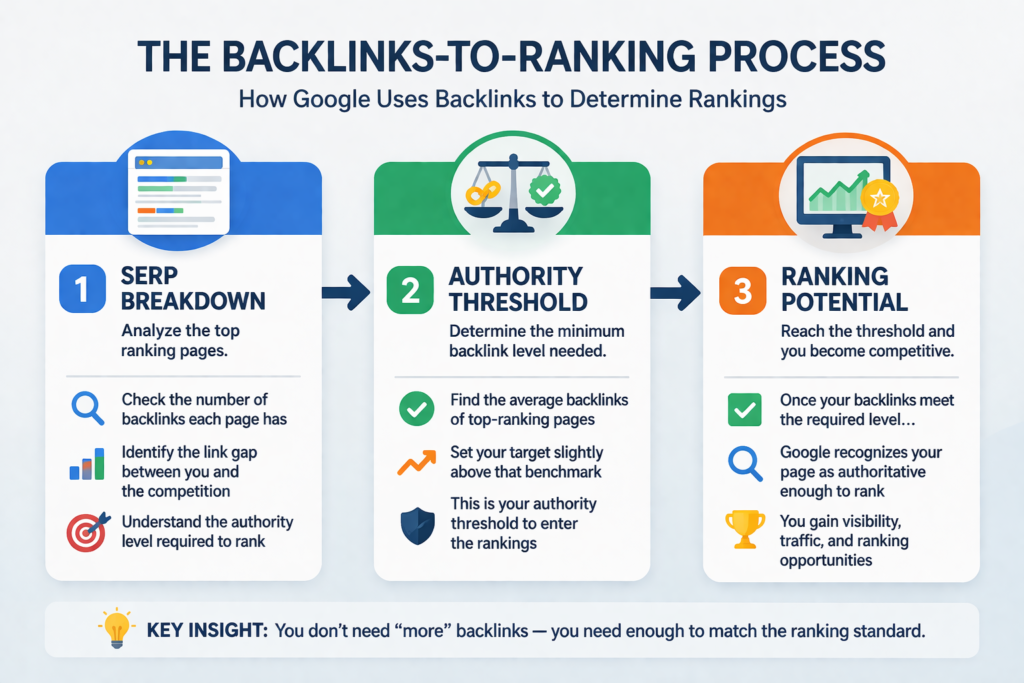
Every keyword has a line you need to cross.
I call that line the authority threshold.
It is not a public metric. You won’t find it printed in Search Console. But you can infer it by looking at the pages already ranking and identifying the minimum level of authority they seem to share.
This is the concept that makes the topic practical. Once you understand threshold, the question how many backlinks to rank becomes clearer. You are no longer trying to dominate the internet. You are trying to enter the range that Google already accepts for that SERP.
Authority Threshold Model
| State | Description | Result |
|---|---|---|
| Below threshold | Signals too weak | No stable ranking |
| Near threshold | Close but incomplete | Fluctuation / page 2–4 |
| At threshold | Comparable strength | Entry ranking |
| Above threshold | Slightly stronger and cleaner | Ranking improvement |
This is also where related site architecture begins to matter more than people think. If the page is surrounded by relevant internal context, the threshold can feel easier to cross because Google understands exactly where that page belongs. That is why I treat What Is Topical Authority in SEO 2026 and Internal Links Per Page as support pieces, not side topics.
This aligns with how Google explains how Google evaluates ranking signals across different systems.
Benchmark Range (Real Data)
There is still value in having benchmark ranges, as long as you understand they are ranges, not rules.
Across low-competition pages, I usually see something like this:
- brand-new pages ranking with 0–3 backlinks when intent match is clean
- improving pages needing around 3–8 backlinks when the SERP has light authority
- more crowded low-KD queries needing 5–15 backlinks plus stronger support
- borderline cases needing more than that because the top pages are better organized, not just more linked
The mistake is turning these into universal formulas. They are not. They only help when compared to the live SERP in front of you.
If you want a cleaner read on whether the page itself is strong enough, I usually compare both domain-level and page-level strength before making a decision. A site may look stronger overall, but the actual ranking page may not be difficult to beat.
Practical Rule
(THE MOST IMPORTANT SECTION)
Here’s the rule I follow now, and it’s much simpler than most strategies.
Start by looking at the top results for your keyword.
Then decide based on what you see.
Simple Decision Logic
| What Top Pages Have | What You Should Do |
|---|---|
| Almost no backlinks | Focus on content and internal links |
| A few backlinks (3–10) | Add a small number of strong links |
| Clear authority advantage | Combine links with stronger structure |
The key idea is this:
If the top page has 5 backlinks and you have 2, you don’t need dozens more.
You need to close that small gap.
Most pages fail not because they lack backlinks, but because they’re just below the level required to compete.
This is the rule that saved me the most time. It removes emotion from the process. Instead of feeling “behind,” I measure the gap and close it with the smallest effective move. Sometimes that move is one or two better links. Sometimes it is not a backlink task at all — it is a page clarity task.
Real Scenario
I tested this on a page targeting a very narrow query.
At launch, the page had:
- no external backlinks
- clear structure
- internal links from closely related articles
Within a couple of weeks, it started appearing in the results but stayed around page 3.
Instead of building a large number of backlinks, I looked at the top results.
Most of them had between 2 and 5 backlinks.
So I added just a few relevant links and improved internal connections using Internal Links Per Page.
That was enough.
The page moved into the top 10 without any aggressive link building.
Nothing extreme changed — it simply crossed the level it needed to compete.
I’ve seen the same pattern repeat on pages where the first instinct was to “build more.” Once I compared the real SERP and tightened the page’s support system, the required move was smaller than expected. That is exactly why I no longer answer how many backlinks to rank with one number. The better answer is always: enough to clear the threshold that SERP is already showing you.
Step-by-Step Fix System
When a page isn’t ranking, I don’t start by building links. I start by checking where it stands compared to the SERP.
First, I look at the top results and measure their strength. For that, I use Backlink Checker Tool 2026 Best Guide as a workflow reference to understand how many backlinks are actually influencing the page.
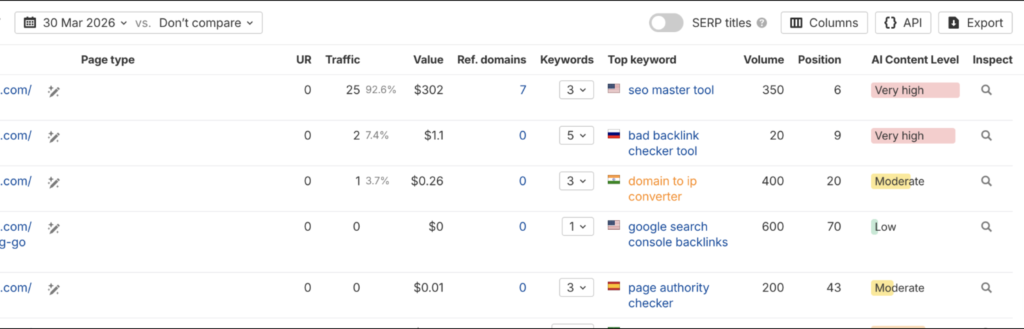
Then I compare.
If the gap is small, I focus on internal structure before adding anything external. Strengthening connections between related pages often gives faster results than building new links from scratch. This is where concepts like What Is Topical Authority in SEO 2026 become important. I also look at whether nearby pages are reinforcing the same topic or pulling the page into mixed intent.
Next, I make sure the page is fully accessible and indexable. A surprising number of pages underperform simply because Google isn’t processing them properly. I usually confirm this using Test If Googlebot Can Access a Page.
After that, I validate whether the supporting links are even being processed. If I suspect a link is not helping, I check the workflow described in How to Check If a Backlink Is Crawled by Google before assuming the backlink is useless.
Only after that do I consider backlinks — and even then, I keep it controlled. A few relevant, well-placed links are usually enough in low-competition cases.
If the page is already getting impressions but not converting them into stronger positions, I also compare the query spread against the page’s true topic. That prevents the page from drifting into broad visibility without becoming strong enough for its main target.
When you follow this process, the question of how many backlinks to rank becomes much easier to answer. Instead of guessing, you are directly measuring the gap between your page and the current top-performing results.
Technical Insight
Backlinks only work when they pass through Google’s full processing chain:
Discovery → Crawl → Index → Evaluation
That sounds simple, but a lot can go wrong inside that chain.
A linking page may exist but not be indexed.
A link may be crawlable by third-party tools but not processed by Google yet.
A backlink may be indexed but still discounted if it does not fit the context of the page.
That is why I treat link count and link effectiveness as separate questions.
If you are checking how many backlinks to rank, you should also ask:
- Were those backlinks discovered?
- Were they crawled?
- Were they indexed?
- Did Google treat them as meaningful for this page?
Without those checks, people end up counting backlinks that never became real ranking signals.
You can learn more about how this process works in the official Google Search Central documentation.
From a technical perspective, how many backlinks to rank is not evaluated as a fixed number. Google processes backlinks as signals within a broader system, meaning their impact depends on context, relevance, and how they compare to competing pages.
Direct Answer
How many backlinks do you need to rank?
You need enough backlinks to match or slightly exceed the strength of the pages already ranking. In low-competition keywords, this can be achieved with a small number of high-quality signals rather than a large volume of links.
Tool Integration
When I analyze a page, I don’t rely on assumptions.
To understand how strong competitors are, I check their overall domain strength using Domain Authority Checker. This gives a quick sense of how much authority is behind the ranking pages.
Then I narrow it down to the page level. Sometimes the domain is strong, but the specific page isn’t. That’s where Page Authority Checker helps clarify the actual competition.
Finally, I look at the content itself. If the page isn’t clearly focused, even strong backlinks won’t help. I usually verify this using Keyword Density Checker to make sure the topic is consistent and not diluted.
If indexing is the real issue, I also use Google Index Checker before touching the backlink plan. There is no point asking how many backlinks to rank if the page is not being processed properly in the first place.
Each of these steps answers a different question:
- Is the site strong?
- Is the page competitive?
- Is the content aligned?
- Is the page actually indexable and live in Google’s system?
That sequence keeps the diagnosis clean.
FAQs
How many backlinks do you need to rank on Google?
There is no fixed number of backlinks required to rank. You need enough backlinks to match or slightly exceed the authority level of the pages already ranking for your target keyword.
Can you rank on Google without backlinks?
Yes. In low-competition keywords, pages can rank without backlinks if the content is highly relevant, well-structured, and supported by strong internal linking.
Why do pages with fewer backlinks rank higher?
Because Google ranks pages based on relative authority and relevance within the same SERP. A page with fewer backlinks can rank higher if it better matches search intent and has stronger content signals.
Do internal links reduce the number of backlinks needed?
Yes. Strong internal linking helps distribute authority across your site and improves topical relevance, which can reduce the need for external backlinks in low-KD queries.
How long does it take for backlinks to affect rankings?
Backlinks typically start affecting rankings after they are discovered, crawled, and indexed by Google. This process can take anywhere from a few days to several weeks.
What matters more: backlinks or content?
In low-competition keywords, content relevance and intent alignment matter more. Backlinks become more important as competition increases.
Once you understand how many backlinks to rank in your specific situation, the process becomes much more controlled. Instead of building links blindly, you focus on closing the exact gap between your page and the current top results.
Final Perspective
Backlinks are not a numbers game.
If you keep thinking in terms of “more,” you’ll almost always overbuild and still miss the result.
What matters is understanding where you stand in relation to the pages already ranking.
Once you see that clearly, the process becomes much simpler.
You’re no longer guessing how much to build.
You’re just closing the gap that actually matters.
And in many cases, that gap is much smaller than you think.
That is the real answer to how many backlinks to rank. Not a universal number. Not a dramatic target. Just the amount required to become competitive in the SERP you are actually trying to win.
In the end, understanding how many backlinks to rank is less about chasing numbers and more about reading the competitive landscape correctly. Once you see what the top pages are actually doing, the path to ranking becomes much more predictable.