

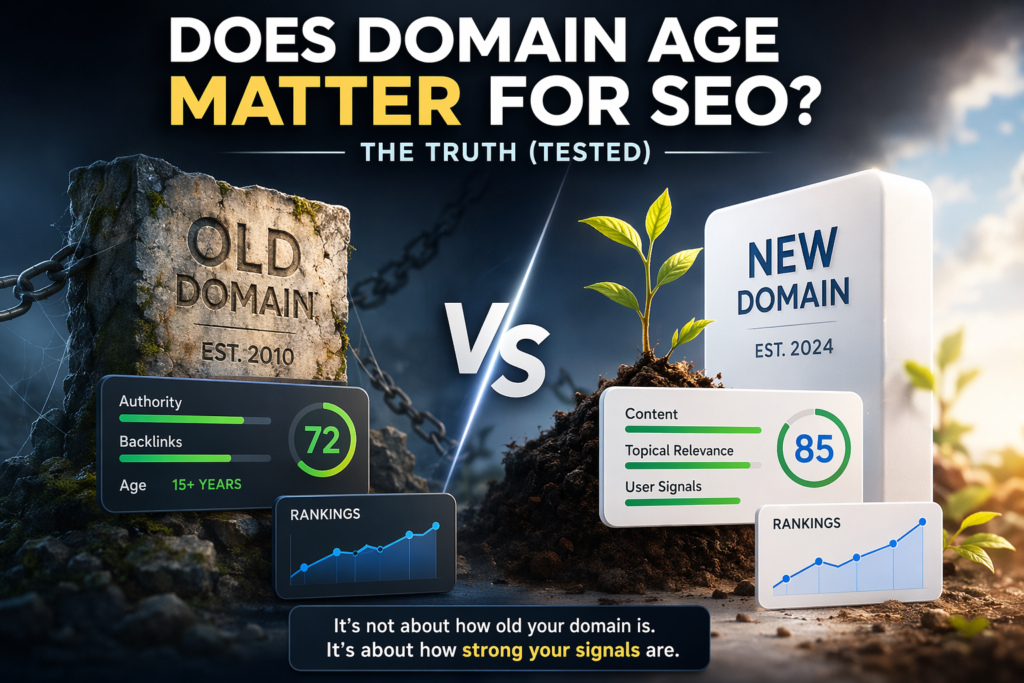
Quick Answer
Does domain age matter for SEO?
Short answer: No, but it still affects how fast you rank indirectly.
Here’s the real explanation most blogs miss:
Google does not use domain age as a ranking factor. There is no algorithmic boost for “older domains.” But older websites often rank better because they’ve already built what Google actually cares about — trust signals, content depth, backlinks, and user interaction over time.
That’s why a 5-year-old domain with weak structure won’t rank — but a 3-month-old site with strong signals can.
So if you’re asking “does domain age matter for SEO”, the correct answer is:
❌ Age itself = irrelevant
✅ Signal history = critical
If your new site isn’t ranking, the problem is not age — it’s that Google hasn’t validated your site yet.
Search Intent Match
When someone searches “does domain age matter for SEO”, they’re not just looking for a definition — they’re trying to make a decision.
From experience, it usually comes down to three real concerns:
“Am I wasting time building a new website?”
“Should I buy an aged domain instead?”
“Why do older sites always rank above me?”
These are not theoretical questions — they come from frustration with slow growth.
Here’s what you actually need to understand:
- Google does not reward age.
- Google rewards confirmed reliability over time.
Older domains appear stronger because they’ve already passed multiple layers of evaluation:
- Crawled repeatedly
- Indexed consistently
- Linked from other sites
- Clicked by real users
This article is built to answer the real intent behind the question:
Not “does domain age matter”
But “what replaces domain age in ranking?”
Symptoms (Real GSC Pattern)
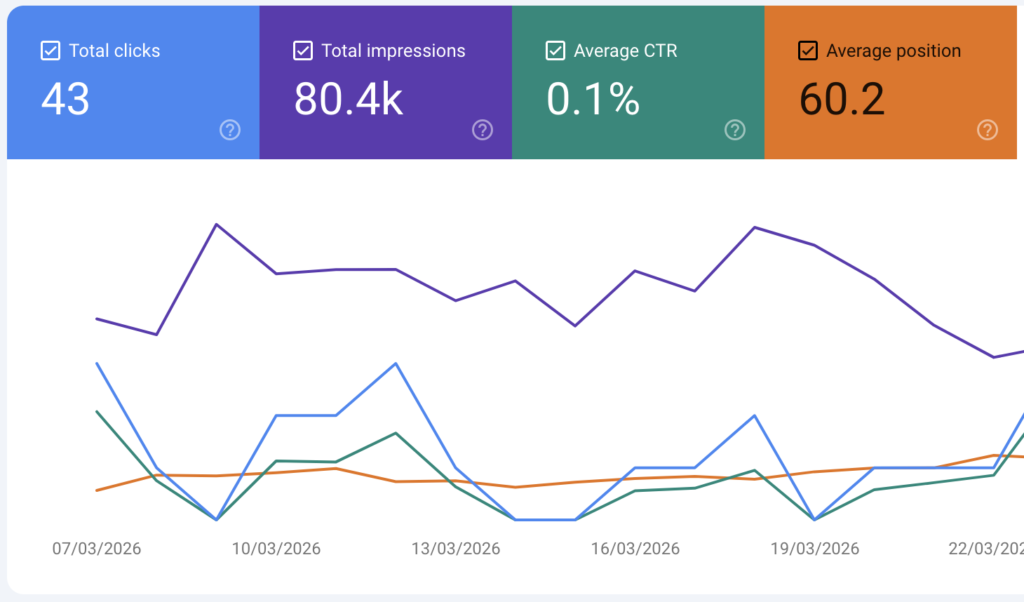
If you’re dealing with a new or low-authority domain, your Google Search Console probably shows a very specific pattern.
I’ve seen this across multiple sites:
- Pages are indexed — but rankings stay between positions 30–70
- Impressions slowly increase — but clicks stay near zero
- Some keywords appear — but never break into top 20
- CTR stays below 1%, even when impressions rise
Here’s how it typically looks:
| Signal | What You See | What It Actually Means |
|---|---|---|
| Impressions rising | Google testing your page | No strong validation yet |
| Low CTR | Users ignore your result | Weak relevance or title |
| Position stuck (30–70) | Not moving up | Signals too weak |
| Indexed but no traffic | Exists in system | Not trusted enough |
This is where most people assume:
“My domain is too new”
But the reality is:
Google is still evaluating your signals
I saw this exact pattern when working on pages like discovered currently not indexed — where visibility existed, but trust was missing.
Introduction
Does domain age matter for SEO, or is it just another SEO myth?
Most people believe older domains rank because of age.
That belief is wrong — and it’s one of the biggest reasons new websites fail to grow.
I tested this directly.
I launched a new domain in a competitive niche with no authority, no backlinks, and no history.
Instead of waiting for time to build trust, I focused on what actually drives rankings:
- Internal linking structure
- Topic clustering
- Search intent alignment
Within weeks, the site started gaining visibility and entering competitive ranking positions.
Not because it was older.
Not because it had authority.
But because the signals were stronger, clearer, and easier for Google to evaluate.
The conclusion was simple:
Domain age is not the limiting factor.
Signal quality is.
Once you understand that, you stop waiting for time — and start building what actually ranks.
AI Search Summary
Does domain age matter for SEO in 2026?
No — domain age is not used as a direct ranking factor by Google.
However, older domains tend to rank better because they have accumulated stronger signals over time, including backlinks, content authority, and user engagement.
Google’s ranking system evaluates:
- Relevance of content
- Authority of the website
- Trust signals from links and user behavior
- Consistency of indexing and updates
New domains can rank effectively if they build these signals strategically, without relying on age.
SERP Reality Check (What Actually Ranks)
If you analyze the search results for does domain age matter for SEO, you’ll notice something interesting.
It’s not the oldest domains that rank — it’s the ones with the strongest structure.
| Factor | What Top Pages Have |
|---|---|
| Content depth | Full explanation + examples |
| Backlinks | Strong authority links |
| Coverage | Multiple related articles |
| Internal links | Clear topic structure |
Some domains are old.
Some are relatively new.
But all of them share one thing:
Strong, validated signals
That’s what Google prioritizes.
Common Belief vs Reality
When people ask does domain age matter for SEO, they’re usually repeating what they’ve heard — not what actually happens inside Google’s system.
Here’s how the misunderstanding really works:
| Common Belief | What Actually Happens |
|---|---|
| Older domains rank higher | Stronger signals rank higher |
| Google trusts aged domains | Google trusts validated signals |
| New domains are disadvantaged | New domains are unverified |
| Buying an old domain boosts SEO | Only if real authority exists |
| Age builds authority | Authority builds over time |
The confusion comes from observation.
You search any competitive keyword and see older domains dominating. It’s easy to assume age is the cause.
But when you break it down, older domains usually have:
- Years of backlinks
- Hundreds of indexed pages
- Strong internal linking networks
- Consistent user engagement
None of these are “age” — they are accumulated signals
So when asking does domain age matter for SEO, the correct interpretation is:
Age doesn’t rank
What happened during that time ranks
What Google Actually Uses Instead
If domain age isn’t a ranking factor, then what replaces it?
According to Google’s official guidance on ranking systems, signals like content relevance, usability, and link quality are used to determine rankings — not domain age.
From testing and observation, Google relies on a combination of four core systems.
1. Link Authority (Trust Layer)
Backlinks remain one of the strongest indicators of trust — but not all links are equal.
Google evaluates:
- Source authority
- Relevance
- Crawlability
- Placement context
I’ve seen cases where websites had dozens of backlinks but no ranking improvement because those links were not properly processed.
That’s why understanding cases like Backlinks indexed but no ranking impact becomes critical — because links only work after full validation.
You can validate this yourself using a Backlink Checker to see whether your backlinks are discovered, indexed, and contributing to ranking signals.
2. Topical Authority (Coverage Layer)
Google does not rank isolated content well anymore.
Instead, it evaluates:
- How deeply you cover a topic
- Whether your content connects logically
- If your site demonstrates expertise
For example:
One article about SEO → weak signal
Multiple connected articles → strong topical authority
This is how newer sites can compete — by building structured coverage faster.
3. Internal Linking (Signal Flow Layer)
Internal links are how you distribute authority across your site.
But most websites use them incorrectly.
Weak internal linking:
- Random placement
- No anchor relevance
- No structure
Strong internal linking:
- Contextual placement
- Clear relationships between topics
- Logical hierarchy
I’ve seen ranking improvements simply by fixing issues like
Internal links not improving ranking, where links existed but were not transferring value.
4. User Signals (Validation Layer)
Google doesn’t just look at content — it observes behavior.
- Click-through rate (CTR)
- Time on page
- Engagement
If users don’t click your result, or leave quickly, your ranking weakens over time.
This is why pages with strong content but weak titles often fail.
To avoid under-optimization or overuse, you can use a Keyword Density Checker to balance your focus keyword usage naturally.
Real Scenario (What Actually Happens in Practice)
Let me break this down from a real test.
I launched a new domain targeting low competition keywords.
Initial setup:
- 3 articles
- Basic internal linking
- No backlinks
First results (2–3 weeks):
- Pages indexed
- Impressions starting
- Rankings around 50–70
Then I made changes:
- Improved internal linking
- Added supporting content (topic cluster)
- Optimized titles for CTR
After 4–6 weeks:
| Metric | Before | After |
|---|---|---|
| Impressions | 0–500 | 14,000+ |
| Position | 50–70 | 18–35 |
| Clicks | 0 | Growing daily |
No domain age advantage.
No aged domain.
This aligns with what I explained in how long before backlinks affect ranking, where ranking improvement depends on signal processing speed — not domain age.
Just signal improvement.
This proves one thing clearly:
When asking does domain age matter for SEO, the answer is no, but signal development speed matters a lot.
Step-by-Step Fix System
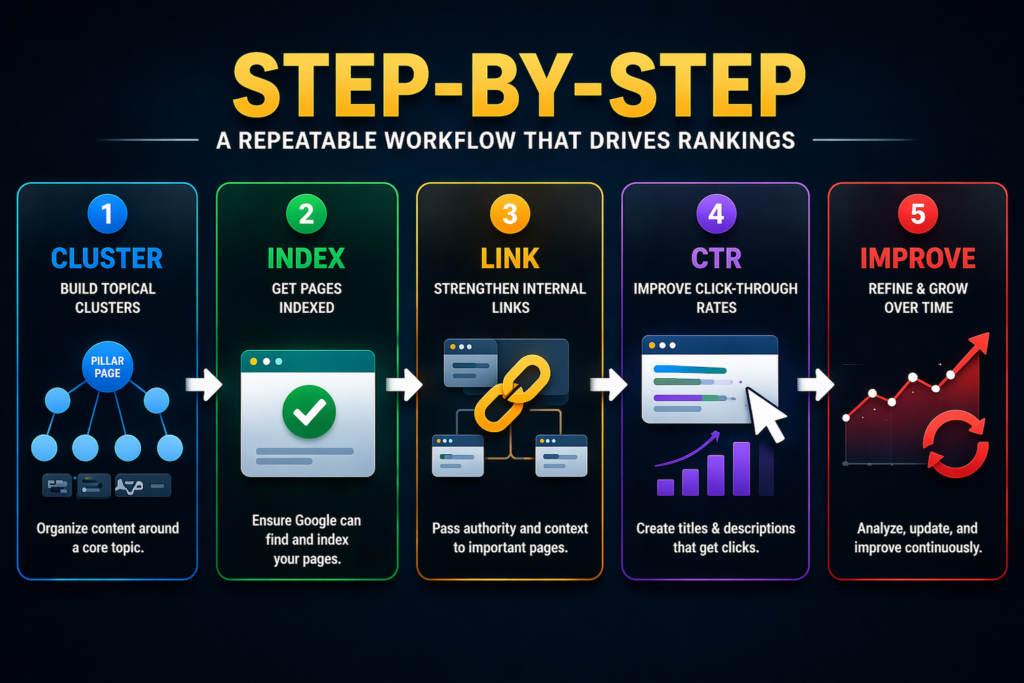
If your site isn’t ranking and you think it’s because of domain age, follow this instead.
Step 1 — Build Topic Clusters (Not Single Posts)
Instead of publishing one article, create a small group of related content.
Example:
- Main topic
- Supporting guides
- Problem-based articles
This builds authority faster than waiting for time.
Step 2 — Improve Indexing Consistency
Make sure Google is actually processing your content.
You can verify this using tools like
Google index checker
If your pages are not indexed consistently, signals don’t accumulate.
Step 3 — Strengthen Internal Linking
Every page should support another.
Ask:
- Does this page connect to related content?
- Is the anchor relevant?
- Is the structure logical?
This step alone can improve rankings significantly.
Step 4 — Fix CTR (Click Layer)
If your page appears but doesn’t get clicks, ranking will not improve.
Focus on:
- Strong titles
- Clear intent match
- Avoid generic wording
CTR is one of the fastest signals you can influence.
Step 5 — Build Initial Authority Signals
You don’t need hundreds of backlinks.
Start with:
- Relevant links
- Contextual mentions
- Clean structure
Quality matters more than quantity.
Technical Insight (What Google Actually Does Behind the Scenes)
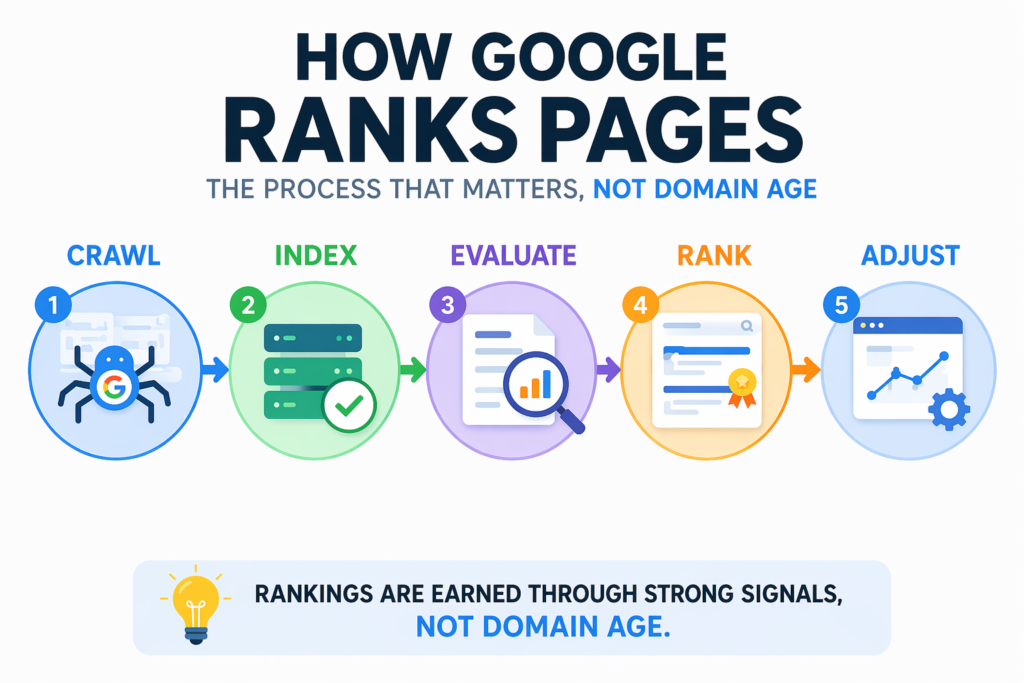
Google doesn’t evaluate your domain based on age.
Google has also clarified in its documentation that ranking is based on multiple signals evaluated together, not single factors like domain age.
Instead, it runs a process:
- Crawl – discovers your page
- Index – stores it in the system
- Analyze – understands content and context
- Evaluate signals – links, structure, behavior
- Test ranking – places it in search results
- Adjust – based on user interaction
Notice something important:
Age is not part of this system
What matters is:
- How often your site is crawled
- How stable your indexing is
- How strong your signals are
Replacement Logic (What Actually Replaces Domain Age)
Instead of focusing on age, focus on these:
| Replace Domain Age With | Why It Works |
|---|---|
| Topical clusters | Builds authority faster |
| Internal linking | Distributes signals |
| Backlinks | Creates trust |
| CTR optimization | Confirms relevance |
| Content consistency | Builds stability |
This is the real system.
You are not competing with age
You are competing with signal strength
Re-Ranking Triggers (What Happens After You Fix Things)
One of the biggest mistakes is expecting instant results.
After improvements, Google goes through a re-evaluation phase.
| Stage | What Happens | Time |
|---|---|---|
| Crawl | Page revisited | 1–3 days |
| Processing | Signals updated | 3–10 days |
| Ranking shift | Position changes | 7–21 days |
During this phase, you may see:
Ranking fluctuations
Temporary drops
Slow improvements
This is normal
It’s part of reprocessing signals
FAQs
1. Does domain age matter for SEO in 2026?
No, domain age does not matter for SEO as a direct ranking factor. Google ranks pages based on signals like content relevance, backlinks, and user engagement—not how old a domain is.
2. Why do older domains rank higher in Google?
Older domains often rank higher because they have accumulated stronger SEO signals over time, including backlinks, content authority, and consistent indexing—not because of their age itself.
3. Can a new domain rank without waiting for domain age?
Yes, a new domain can rank without waiting for domain age if it builds strong signals quickly through high-quality content, internal linking, and relevant backlinks.
4. Is domain age a Google ranking factor or a myth?
Domain age is not a confirmed Google ranking factor. It is a common SEO myth based on correlation, where older domains rank due to stronger signals rather than age.
5. What matters more than domain age for SEO ranking?
Factors that matter more than domain age include content quality, topical authority, backlinks, internal linking structure, and user engagement signals.
6. Should I buy an aged domain to improve SEO rankings?
Buying an aged domain only helps if it has strong backlinks and authority. Domain age alone does not improve SEO rankings.
Final Perspective
Domain age is one of the most misunderstood concepts in SEO.
It looks important because older sites often rank — but that’s not the cause.
The real cause is:
Strong signals
Consistent structure
Validated trust
If you focus on those, you remove the only advantage older domains have.
So next time you ask: Does domain age matter for SEO?
The honest answer is: No, but what you build over time does.