

Domain Authority is one of the most misunderstood metrics in SEO. Some site owners obsess over it, others dismiss it entirely. Both approaches miss the point. In 2026, Domain Authority is not a ranking factor, but it remains a useful comparative signal when it is interpreted correctly.
During SEO audits, I often see businesses make poor decisions based on a single number without understanding what it represents. A Domain Authority Checker is a diagnostic tool, not a scorecard. Used properly, it helps you assess competitiveness, benchmark progress, and set realistic expectations. Misused, it leads to wasted effort and false conclusions.
This article explains what Domain Authority really measures, how to use a Domain Authority checker responsibly, and how to translate authority data into actions that actually support rankings.
Why Domain Authority Still Matters in 2026
Google does not use Domain Authority as a direct ranking factor. That fact has not changed. What has changed is how competitive most search results have become. In many niches, pages rank not only because they are relevant, but because they come from sites that demonstrate consistent trust, authority, and depth. Google Search Central – How Search Works (authority & relevance)
Domain Authority acts as a proxy for those competitive conditions. It helps answer a simple question: how strong is this site compared to others ranking for the same topic?
In 2026, this comparison is more important than ever. New websites can rank, but only when expectations are aligned with reality. A Domain Authority checker provides context. It shows whether you are competing with sites that have years of link acquisition, brand recognition, and topical coverage.
When interpreted correctly, Domain Authority helps prioritize strategy. It does not determine outcomes, but it informs them.
This approach also works best when combined with clear Keyword Cluster Ideas, where related topics are organized into structured groups that reinforce topical authority across your site.
What a Domain Authority Checker Actually Measures
Domain Authority is a third-party metric, most commonly associated with Moz, that predicts how likely a domain is to rank compared to others. It is calculated using link data, including the number of linking domains, link quality, and overall link profile strength.
It is important to separate what Domain Authority is from what it is not. It is not a measure of content quality. It is not a measure of traffic. It is not used by Google internally.
A Domain Authority checker aggregates link-based signals into a single comparative score. Its value lies in relative comparison, not absolute interpretation. A score of 40 is meaningless without context. A score of 40 compared to competitors averaging 20 or 70 tells a very different story.
Understanding this distinction prevents most misuse.
To understand where that link-based authority is coming from in practice, it is often useful to analyze your profile with a Backlink Checker, which reveals the quantity, quality, and relevance of the sites linking to you.
Common Authority Mistakes I See in SEO Audits
One of the most common mistakes is chasing Domain Authority as a goal in itself. Sites invest in low-quality links or irrelevant placements simply to inflate the score. This rarely leads to sustainable rankings and often creates long-term problems.
Another frequent issue is comparing Domain Authority across unrelated niches. A local service site does not need the same authority as a national publisher. Context matters.
I also see many site owners ignore page-level factors entirely. Strong domains still require relevant, well-structured pages. Domain Authority does not compensate for weak content.
Finally, some teams treat small fluctuations in Domain Authority as performance indicators. Because the metric is recalculated periodically, minor changes are often noise rather than signals.
How to Use a Domain Authority Checker Properly
The correct way to use a Domain Authority checker is as part of competitive analysis. Start by identifying the pages ranking for your target queries. Then compare the Domain Authority of those sites, not random competitors.
Look for patterns rather than thresholds. If top results consistently come from domains with significantly higher authority, that tells you something about the effort required to compete.
Use Domain Authority to guide expectations, not limit ambition. A lower-authority site can still rank by targeting less competitive queries, building topical authority, and earning relevant links over time.
This becomes far more effective when your site is organized around clear topical silos rather than scattered pages, which is why a structured approach to keyword clustering is essential before you scale link building or authority efforts.
Most importantly, combine Domain Authority with other signals. Content quality, internal linking, and user engagement often determine whether authority translates into rankings.
Pairing this analysis with AI Keyword Suggestion tools can further refine your strategy by surfacing intent-aligned queries you might otherwise miss, helping you target topics where your current authority level is most likely to convert into real rankings.
Real Examples: Low Authority vs High Authority Sites
In practice, I often see low-authority sites outrank stronger domains for specific queries. This usually happens when the lower-authority site matches intent more precisely and provides clearer answers.
Conversely, high-authority sites sometimes rank with thin or outdated content simply because their overall trust signals compensate. This does not mean authority alone is enough. Over time, relevance still wins.
These examples highlight the real value of Domain Authority. It explains why some pages rank more easily than others, but it does not dictate outcomes in isolation.
Best Practices to Improve Domain Authority the Right Way
Improving Domain Authority indirectly means improving the signals that contribute to it. The most sustainable approach is earning links through content that deserves them.
Before pursuing new links, a systematic backlink analysis helps you identify which existing links are strengthening your domain, which are neutral, and which may be dragging your authority down.
Focus on publishing content that fills real gaps, not recycled summaries. Resources, tools, and original insights attract higher-quality links than generic articles. Google Search Central – Link spam policies.
Internal linking also matters. Strong internal structure helps distribute authority across a site, allowing key pages to benefit from overall domain strength.
Avoid shortcuts. Paid links, link exchanges, and low-quality directories may temporarily inflate metrics but often undermine trust in the long run.
Domain Authority vs Other SEO Metrics in 2026
Domain Authority is not the only metric available. Other tools offer similar scores, such as Domain Rating or Trust Flow. Each uses different data and weighting.
In 2026, experienced SEO professionals rarely rely on a single metric. Instead, they look for alignment. When multiple indicators suggest similar levels of competitiveness, confidence increases.
Ultimately, rankings and traffic remain the real outcomes that matter. Authority metrics help interpret those outcomes, not replace them.
At the same time, evaluating results at the page level with a Page Authority Checker helps you understand whether individual URLs — not just the overall domain — have enough link strength to compete for your target keywords.
Is Using Domain Authority Tools Safe for SEO and AdSense?
Yes. Using a Domain Authority checker is purely analytical. It does not affect your site directly and poses no risk when used responsibly.
From an AdSense perspective, authority metrics are irrelevant to approval. What matters is content quality, originality, and compliance with policies. In fact, understanding authority often leads to better content decisions, which indirectly supports AdSense approval.
Problems only arise when authority metrics are misused to justify manipulative link practices.
How to Use This Domain Authority Checker
This tool works best when you treat it as a comparison instrument, not a scoreboard. Use it in three practical steps:
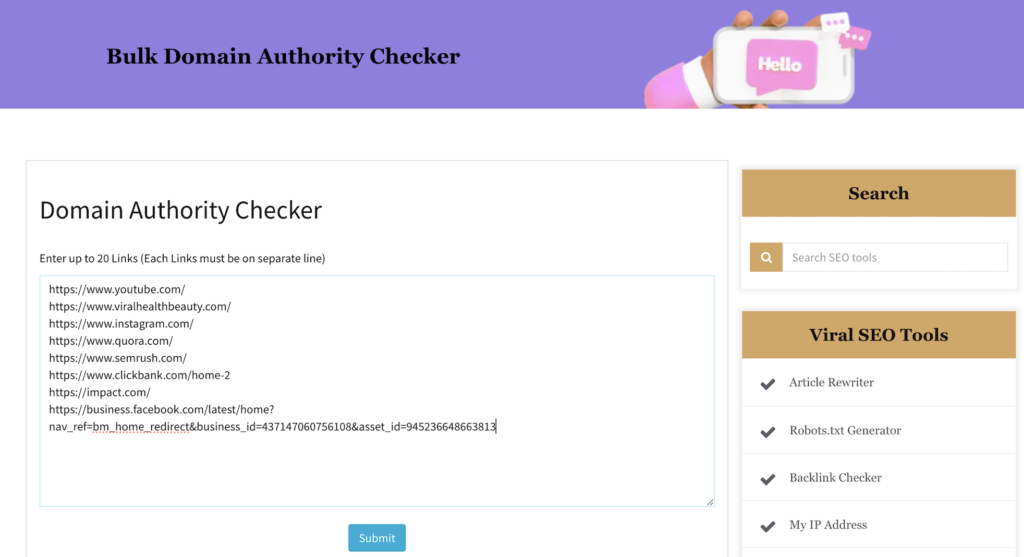
Step 1 — Enter your domains correctly
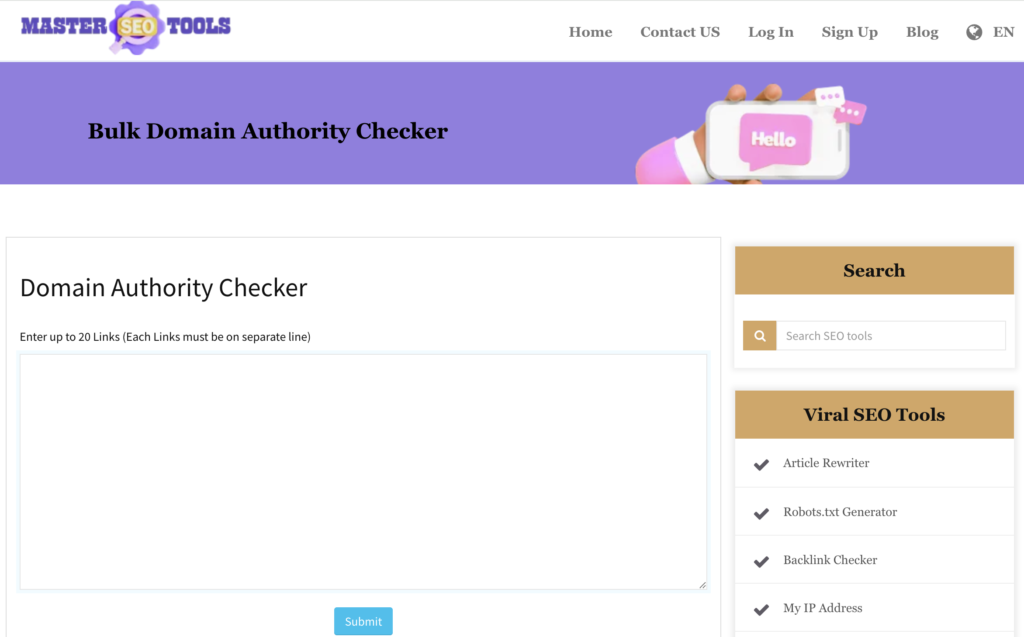
Paste one domain per line. You can check your own site, competitors, or potential link partners in the same run.
Step 2 — Run the analysis
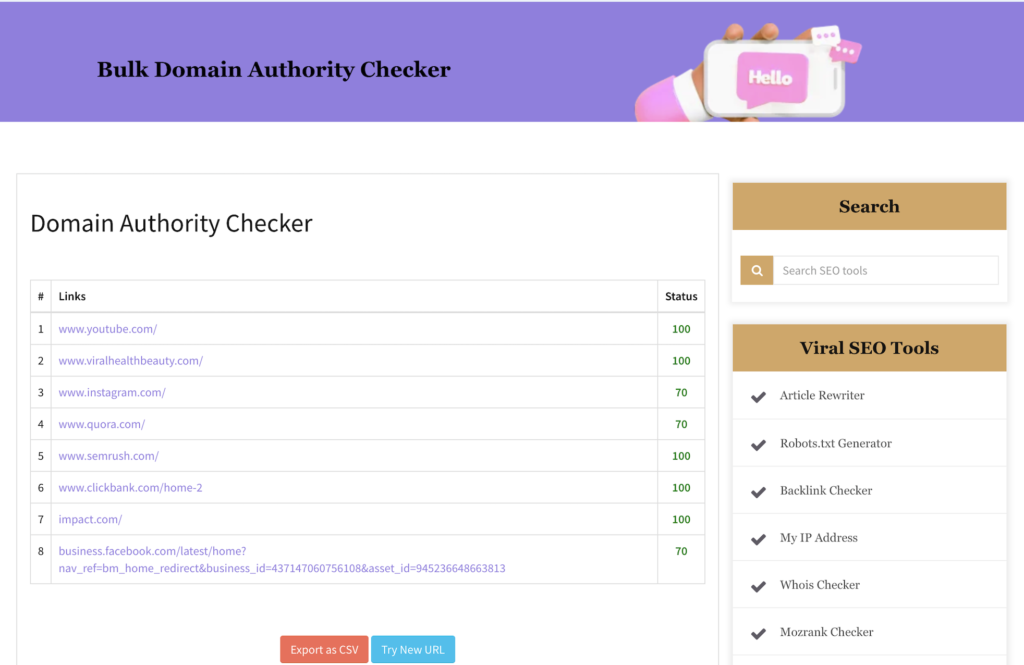
Click Check Authority and wait for the results table to load. The tool evaluates each domain using current link-based authority signals.
Step 3 — Interpret results with context
Compare your score against sites that rank for your target keywords. If their authority is significantly higher, prioritize content depth, internal linking, and earned backlinks before expecting quick ranking gains.
Used this way, the Domain Authority Checker helps you set realistic expectations, plan link strategy, and measure progress over time — without chasing vanity metrics.
FAQ
Q1: Is Domain Authority a Google ranking factor?
No. It is a third-party comparative metric, not a Google signal.
Q2: Does this tool show real-time Domain Authority?
Yes. It pulls the latest available authority signals at the time of your check.
Q3: Can beginners use this checker?
Yes. Paste a domain and click “Check.”
Conclusion
Domain Authority is neither a magic number nor a meaningless metric. In 2026, its value lies in context and interpretation. A Domain Authority checker helps you understand the competitive landscape, not predict rankings with certainty.
When used as part of a broader SEO strategy that prioritizes relevance, quality, and user experience, authority metrics become a useful guide rather than a distraction.
Taken together with keyword clustering and CTR optimization, Domain Authority analysis completes a balanced foundation for sustainable organic growth.