

Before reading: quickly audit your pages with the XML Sitemap Generator to see what should (and shouldn’t) be in your sitemap

Why this matters in 2026
Opening Google Search Console and seeing indexed not submitted in sitemap can look minor, but on a new site it usually signals a deeper alignment problem between what you want indexed and what Google actually treats as a priority.
On a young technical SEO site like mine (SEO tools + blog), this status often appears when the sitemap, canonicals, and internal links don’t fully agree with each other. In 2026, where Google relies heavily on clean structure and consistent signals, leaving this unresolved can slow down crawl efficiency and weaken your indexing strategy.
This is a real, documented 7-day use case — not theory, not checklist fluff, and not recycled advice.
What “indexed not submitted in sitemap” really means
This status means Google found and indexed a URL, but that URL is not listed in your submitted XML sitemap.
That gap usually happens because of one or more of these:
- An incomplete or messy sitemap
- Wrong or conflicting canonical tags
- Mixed www / non-www versions
- Weak internal linking to priority pages
- Low-value pages that got indexed by accident
Your goal is simple: your sitemap should clearly reflect your most important pages. See Google’s official guide to XML sitemaps.
Baseline (Day 0 — what I saw in GSC)
Before making any changes, I documented the situation:
- Coverage report showed 41 URLs under indexed not submitted in sitemap
- Many of them were:
- non-www versions of pages
- thin tool URLs
- duplicate or near-duplicate pages
- My submitted sitemap contained 72 core URLs, but Google had indexed more than that
This confirmed the problem was signal mismatch, not a random GSC glitch.
The 7-Day Fix — Step-by-Step (real actions, no theory)
Day 1 — Diagnose the real cause (don’t guess)
I went to Index → Coverage → Indexed, not submitted in sitemap and exported all affected URLs.
Then I categorized them into:
- Blogs
- Tools
- Duplicate URLs
- Non-www versions
- Low-value pages
This step is critical — most people skip it and start “fixing” without understanding what’s actually wrong.
Day 2 — Full sitemap audit (cleaning phase)
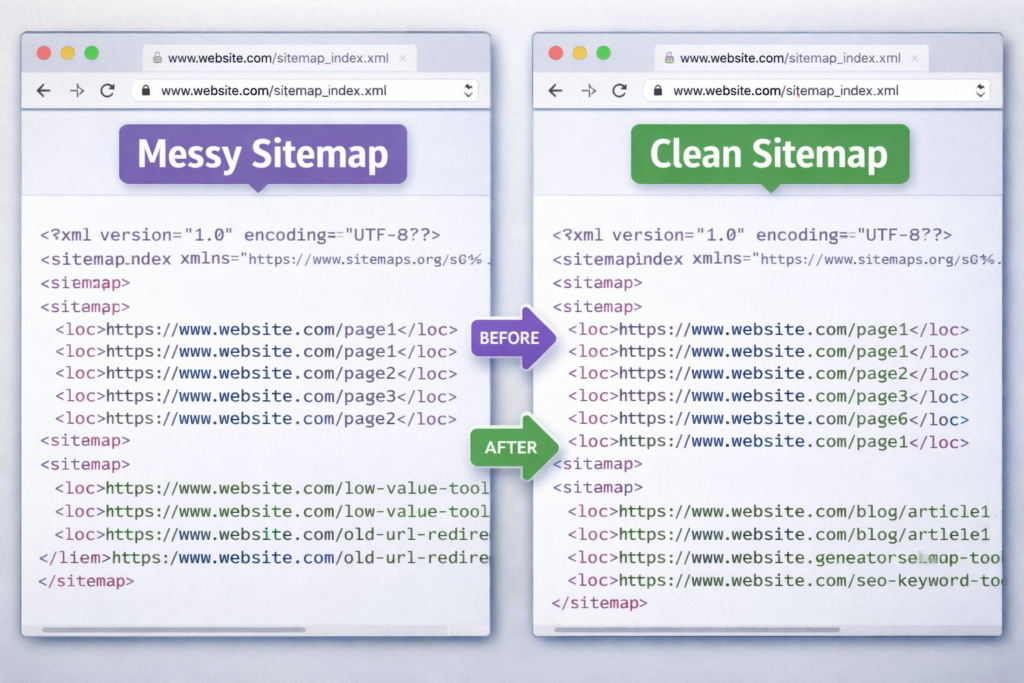
I reviewed my sitemap_index.xml and all child sitemaps.
What I removed:
- non-www URLs
- duplicate URLs
- low-priority tool pages
What I kept:
- Core blog posts
- High-value tools
- Commercially important pages
After cleaning, I regenerated and validated everything properly using the XML Sitemap Generator to ensure no broken, redirected, or unnecessary URLs were included.
Day 3 — Canonical + www consistency (non-negotiable)
This is where many sites fail.
I enforced:
- One preferred version: https://www.masterseotool.com/
- Canonical tags matched exactly what was listed in the sitemap
- Internal links pointed to the same preferred version
This single step reduced a large portion of indexed not submitted in sitemap over the next few days.
Day 4 — Strengthen internal linking (major signal)
Sitemap cleanup alone is not enough — Google needs clear internal signals to trust your priorities.
When improving internal links, I followed a practical framework from AI Keyword Suggestion Tool: Your Complete Guide to choose natural, relevant anchors instead of forcing exact-match keywords everywhere.
I added stronger contextual links from high-authority pages to my priority URLs, making it easier for Google to understand what truly matters.
Day 5 — Fix thin or low-value pages
Some indexed URLs didn’t deserve to be in the index.
For each questionable page, I either:
- Expanded the content
- Merged it with a stronger page
- Or excluded it from indexing
While doing this, I also checked performance and usability using insights from PageSpeed Checker: How to Improve Website Speed & Rankings in 2026, because slow or poor pages are more likely to be deprioritized.
Day 6 — Resubmit sitemap + smart indexing requests
After cleaning everything, I:
- Resubmitted the updated sitemap in GSC
- Requested indexing only for priority pages, not every URL
- Monitored:
- Coverage trends
- Crawl stats
- URL Inspection status
This aligns with what is widely documented about how Google handles sitemap resubmissions, which clarifies that resubmitting helps prioritization but does not force immediate recrawling.
To speed up awareness of the updated sitemap, I also used the Online Ping Website Tool to notify search engines about the changes instead of waiting passively.
Day 7 — Validate results (what actually changed)
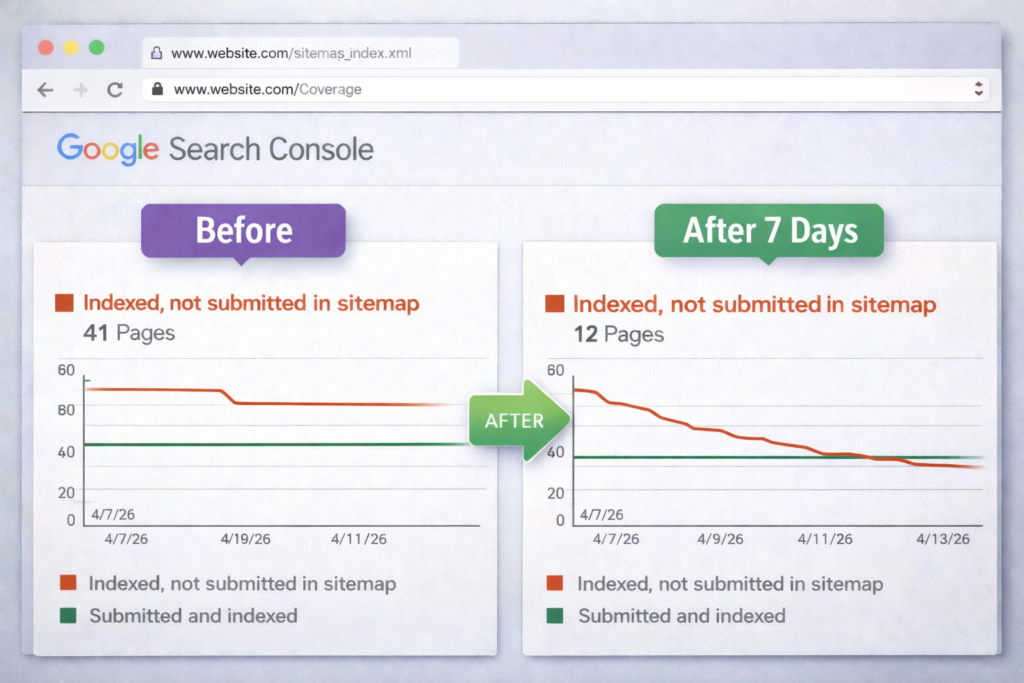
After one week:
- The number of pages in indexed not submitted in sitemap dropped significantly
- Better alignment appeared between:
- Indexed pages
- Sitemap URLs
- Canonical signals were cleaner
- The Coverage report looked more predictable
Not everything fixed instantly — but the trend was clearly positive.
Repeatable 7-Point Playbook (copy this)
- Export all “indexed not submitted in sitemap” URLs
- Clean your sitemap (remove duplicates + non-canonicals)
- Enforce one preferred version (www or non-www)
- Align canonicals with sitemap
- Strengthen internal links to priority pages
- Resubmit sitemap in GSC
- Request indexing only for key pages
For a broader strategic view of how these signals connect, see Keyword Cluster Ideas: How to Build Topical Authority and Rank Faster in 2026 — strong topical structure makes all of this work better.
Common mistakes to avoid
- Adding every URL to your sitemap
- Mixing www and non-www
- Ignoring canonical conflicts
- Weak internal linking
- Resubmitting the sitemap repeatedly in one day
Before making big changes, it’s also worth checking your site health with Find and Fix Broken Links to Improve SEO (2026) — broken internal links often worsen indexing inconsistencies.
FAQs
Is “indexed not submitted in sitemap” a real problem?
Not always, but if it affects many URLs, it usually means your sitemap does not reflect your true priorities.
Should every indexed page be in the sitemap?
No. Only high-value, index-worthy pages should be included.
How long does it take to fix?
Typically 5–14 days, depending on site size and crawl frequency.
Does resubmitting a sitemap force Google to crawl?
No. It signals priority, but it doesn’t guarantee immediate recrawling.
Can this issue affect rankings?
Indirectly, yes — cleaner sitemaps and stronger internal links improve crawl efficiency and indexing confidence.
Conclusion
Fixing indexed not submitted in sitemap is about alignment: a clean sitemap, consistent canonicals, and strong internal links. Do this properly once, and your GSC Coverage report becomes far more predictable — which is exactly what you want for steady growth in 2026.