


Choosing the best AI keyword suggestion tool in 2026 can make the difference between ranking in weeks or struggling for months. With search engines becoming more AI-driven and intent-focused, traditional keyword research methods are no longer enough.
Today’s best AI keyword suggestion tools analyze search intent, semantic relationships, trends, and competition levels to uncover profitable opportunities faster. Whether you’re a blogger, affiliate marketer, small business owner, or SEO professional, using the right tool helps you find low-competition keywords that actually convert.
In this guide, we compare the top AI keyword suggestion tools available in 2026 — including free and paid options — and break down which one is best depending on your goals.
Top AI Keyword Suggestion Tools in 2026 (Compared)
| Tool | Best For | Free Version | AI Features | Pricing |
|---|---|---|---|---|
| Master SEO Tool | Bloggers & Beginners | Yes | AI keyword suggestions, clustering | Free |
| Semrush | Agencies & Advanced SEO | Limited Trial | AI keyword gap, intent analysis | Paid |
| Ahrefs | Competitive Research | No | AI keyword difficulty, SERP analysis | Paid |
| Mangools (KWFinder) | Small Businesses | Limited | Keyword difficulty scoring | Paid |
| Keyword Tool.io | Quick Keyword Ideas | Limited | Autocomplete-based suggestions | Freemium |
Each AI keyword suggestion tool offers different strengths. Some focus on deep competitive analysis, while others prioritize speed and simplicity. If you’re looking for a free AI keyword suggestion tool designed for bloggers and content creators, Master SEO Tool provides AI-driven keyword ideas without requiring a subscription.
Best AI Keyword Suggestion Tools (Detailed Breakdown)
1. Master SEO Tool – Best Free AI Keyword Suggestion Tool for Bloggers
Master SEO Tool is designed for bloggers, niche site owners, and beginners who need fast keyword ideas without paying for expensive SEO subscriptions. It focuses on uncovering low-competition keywords, identifying search intent, and helping structure content effectively.
Key strengths:
- 100% free access
- AI-powered keyword suggestions
- Beginner-friendly interface
- Ideal for blog growth and content planning
If you want a practical AI keyword suggestion tool without recurring costs, this is a strong starting point.
2. Semrush – Best for Advanced Competitive Research
Semrush provides deep keyword data, competitor analysis, and AI-powered keyword gap tools. It is ideal for agencies and experienced SEO professionals but requires a paid subscription.
3. Ahrefs – Best for SERP and Difficulty Analysis
Ahrefs is known for accurate keyword difficulty scoring and detailed SERP analysis. It’s powerful for competitive research but does not offer a fully free version.
4. Mangools (KWFinder) – Best for Simplicity
Mangools offers an easy-to-use keyword finder with clear difficulty metrics. Suitable for small businesses, though advanced features require payment.
5. Keyword Tool.io – Best for Autocomplete-Based Ideas
Keyword Tool.io generates keyword suggestions using autocomplete data from search engines. The free version is limited, with full data available on paid plans.
How to Choose the Best AI Keyword Suggestion Tool
Not all AI keyword suggestion tools are built the same. Choosing the right one depends on your goals, experience level, and budget. Before deciding, consider these key factors:
1. Search Intent Detection
The best tools go beyond basic keyword ideas and analyze user intent — informational, commercial, or transactional. This helps you target keywords that actually convert.
2. Keyword Difficulty Accuracy
Look for tools that provide realistic difficulty scores. Overly simplified metrics can mislead your content strategy.
3. AI-Powered Clustering
Modern AI keyword tools group related terms together, making it easier to build topic clusters and strengthen topical authority. You can explore a full keyword clustering strategy guide to see how clusters improve rankings.
4. Data Sources and Reliability
Some tools rely heavily on autocomplete data, while others combine multiple sources including SERP analysis and competitive research.
5. Pricing vs. Features
If you’re a beginner or blogger, a free AI keyword suggestion tool may be enough. Agencies and advanced SEO teams may need more detailed competitor data and analytics.
How AI Keyword Suggestion Tools Work
Before choosing the best AI keyword suggestion tool, it’s important to understand how these tools actually work behind the scenes. The most effective tools don’t just generate random keyword ideas — they analyze search intent, semantic relationships, trends, and competition to uncover realistic ranking opportunities.
This aligns with Google’s documentation on how search systems evaluate content and intent.
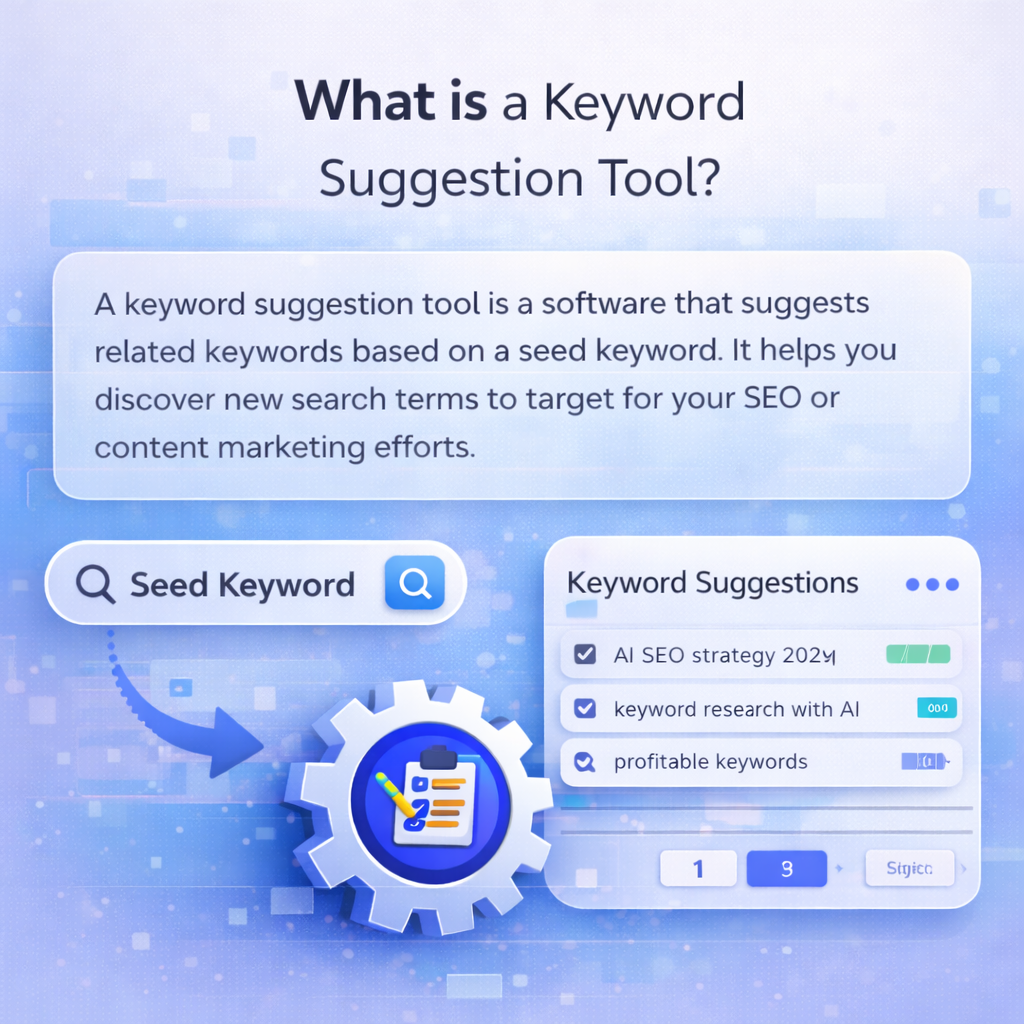
Think of an AI keyword suggestion tool as your research assistant for SEO. You feed it a basic keyword or topic (we call this a “seed keyword”), and it generates a list of related terms that real people are actually typing into search engines and AI platforms.
Here’s what makes 2026 different: today’s AI Keyword Suggestion Tools don’t just spit out word combinations. They dig deeper, analyzing what users really mean when they search, how language patterns connect, and which trends are gaining momentum.
Why this matters for your SEO and content planning:
- You discover what your audience is genuinely looking for
- You uncover opportunities where competition is low but intent is high
- You can map out entire content structures—blog posts, landing pages, topic clusters—with confidence
Quick clarification on terminology:
Keyword ideas are your starting point—raw suggestions straight from the tool. Keyword research is what happens next: you filter those ideas based on search volume, competition levels, and user intent to identify which ones are actually worth targeting.
Here’s a real example:
Let’s say your seed keyword is “AI SEO tools”
The tool might suggest:
- AI keyword suggestion tool
- AI SEO strategy 2026
- keyword research with AI
Step-by-Step: How AI Keyword Tools Generate Keyword Ideas

Modern keyword suggestion tools follow a straightforward process, but there’s sophisticated technology working behind the scenes.
Step one: You enter a seed keyword
Start with something basic like “keyword research” or “AI SEO tools”—whatever’s relevant to your niche.
Step two: The tool gathers data
It’s pulling information from multiple sources:
- What people type into search bars (autocomplete data)
- Related searches that appear at the bottom of search results
- Patterns in how users actually behave online
- Current trends and seasonal shifts
- Semantic connections that AI identifies between concepts
Step three: Smart filtering kicks in
This is where things get interesting in 2026. The best AI-powered tools let you filter results by:
- How many people search for it (search volume)
- How hard it’ll be to rank (keyword difficulty)
- Why people are searching (informational, commercial, or transactional intent)
- When searches spike or decline (trends and seasonality)
Let’s walk through a real example:
You enter the seed keyword “keyword tool”
The results might include:
- AI keyword suggestion tool 2026
- best keyword tool for bloggers
- keyword research for AI search
This whole process ensures you’re targeting keywords that match how real people think and search—not just guessing what might work.
Why Keyword Suggestion Tools Matter for SEO
Here’s the truth: your SEO success depends entirely on picking the right keywords upfront. Without a keyword suggestion tool, you’re essentially throwing darts blindfolded and hoping something sticks.
What these tools deliver in 2026:
Faster rankings through long-tail keywords
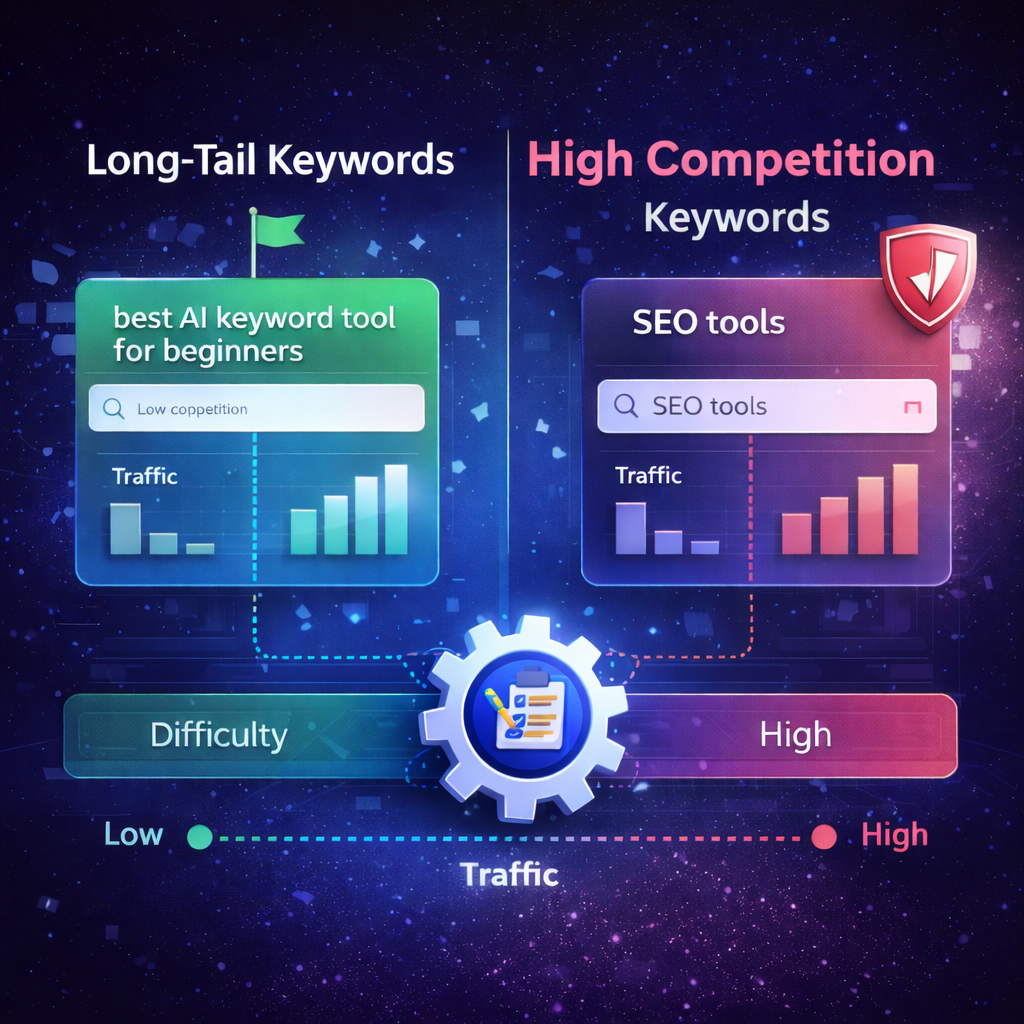
Long-tail keywords are more specific phrases that signal clearer intent. They’re also way less competitive, which means you can actually rank for them without waiting months or competing against massive sites.
Long-tail keywords are easier to rank for and convert better, which is supported by industry keyword research studies showing that intent-driven searches outperform generic terms.
Avoiding the high-competition trap
Sure, a keyword might have impressive search volume. But if it’s dominated by established authority sites with years of backlinks and resources, you’re wasting your time. Smart tools help you sidestep these dead ends and find realistic opportunities instead.
Smarter content planning
When you see all the keyword suggestions laid out, you start recognizing patterns. Some keywords deserve their own dedicated blog posts. Others work perfectly as subheadings within larger articles. This clarity makes content planning so much easier.
Real-world example:
Generic keyword: “SEO tools”
Long-tail alternative: “AI keyword suggestion tool for beginners”
The second option is dramatically easier to rank for, and it brings in visitors who are more likely to actually use what you’re offering.
To measure whether your selected keywords are improving visibility, track performance regularly with a keyword position checker tool.
Types of Keywords You Should Target
A solid keyword strategy isn’t built around just one type of keyword. You need variety.
Short-tail keywords
- Usually just 1-2 words
- High search volume but fierce competition
- Example: “SEO tools”
Long-tail keywords
- Three words or more
- Lower search volume but much clearer intent
- Example: “AI keyword suggestion tool 2026”
Informational keywords
- People searching to learn something
- Example: “how keyword research works”
Commercial keywords
- Searchers who are considering a purchase
- Example: “best AI keyword tool”
Transactional keywords
- Ready-to-buy searches
- Example: “buy keyword research software”
An AI keyword suggestion tool automatically identifies and categorizes these different types, saving you hours of manual sorting.
When organizing related terms into topic groups, using an AI keyword cluster ideas tool helps streamline the process and maintain topical consistency.
How to Use a Keyword Suggestion Tool (Step-by-Step)
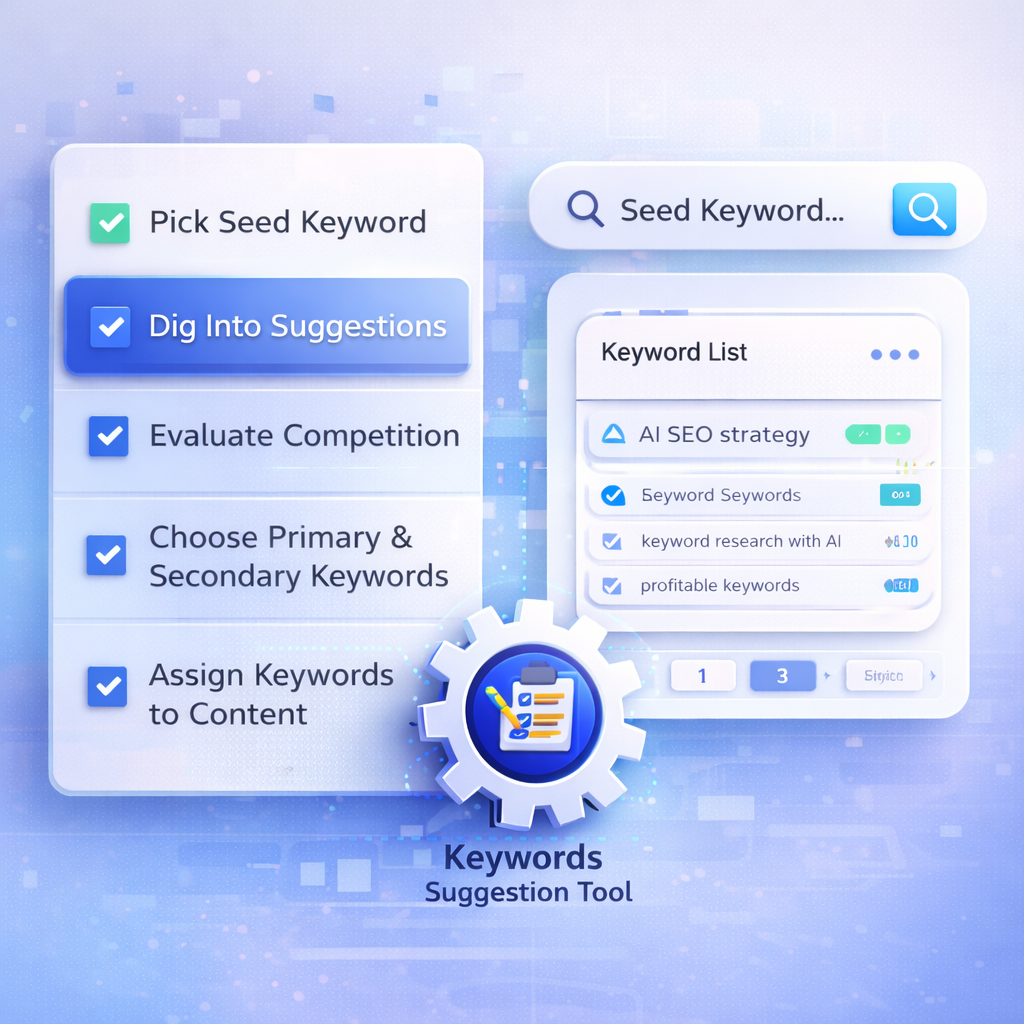
Ready to put this into practice? Here’s a workflow you can implement today.
Step 1: Pick your seed keyword
Choose a broad topic that fits your niche. Something like “keyword research” works great if you’re in the SEO space.
Step 2: Dig into the suggestions
Look for keywords that show:
- Clear intent (you can tell what the searcher wants)
- Natural phrasing (how people actually talk)
- Current relevance for 2026
Step 3: Evaluate the competition
Skip keywords that are completely dominated by major brands—unless your site already has serious authority.
Step 4: Choose your primary and secondary keywords
You want:
- One main keyword as your primary focus
- Three to five supporting keywords that complement it
Step 5: Assign keywords to specific content
Map out where each keyword will live:
- Individual blog posts
- Landing pages
- FAQ sections
Here’s how this looks in action:
Primary keyword: “AI keyword suggestion tool”
Secondary keywords: “keyword research 2026,” “AI SEO strategy,” “profitable keywords”
Common Keyword Research Mistakes (With Examples)
Even with all the tools available in 2026, people still make the same costly mistakes.
Mistake #1: Chasing only high-volume keywords
Bad choice: “SEO”
Better choice: “AI SEO keyword research”
The first one sounds impressive but is nearly impossible to rank for. The second is achievable and brings in people who actually care about what you’re offering.
Mistake #2: Ignoring what people actually want
A keyword might look perfect on paper, but if it attracts the wrong audience, you’ve wasted your effort.
Mistake #3: Keyword stuffing
Cramming your keyword into every sentence makes your content unreadable and tanks your rankings. Use a proper keyword density checker guide to maintain natural optimization.
Mistake #4: Not checking who you’re up against
If every result for your target keyword comes from massive authority sites, you need to find a different angle.
Bad choice: “best tools”
Good choice: “best AI keyword suggestion tool for bloggers”
Keyword Suggestion Tool vs Other Keyword Tools
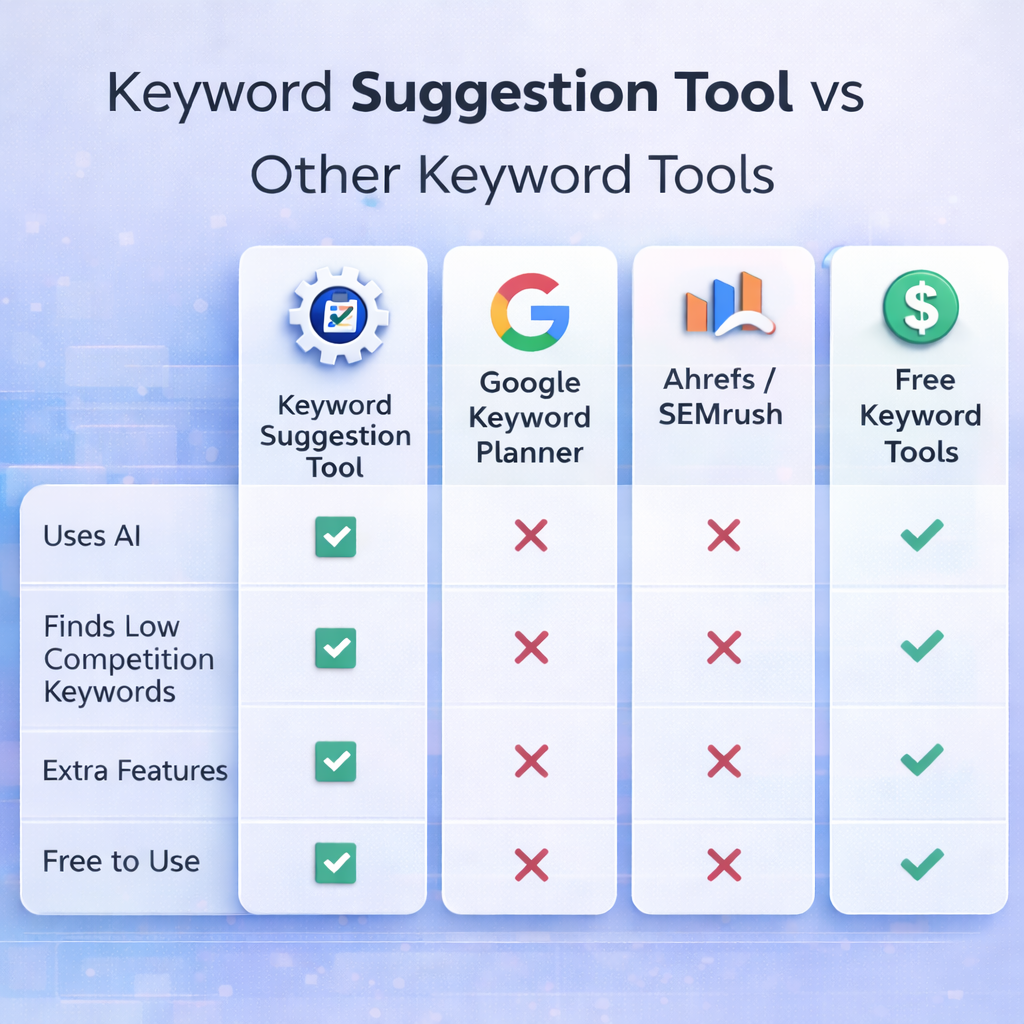
Not all keyword tools do the same job. Understanding the differences helps you pick the right one.
| Tool Type | Best For | Limitations |
| Keyword Suggestion Tool | Generating content ideas, discovering intent | Results need validation |
| Google Keyword Planner | PPC campaigns and ads | Limited help for organic SEO |
| Ahrefs / SEMrush | In-depth competitive analysis | Expensive subscriptions |
| Free keyword tools | Beginners just starting out | Less accurate, limited features |
In 2026, AI-powered keyword suggestion tools hit a sweet spot—combining ease of use with intelligent insights.
Best Practices for Keyword Research in 2026
SEO has evolved, and your approach needs to keep up.
Put search intent first
Search volume matters, but intent matters more. Understanding why someone searches tells you exactly what content to create.
Work with keyword clusters
Group related keywords together and build comprehensive content around entire topics instead of creating thin articles for every minor variation.
Use multiple tools together
Don’t rely on just one source. Cross-reference keyword suggestions with analytics, competitor tracking, and structured monitoring systems. For a deeper comparison of AI-based monitoring systems, review how AI SEO tracking tools vs traditional SEO tools differ in performance analysis.
Optimize for AI search and featured snippets
Structure your content clearly with descriptive headings and provide direct, concise answers to common questions.
Build internal linking into your strategy
Connect related pieces of content to establish topical authority across your entire site.
Using an AI Keyword Suggestion Tool ensures your content matches how modern search engines actually process and evaluate information.
Who Should Use a Keyword Suggestion Tool?
Keyword suggestion tools help:
- Bloggers working to build consistent organic traffic
- SEO beginners learning the fundamentals of keyword research
- Small businesses trying to reach niche customers
- Affiliate marketers hunting for keywords that signal buying intent
- Agencies juggling research for multiple clients
If search traffic matters to your goals, then keyword research isn’t optional—it’s essential.
FAQs
1. What is the best AI keyword suggestion tool in 2026?
The best AI keyword suggestion tool depends on your needs. For beginners and bloggers, free tools like Master SEO Tool provide AI-driven keyword ideas without subscription costs. Advanced users may prefer paid platforms such as Semrush or Ahrefs for deeper competitive analysis.
2. Are free AI keyword suggestion tools accurate?
Free AI keyword suggestion tools can be accurate for discovering keyword ideas and search intent. However, paid tools typically offer more advanced data such as competitor analysis, detailed difficulty scores, and historical trends.
3. How do AI keyword suggestion tools find keywords?
AI keyword suggestion tools analyze search engine autocomplete data, semantic relationships, user intent patterns, and competition metrics to generate relevant keyword ideas based on a seed keyword.
4. What keyword difficulty score should beginners target?
New websites should focus on low to medium keyword difficulty scores, especially long-tail keywords with clear intent. This increases the chances of ranking without strong domain authority.
5. How often should keyword research be updated?
Keyword research should be reviewed quarterly or whenever major industry trends shift. Regular updates help capture new search intent and emerging keyword opportunities.
conclusion
Keywords still form the backbone of effective SEO—even as AI transforms how search works. A quality AI Keyword Suggestion Tool shows you what users actually want, how they phrase their searches, and where untapped opportunities exist. When you use it correctly, you save time, climb rankings faster, and build traffic that sticks around.
Try our Keyword Suggestion Tool today and check out our other resources like Position Checker and Keyword Density Checker to round out your SEO toolkit.