

Intro:
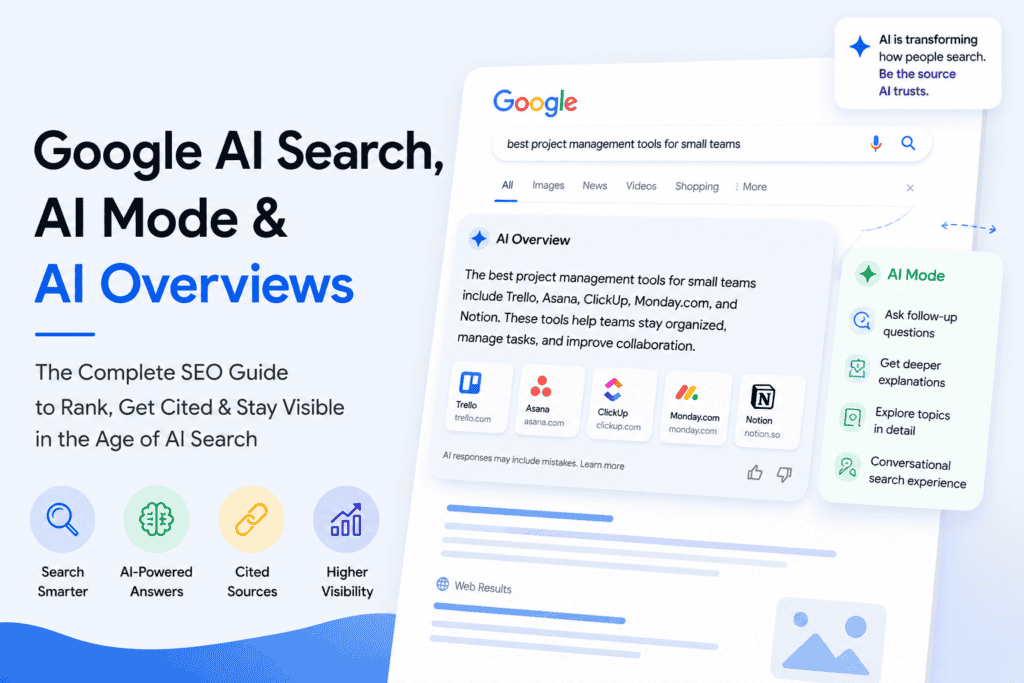
Google AI Search Optimization is becoming essential as Google expands AI Overviews and AI Mode across Search.
Google Search is changing faster than at any time in the last decade. Instead of returning only a list of blue links, Google now uses generative AI to answer complex questions, summarize information from multiple sources, and guide users through follow-up conversations. This evolution has introduced AI Overviews and AI Mode, two experiences that are changing how people discover websites and consume information.
For website owners, marketers, and SEO professionals, the biggest question is no longer “How do I rank #1?” but “How do I become one of the sources Google’s AI chooses to cite?”
The good news is that Google’s official guidance has not abandoned traditional SEO. High-quality, original, and trustworthy content remains the foundation of visibility. AI-powered search builds on those same ranking systems while rewarding pages that answer questions clearly, demonstrate expertise, and provide genuine value.
In this guide, you’ll learn:
- What Google AI Search is.
- The difference between AI Mode and AI Overviews.
- How Google chooses sources.
- Practical optimization strategies that align with Google’s recommendations.
- Common mistakes to avoid.
- A checklist you can use to improve your site’s visibility.
If you’re new to SEO, start with our AI Keyword Clustering SEO 2026 guide before reading this article. Understanding user intent is the foundation of every successful SEO strategy.
What Is Google AI Search?
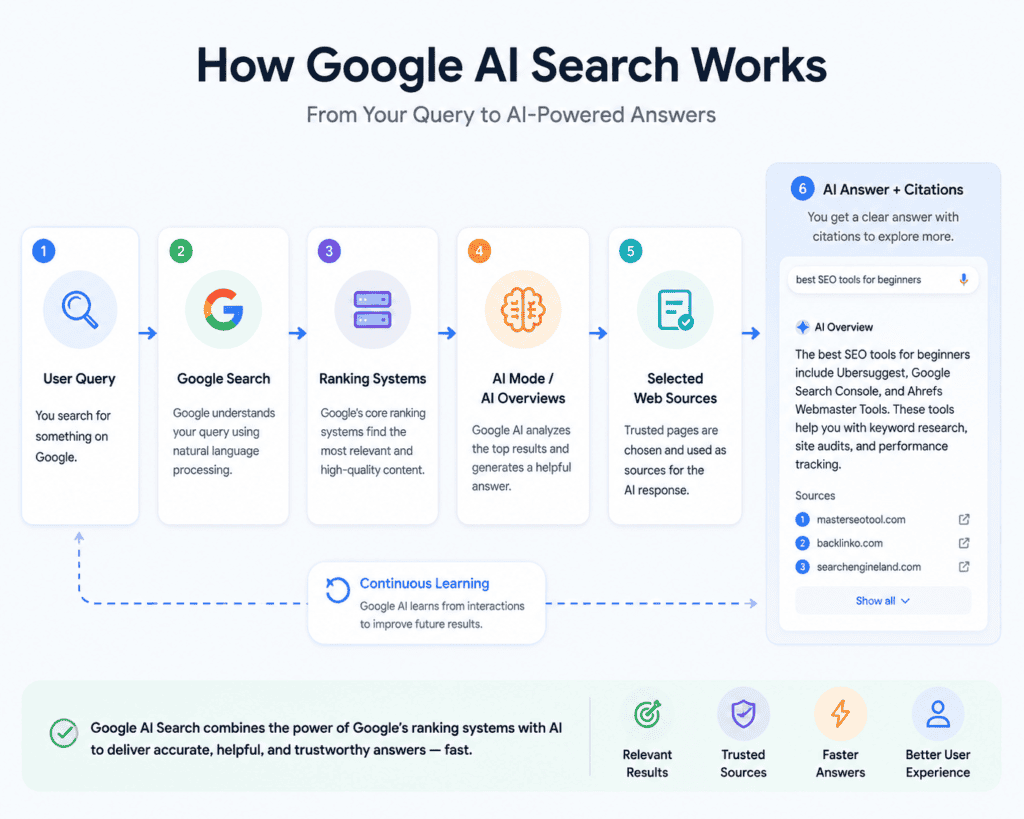
Google AI Search refers to Google’s AI-powered search experiences that help users find information more quickly by combining traditional search results with AI-generated responses.
Instead of simply matching keywords to web pages, AI Search attempts to understand the user’s intent, gather information from multiple authoritative sources, and generate a concise answer while linking to the original content.
Google currently offers two primary AI experiences.
| Feature | Purpose | User Experience |
|---|---|---|
| AI Overviews | Provides an AI-generated summary above traditional search results. | Quick answers with links to supporting websites. |
| AI Mode | Offers a conversational search experience for complex or follow-up questions. | Interactive responses with cited sources. |
Unlike earlier search features, these systems rely on advanced language models combined with Google’s existing ranking systems to determine which pages deserve visibility.
According to Google’s official guidance on AI features in Search, the same SEO fundamentals remain relevant for AI Overviews and AI Mode.
According to Google’s official documentation, websites do not need a separate indexing process for AI features. Pages that are crawlable, indexable, and eligible for Google Search can also appear in AI experiences when they provide useful and relevant information.
For publishers, Google AI Search Optimization means making content easy to understand, technically accessible, and genuinely useful to the people behind each query.
Related Reading
AI Mode vs AI Overviews
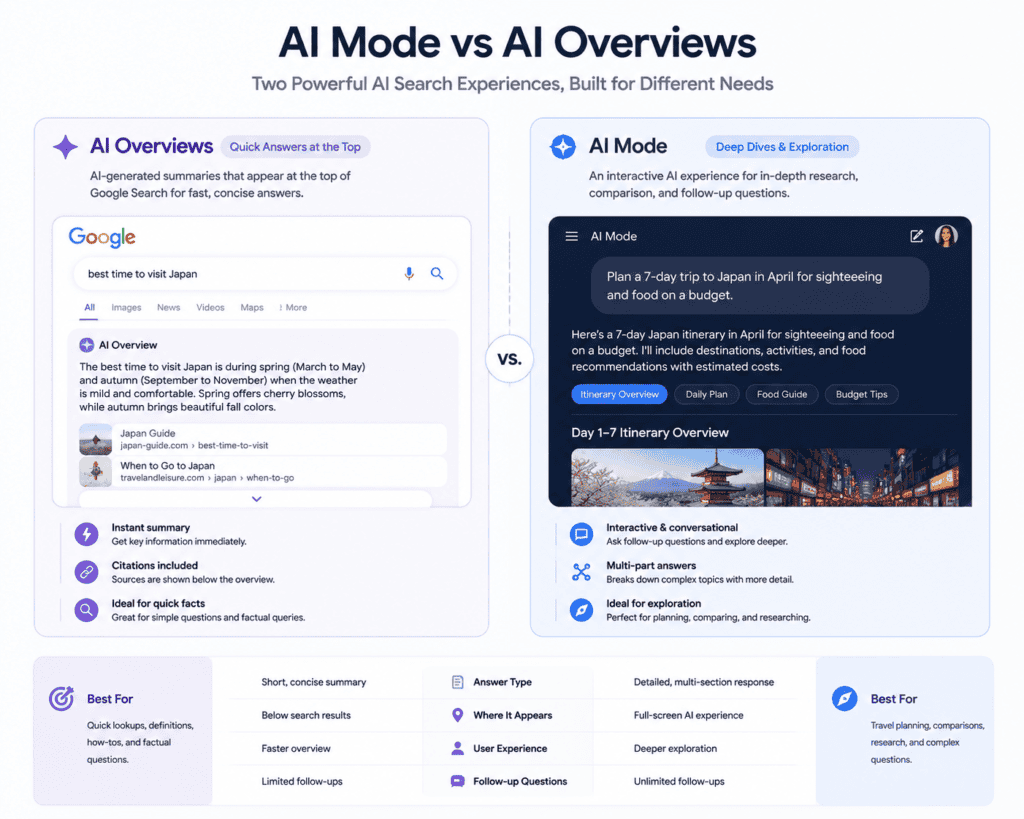
Although these names are often used interchangeably, they serve different purposes.
| AI Mode | AI Overviews |
|---|---|
| Interactive conversation | One-time AI summary |
| Designed for complex questions | Designed for quick answers |
| Allows follow-up prompts | Appears above standard search results |
| Explores multiple aspects of a topic | Summarizes the most relevant information |
For example, if a user searches “How do I optimize my website for Google AI Search?”, Google may display an AI Overview summarizing the main recommendations.
If the user then asks follow-up questions such as “Does schema markup help?” or “How important are backlinks?”, AI Mode can continue the conversation while citing relevant sources.
For publishers, the optimization strategy is largely the same: create comprehensive, trustworthy, and well-structured content that directly answers users’ questions.
Google AI Search Optimization should account for both AI Overviews and AI Mode because users can encounter AI-generated information at different stages of their search journey. Content that answers questions clearly while providing deeper supporting information is better positioned for this evolving search experience.
How Google Chooses Sources for AI Search
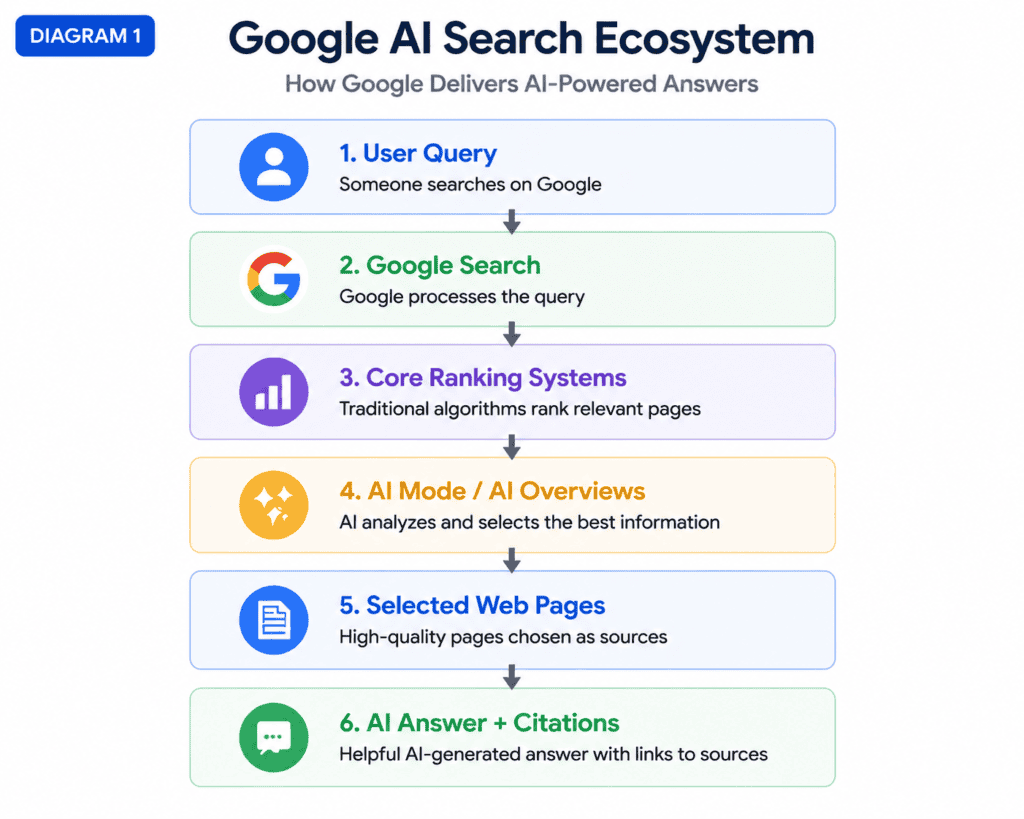
One of the biggest misconceptions is that AI Mode has a completely different ranking algorithm.
Google has stated that AI Search builds on the same core ranking systems used in traditional Search. That means factors such as relevance, content quality, page experience, and trust remain essential.
In practice, Google is more likely to surface pages that:
- Answer the user’s question clearly.
- Demonstrate expertise.
- Provide original insights rather than repeating existing information.
- Cover the topic comprehensively.
- Are technically accessible to Googlebot.
- Earn trust through reputable backlinks and strong site quality.
This is why SEO fundamentals still matter. AI-generated responses may change how users interact with search results, but they still depend on the quality of the underlying web content.
If your site has indexing issues, resolve them first. Our guides on XML Sitemap, Robots.txt, Duplicate Without User-Selected Canonical, and Page Indexed but No Impressions can help you diagnose common technical problems before focusing on AI Search optimization.
Does Traditional SEO Still Matter?
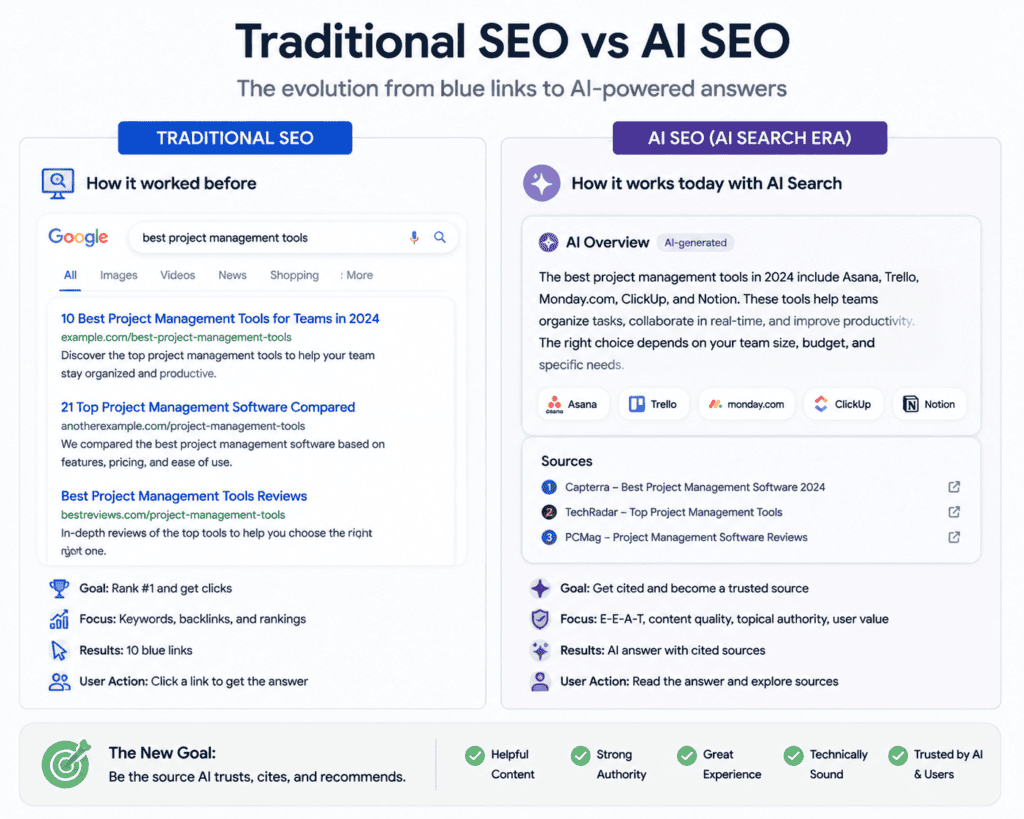
Yes, perhaps more than ever.
Google has consistently explained that there is no separate “AI SEO” algorithm. Instead, AI features rely on the same systems that have ranked useful content for years.
The difference is that AI-generated responses often synthesize information from multiple sources instead of directing users to a single webpage. That makes content quality, clarity, and topical coverage even more important.
The table below summarizes how traditional SEO principles translate into AI-powered search.
| Traditional SEO Principle | Why It Matters for AI Search |
|---|---|
| High-quality content | Provides reliable information for AI-generated answers. |
| Search intent | Helps AI identify pages that answer the user’s question. |
| E-E-A-T | Increases confidence in your content’s reliability. |
| Internal linking | Strengthens topical relationships across your website. |
| Structured content | Makes information easier for search systems to interpret. |
| Freshness | Ensures AI references current and accurate information. |
Rather than replacing SEO, AI Search raises the standard for what constitutes genuinely helpful content.
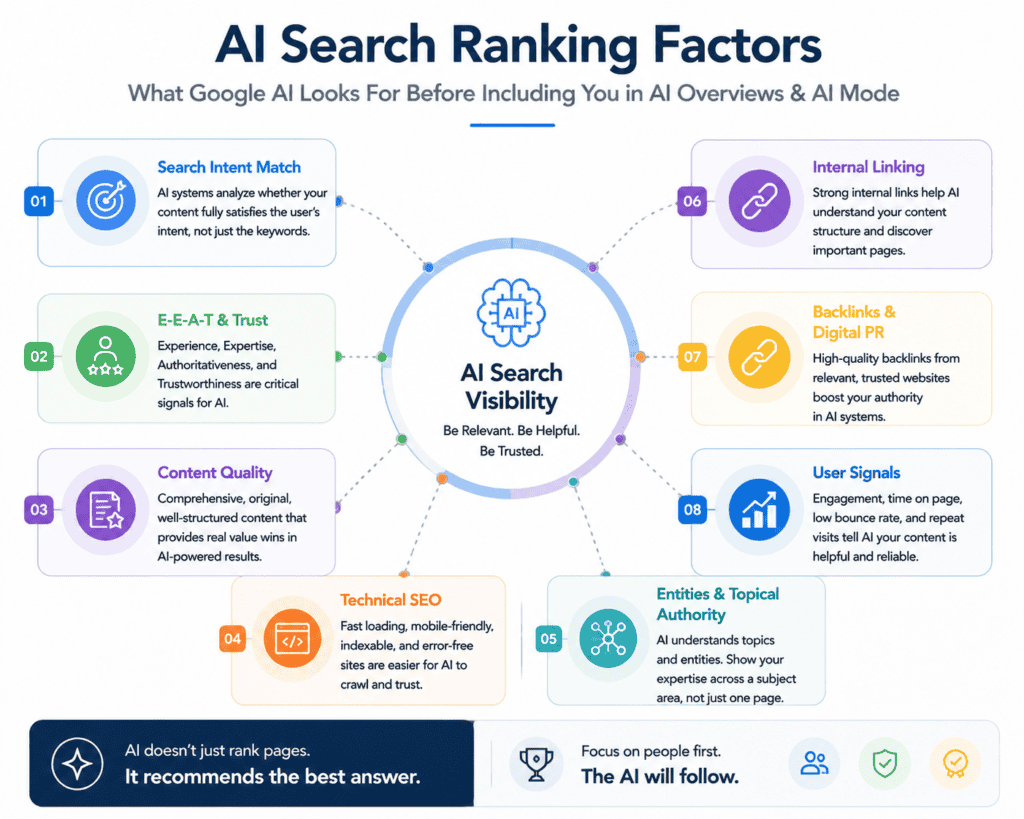
15 Proven Strategies to Optimize for Google AI Search
Effective Google AI Search Optimization starts with the same fundamentals that support strong organic search performance: relevance, quality, accessibility, and trust.
Google has made one thing clear: there is no special “AI Mode ranking algorithm.” Instead, AI-powered search relies on the same quality signals used in traditional Search while placing greater emphasis on content that is helpful, trustworthy, well-structured, and easy to understand.
The following strategies are based on Google’s published guidance and modern SEO best practices.
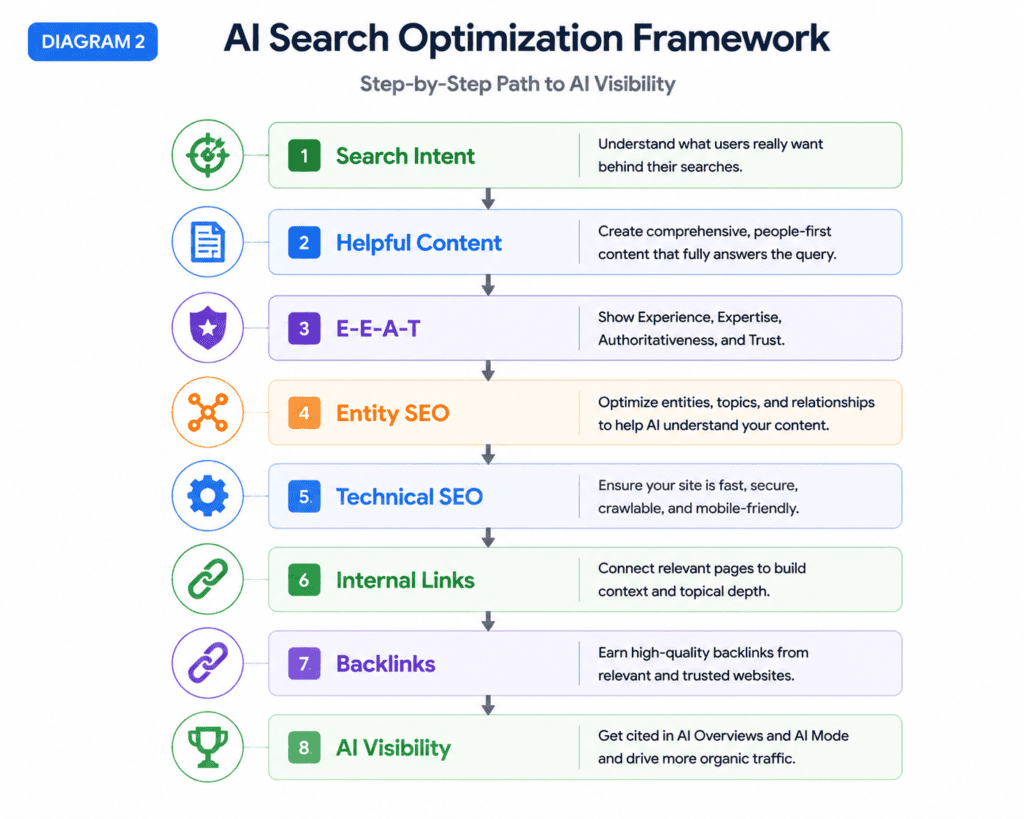
Match Search Intent Before Targeting Keywords
Many websites still begin SEO with keywords alone. Today, successful pages begin with search intent.
Ask yourself:
- What problem is the user trying to solve?
- What information are they expecting?
- Would they prefer a quick answer, a comparison, or a detailed guide?
For example, someone searching “Google AI Search Optimization” isn’t looking for a dictionary definition. They want practical guidance on improving their visibility in AI-powered search results.
Before publishing any article, review our AI Keyword Clustering SEO 2026 guide to ensure your content aligns with the user’s expectations.
Build Topical Authority Instead of Publishing Random Articles
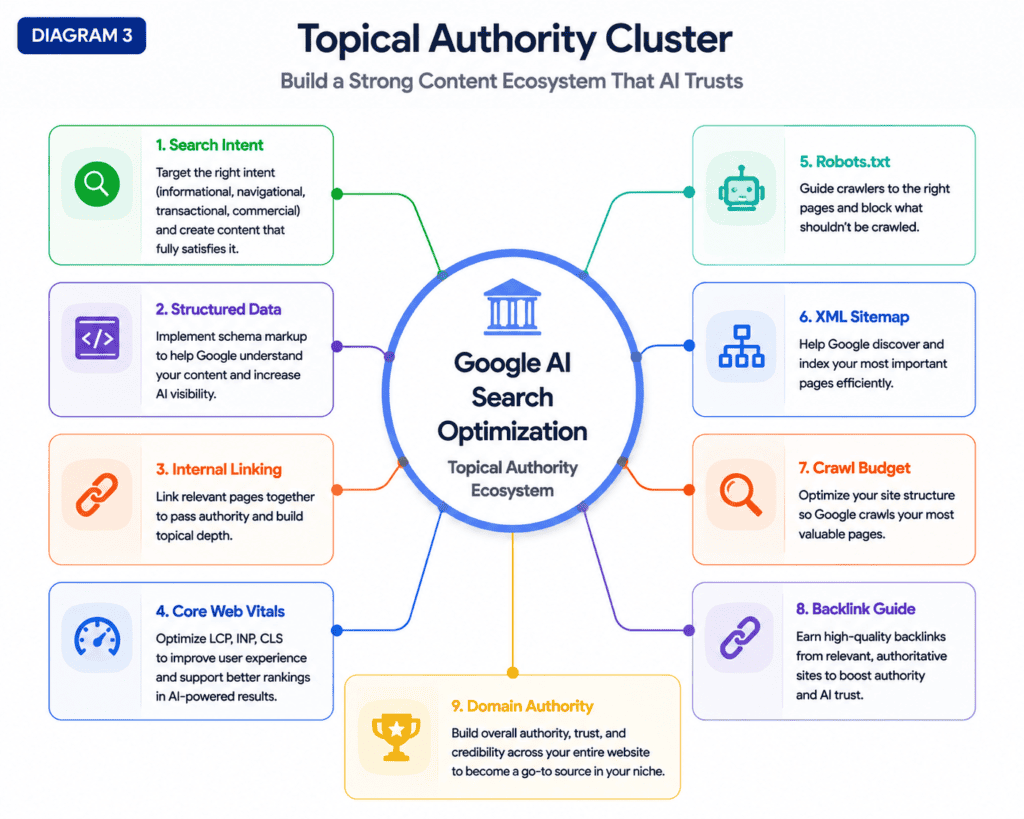
Google increasingly rewards websites that demonstrate consistent expertise within a subject.
Instead of writing isolated articles, create interconnected content clusters that cover a topic from multiple angles.
For example:
| Pillar Article | Supporting Articles |
|---|---|
| Google AI Search Optimization | Search Intent, Structured Data, Topical Authority, Internal Linking, Core Web Vitals |
| Backlink Checker | Backlink Analysis, Toxic Backlinks, Link Building, Anchor Text Guide |
| Domain Authority Checker | Domain Authority Explained, Page Authority, Website Trust Signals |
This approach helps search engines understand your expertise while improving the user experience through logical navigation.
A strong content cluster therefore supports Google AI Search Optimization by establishing clear relationships between your pillar page and its supporting resources.
Demonstrate E-E-A-T Throughout Your Content
Google evaluates pages based on Experience, Expertise, Authoritativeness, and Trustworthiness (E-E-A-T).
Although E-E-A-T is not a direct ranking factor, it plays a significant role in how Google’s quality systems evaluate content.
Improve E-E-A-T by:
- Publishing original research or case studies.
- Explaining concepts with practical examples.
- Keeping content updated.
- Citing authoritative sources.
- Displaying clear author information.
- Maintaining transparent editorial policies.
Avoid publishing generic AI-generated articles that simply repeat information already available elsewhere.
Google’s people-first content guidance recommends creating content primarily to help users rather than content designed mainly to attract search traffic.
Trust is particularly important for Google AI Search Optimization. Clear authorship, accurate sourcing, first-hand experience, and transparent information about your website can strengthen the credibility of your content for both readers and search engines.
Write for Humans First, Search Engines Second
AI-generated search experiences are designed to identify content that genuinely helps users.
Rather than writing repetitive paragraphs around one keyword, focus on answering real questions naturally.
Good practices include:
- Short paragraphs.
- Clear headings.
- Bullet lists.
- Tables.
- Practical examples.
- Simple language.
The easier your content is to understand, the more likely it is to satisfy both users and Google’s AI systems.
Cover the Entire Topic, Not Just the Primary Keyword
Modern SEO is based on semantic understanding rather than exact keyword repetition.
Instead of mentioning only Google AI Search Optimization, naturally discuss related concepts such as:
- AI Mode
- AI Overviews
- Helpful Content
- Search Intent
- Entity SEO
- Structured Data
- Knowledge Graph
- Semantic Search
- User Experience
This broader coverage increases topical relevance without keyword stuffing.
Create Content That AI Can Easily Summarize
AI-generated answers favor pages that organize information logically.
Use:
- Question-based headings.
- Numbered steps.
- Comparison tables.
- Definitions.
- Key takeaways.
- Checklists.
For example:
| Poor Structure | AI-Friendly Structure |
|---|---|
| Long blocks of text | Clear H2 and H3 headings |
| Hidden answers | Direct answers near the top |
| No formatting | Lists, tables, and summaries |
| Repeated keywords | Natural semantic language |
Well-structured pages improve readability while making it easier for Google’s systems to identify important information.
Strengthen Internal Linking
Internal links help both users and search engines discover related content.
Instead of adding links randomly, connect pages that naturally expand on the current topic.
For this guide, relevant internal resources include:
Existing Blog Articles
- AI Keyword Clustering SEO 2026
- Topical Authority: Complete Guide
- Structured Data Schema Markup
- Internal Linking Best Practices
- PageSpeed Checker 2026
- Duplicate Without User-Selected Canonical
- XML Sitemap Guide
- Robots.txt Guide
- Crawl Budget Explained
- Page Indexed but No Impressions
Useful SEO Tools
Encourage readers to evaluate their own websites using your tools:
- Domain Authority Checker
- Backlink Checker
- Keyword Position Checker
- Google Index Checker
- Meta Tags Analyzer
- PageSpeed Checker
- Broken Links Finder
Rather than forcing these links, introduce them where they solve a problem the reader is already trying to address.
Use Structured Data Where Appropriate
Structured data helps search engines better understand the content on your pages.
While schema markup does not guarantee inclusion in AI-generated answers, it improves content interpretation and eligibility for enhanced search features.
When implementing schema markup, follow Google’s structured data guidelines to ensure the markup accurately represents the visible content on the page.
Common schema types include:
| Schema Type | Best Used For |
|---|---|
| Article | Blog posts |
| FAQPage | Frequently asked questions |
| BreadcrumbList | Site navigation |
| Organization | Business information |
| Person | Author profiles |
| WebPage | General informational pages |
If you’re unfamiliar with structured data, read our Structured Data Schema Markup guide before implementing schema on your website.
Improve Technical SEO
Even outstanding content cannot perform well if search engines struggle to crawl or index your pages.
Regularly review:
- Crawl errors.
- Broken links.
- Page speed.
- Mobile usability.
- Index coverage.
- Duplicate content.
Our Google Index Checker, Broken Links Finder, and PageSpeed Checker make these tasks easier and can help identify issues before they affect your rankings.
Keep Content Fresh
AI-powered search favors information that remains accurate and relevant.
Instead of constantly publishing new articles, revisit existing content every few months to:
- Update statistics.
- Add new examples.
- Refresh screenshots.
- Expand sections.
- Improve internal links.
- Include Google’s latest recommendations.
Updating authoritative content is often more effective than publishing dozens of new low-quality articles.
Optimize for Entity SEO, Not Just Keywords
Search engines no longer rely solely on keyword matching. Instead, they understand entities—people, organizations, technologies, products, and concepts—and the relationships between them.
For this article, important entities include:
- Google Search
- Google AI Mode
- AI Overviews
- Google Search Console
- Googlebot
- E-E-A-T
- Structured Data
- Schema.org
- Core Web Vitals
- Knowledge Graph
Instead of repeating “Google AI Search Optimization” dozens of times, naturally discuss these related concepts throughout your content.
Entity relationships also strengthen Google AI Search Optimization by giving Google clearer context about the people, organizations, concepts, tools, and topics discussed on a page. Cover related entities naturally instead of repeatedly using the same keyword.
Example
| Keyword-First Writing | Entity-Based Writing |
|---|---|
| Repeats the same keyword excessively | Covers related concepts naturally |
| Limited topical depth | Demonstrates comprehensive knowledge |
| Higher risk of keyword stuffing | Better semantic relevance |
| Less engaging | More useful for readers |
Do Backlinks Still Matter for AI Search?
Yes.
Backlinks remain one of the strongest signals that help Google evaluate the credibility and authority of a website.
Although AI-generated answers focus on usefulness and relevance, they still rely on Google’s ranking systems, where high-quality backlinks continue to play an important role.
Focus on earning links from:
- Industry publications
- Educational websites
- Government resources
- Well-established blogs
- Original research citations
Avoid:
- Buying backlinks
- Link farms
- Automated link-building software
- Spam directories
Use our Backlink Checker to analyze your backlink profile and identify opportunities for improvement.
Backlinks can support Google AI Search Optimization by strengthening signals of authority and helping search engines discover relationships between trusted sources. Prioritize relevant, editorially earned links rather than high-volume link building.
Improve User Experience
Google’s AI systems prioritize content that users can easily read and navigate.
Improve the experience by:
- Writing concise paragraphs.
- Using descriptive headings.
- Including comparison tables.
- Adding visuals where appropriate.
- Breaking long sections into smaller parts.
- Optimizing for mobile devices.
A fast-loading, well-organized page keeps visitors engaged longer, which often leads to better overall search performance.
Monitor Performance and Continuously Improve
SEO is an ongoing process rather than a one-time task.
Track your progress using:
| Tool | Purpose |
|---|---|
| Google Search Console | Monitor impressions, clicks, indexing, and search queries |
| Google Analytics 4 | Analyze user behavior and engagement |
| Keyword Position Checker | Track keyword rankings over time |
| Google Index Checker | Confirm pages are indexed |
| Backlink Checker | Monitor authority and new backlinks |
Review your content every three to six months and update it whenever Google’s guidance or search behavior changes.
Measuring Google AI Search Optimization requires looking beyond a single ranking position. Track impressions, clicks, queries, indexed pages, and changes in organic visibility to understand whether your optimization strategy is producing meaningful results.
Common Mistakes to Avoid
Many websites fail to appear in AI-powered search because they focus on shortcuts instead of building genuinely useful resources.
Avoid these common mistakes:
| Mistake | Better Approach |
|---|---|
| Keyword stuffing | Write naturally and comprehensively |
| Publishing thin AI-generated articles | Add original insights, examples, and research |
| Ignoring search intent | Answer the user’s actual question |
| Weak internal linking | Connect related articles logically |
| Outdated information | Update content regularly |
| Poor technical SEO | Fix crawl, indexing, and speed issues |
| Publishing isolated content | Build topic clusters around pillar pages |
Remember, Google’s AI systems reward content that helps users—not pages designed solely to manipulate rankings.
A common Google AI Search Optimization mistake is focusing on AI-specific tactics while neglecting basic SEO. Poor crawlability, weak content, unclear site structure, and irrelevant information can limit visibility regardless of how well a page targets AI search.
Google AI Search vs Traditional SEO
Although the fundamentals remain the same, AI-powered search changes how users interact with search results.
| Traditional SEO | AI Search Optimization |
|---|---|
| Focus on ranking webpages | Focus on becoming a trusted AI citation |
| Blue links dominate | AI-generated summaries appear first |
| Exact-match keywords were once important | Semantic relevance and entities matter more |
| Single-page optimization | Strong topical clusters perform better |
| Ranking position is the primary metric | Visibility across AI experiences becomes equally important |
| SEO focused mainly on search engines | SEO now focuses on helping both users and AI understand content |
The goal is no longer just to rank first—it is to become one of the trusted sources Google’s AI relies on when generating answers.
Use the following Google AI Search Optimization checklist as a final review before publishing or updating important content.
Google AI Search Optimization Checklist
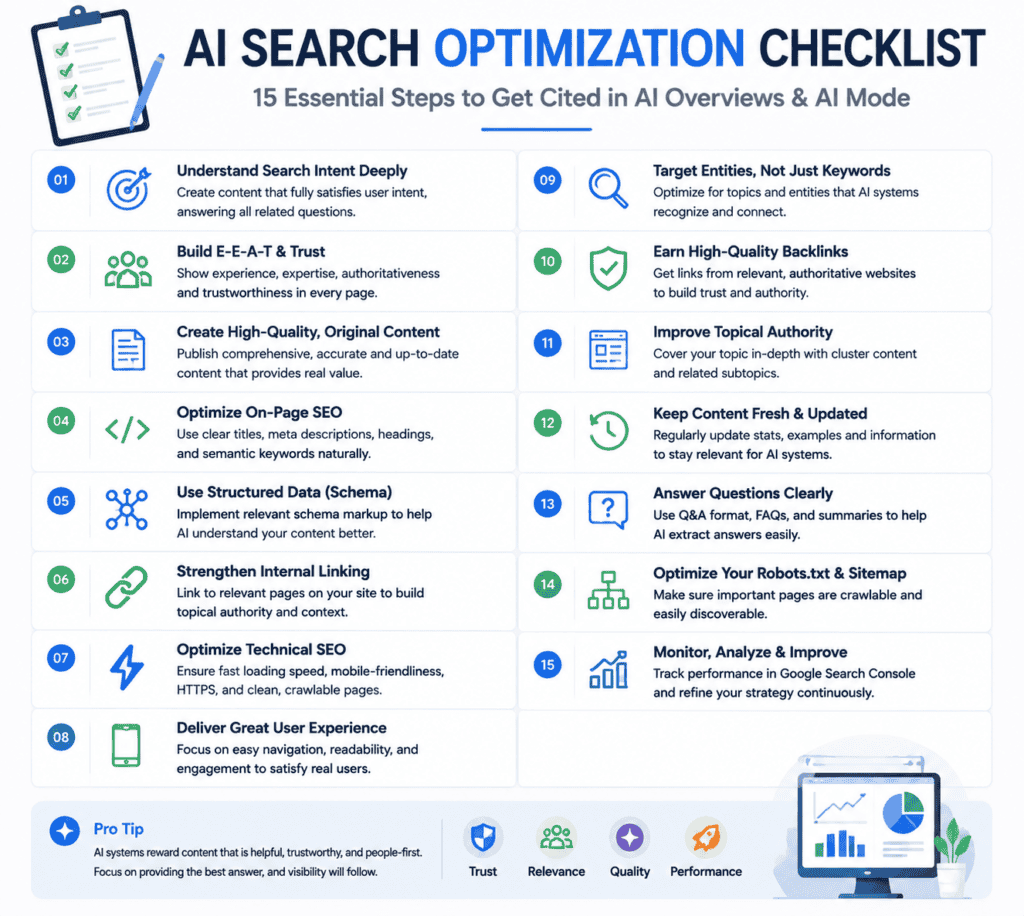
Before publishing a page, review the following checklist:
| Checklist Item | Status |
|---|---|
| Content satisfies search intent | ☐ |
| Original insights or examples included | ☐ |
| Logical heading structure (H2/H3) | ☐ |
| Internal links to related content | ☐ |
| External references from authoritative sources | ☐ |
| Images optimized with descriptive alt text | ☐ |
| Appropriate structured data implemented | ☐ |
| Mobile-friendly design | ☐ |
| Fast page loading speed | ☐ |
| Content reviewed for accuracy and freshness | ☐ |
Completing this checklist won’t guarantee AI visibility, but it aligns your content with Google’s recommended best practices.
Related Resources on MasterSEOTool
To continue improving your SEO knowledge, explore these guides:
Articles
- AI Keyword Clustering SEO 2026
- Topical Authority: Complete Guide
- Structured Data Schema Markup
- How Many Internal Links Per Page?
- PageSpeed Checker 2026
- Duplicate Without User-Selected Canonical
- XML Sitemap Guide
- Robots.txt Guide
- Crawl Budget Explained
- Page Indexed but No Impressions
Free SEO Tools
- Domain Authority Checker
- Backlink Checker
- Keyword Position Checker
- Meta Tags Analyzer
- Google Index Checker
- Broken Links Finder
- PageSpeed Checker
These resources complement the strategies discussed in this guide and can help you build a stronger, more technically sound website.
Frequently Asked Questions (FAQs)
What is Google AI Search?
Google AI Search is Google’s AI-powered search experience that combines traditional ranking systems with generative AI to provide more comprehensive answers to users’ questions. Depending on the query, Google may display AI Overviews or offer an interactive experience through AI Mode while linking to relevant web pages.
What is the difference between AI Mode and AI Overviews?
AI Overviews generate a concise summary that appears above traditional search results for many informational queries.
AI Mode provides a conversational experience where users can ask follow-up questions and explore topics in greater depth.
Both rely on Google’s existing search infrastructure but present information differently.
Can my website appear in Google AI Search?
Yes.
If your pages are crawlable, indexable, and provide original, helpful content, they may be selected as supporting sources for AI-generated responses.
There is no separate submission process for AI Mode or AI Overviews.
Does Google have a special AI SEO algorithm?
No.
Google has stated that AI-powered search builds on its existing ranking systems. The same principles that support strong organic rankings—quality content, relevance, technical SEO, and trust—also improve your chances of appearing in AI-powered experiences.
Is structured data required for AI Search?
No.
Structured data does not guarantee visibility in AI-generated answers, but it helps Google understand your content more effectively and may improve eligibility for rich search features.
Learn more in our Structured Data Schema Markup guide.
Are backlinks still important?
Yes.
Backlinks remain an important indicator of authority and trust.
Rather than pursuing large quantities of links, focus on earning high-quality backlinks from reputable websites within your industry.
Use our Backlink Checker to monitor your backlink profile and discover opportunities for improvement.
Does AI-generated content rank in Google?
AI-generated content is not automatically penalized.
Google evaluates content based on quality, usefulness, originality, and trustworthiness—not the method used to create it.
Always review AI-assisted content carefully, add original insights, and ensure it provides value beyond what is already available online.
How often should I update my content?
Review important pages every three to six months.
Updates should include:
- New statistics
- Current Google guidance
- Additional examples
- Improved internal links
- Expanded sections
- Updated screenshots (when relevant)
Regular updates help maintain accuracy and improve long-term performance.
How can I measure AI Search performance?
Although there is currently no dedicated “AI Mode” report in Google Search Console, you can monitor:
- Organic impressions
- Clicks
- Average position
- Indexed pages
- Top-performing queries
- User engagement metrics in Google Analytics
Combining these insights provides a clearer picture of how your content performs over time.
What is the best long-term strategy for AI Search optimization?
Rather than chasing algorithm changes, focus on building a website that consistently publishes:
- Helpful content
- Accurate information
- Strong topical authority
- Excellent user experience
- Reliable technical SEO
- Clear internal linking
These fundamentals remain effective regardless of how Google’s search experience evolves.
Final Thoughts
Google AI Search Optimization is not replacing SEO—it is reshaping how high-quality content is discovered and presented.
While AI Overviews and AI Mode introduce new ways for users to interact with search results, Google’s core objective remains unchanged: delivering the most relevant, trustworthy, and helpful information.
Instead of looking for shortcuts or “AI SEO hacks,” invest in creating comprehensive resources that genuinely solve users’ problems. Build topical authority, organize your content into logical clusters, strengthen your technical SEO, and keep your pages accurate and up to date.
If you consistently follow these principles, your website will be better positioned not only for traditional rankings but also for future AI-powered search experiences.