
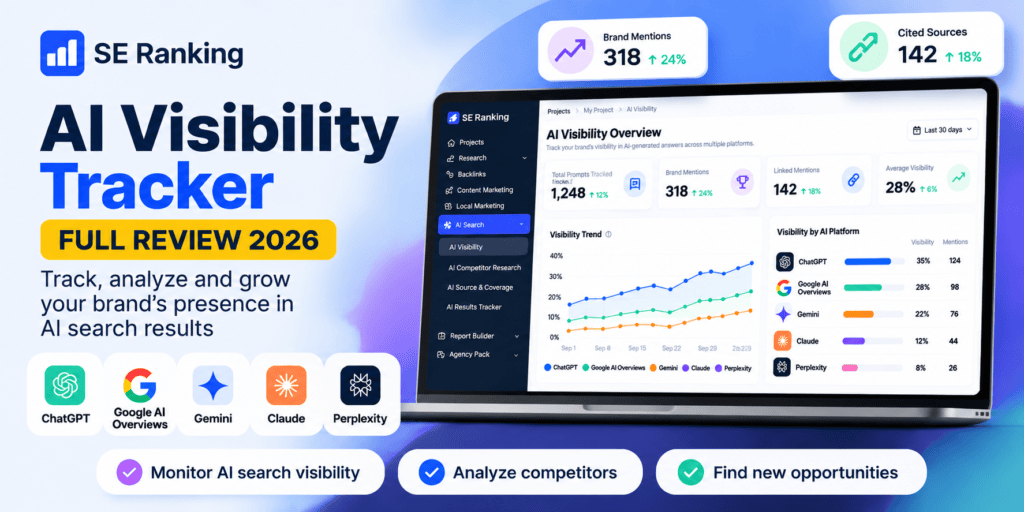
If you’re investing time in SEO, you probably want to know more than where your website ranks on Google. You also want to know whether your brand appears when people ask ChatGPT, Google AI or other AI-powered search tools for recommendations.
That’s where AI visibility tracking comes in.
In this SE Ranking AI Visibility Tracker review, I’ll explain what the platform offers, how its AI tracking features work, what the current pricing looks like, and where I think website owners should be careful before paying.
My assessment is based on SE Ranking’s official product documentation and pricing information. I haven’t independently tested every feature, so I’ll distinguish confirmed product details from my own recommendations.
Quick verdict: SE Ranking is worth considering if you want AI visibility monitoring alongside traditional SEO tools. However, the right plan depends on how many prompts, platforms and competitors you need to track. Smaller websites should calculate the full cost before committing.
Affiliate disclosure: This article contains affiliate links. I may earn a commission if you purchase through them, at no additional cost to you. This does not change my assessment of the product.
What Is SE Ranking’s AI Visibility Tracker?
SE Ranking is an SEO platform that combines traditional SEO research and website auditing with tools for monitoring visibility in AI-generated answers.
Its AI Search Toolkit includes several related capabilities:
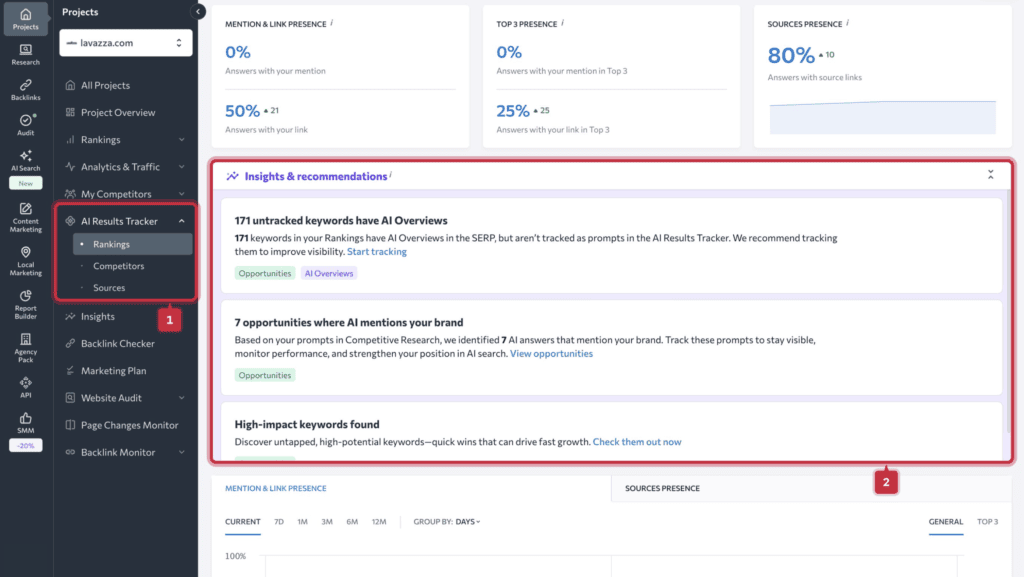
- AI Results Tracker: Monitors whether your brand appears in answers generated for selected prompts.
- AI Competitor Research: Helps compare your brand’s presence with competing websites.
- AI Source & Coverage Analysis: Shows which websites and pages appear as sources in AI answers.
SE Ranking AI visibility tracking helps marketers understand where their brands appear in selected AI-generated answers.
These features address a different question from traditional rank tracking. A conventional rank tracker measures your position for a keyword in search results. AI visibility tracking examines whether your brand is mentioned or linked when an AI system responds to a particular question.
You can explore the features in the official SE Ranking AI Visibility Tracker guide.
I would not treat every AI visibility product from SE Ranking as the same thing. Its AI Search add-on extends capabilities inside the SEO platform, while SE Visible is a separate product focused on strategic AI visibility reporting. The company’s AI Search Add-on documentation explains the distinction.
Key Features: What Can You Actually Track?
1. Brand mentions and links in AI answers
One of the main reasons to use an AI visibility tracker is to see whether your brand appears in answers to relevant questions.
Review SE Ranking AI visibility trends over time rather than judging performance from a single report.
SE Ranking AI visibility reports can help you monitor brand mentions across the prompts you choose to track.
For example, imagine someone asks an AI assistant to recommend affordable SEO tools for a small website. You may want to know whether your website or product is mentioned, whether a competitor is recommended instead, and whether the answer includes a link to your content.
SE Ranking’s AI Results Tracker monitors brand mentions and links associated with selected prompts. It also provides information about how your brand appears in the resulting answers.
This is useful for discovering gaps, but it does not mean the software can measure every possible AI conversation. Your results depend on the prompts, platforms and tracking coverage available to you.
Accurate SE Ranking AI visibility tracking starts with selecting prompts that reflect the questions your target audience actually asks.
2. AI competitor research
Competitor research is another useful feature.
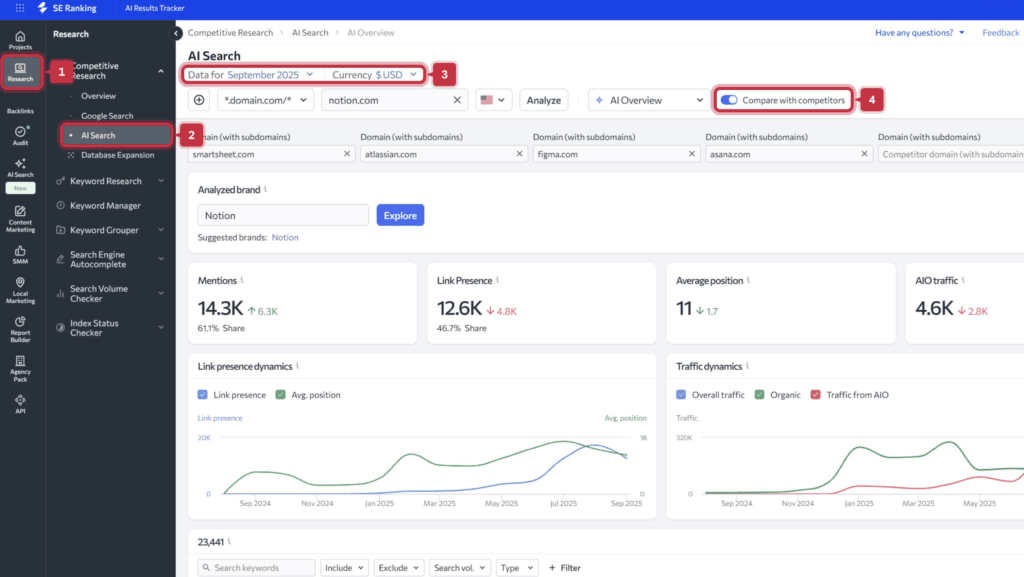
Instead of checking your own brand in isolation, you can compare your visibility with competing domains and investigate the prompts and topics behind their appearances.
SE Ranking AI visibility data also helps you compare your brand’s presence with competing websites across supported platforms.
For example, if another SEO website appears frequently in AI answers about keyword research, you can investigate the topics and pages associated with that visibility. You can then decide whether your own content answers the same questions adequately.
This doesn’t prove that copying a competitor’s content will improve your visibility. It gives you information to investigate and helps identify possible content gaps.
Use SE Ranking AI visibility findings to identify content gaps worth investigating before updating existing pages.
3. AI source and citation analysis
AI-generated answers may reference external websites, articles, documentation or other sources.
SE Ranking’s source analysis helps identify domains and URLs appearing in AI answers and examine the types of sources being cited. The company also describes coverage analysis across supported markets and languages.
SE Ranking AI visibility insights can reveal which websites and pages appear as sources in monitored AI answers.
For content publishers, this can help answer practical questions:
- Which pages from my website appear as sources?
- Which external websites are frequently cited in my topic?
- Are competing brands receiving citations that my content is missing?
- Which subjects should I investigate before updating my articles?
I see this as one of the more useful applications of AI visibility monitoring. It connects the measurement of visibility with the work of improving content.
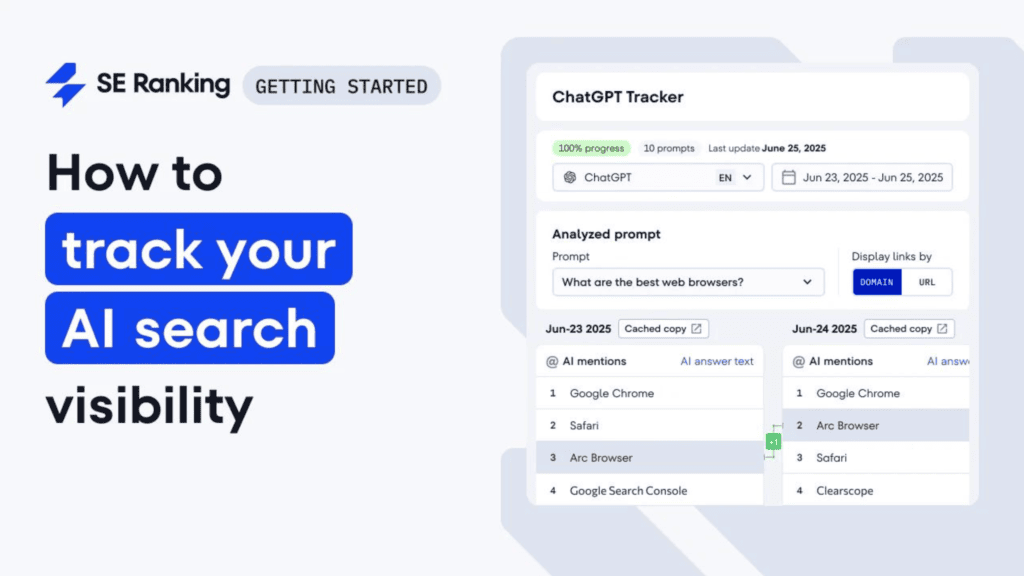
4. Tracking changes over time
A single AI-generated answer is not enough to judge your website’s overall visibility.
Responses can vary with the question, platform and time of the check. Tracking selected prompts repeatedly gives you a more consistent way to observe changes.
SE Ranking describes historical visibility tracking and comparisons of brand mentions and links. However, tracking changes does not establish that a particular content edit caused them. Other factors may also influence the results.
SE Ranking AI Visibility Tracker Pricing in 2026
Pricing deserves careful attention because the cost depends on the subscription and the additional tracking capacity you need.
The following figures were checked against SE Ranking’s official pricing page on October 21, 2026. They may change, so confirm the price and included limits before purchasing.
| Plan or package | Monthly billing | Annual billing equivalent |
|---|---|---|
| Core | $129/month | $103.20/month |
| Growth | $279/month | $223.20/month |
| AI Search add-on, 200 package | $89/month | $71.20/month |
| AI Search add-on, 450 package | $179/month | $143.20/month |
| AI Search add-on, 1,000 package | $345/month | $276/month |
Annual prices are monthly equivalents; annual subscriptions are billed upfront. The figures above come from SE Ranking’s official subscription and pricing page and its AI Search Add-on pricing documentation.
Before paying for SE Ranking AI visibility features, check the current plan, add-on requirements, and available tracking limits.
What do the Core and Growth plans include?
The official pricing page currently lists:
- Core: 10 projects, one manager seat, 2,000 tracked keywords, 100 prompts to track daily and five AI platforms in its tracking allowance.
- Growth: 30 projects, three manager seats, 5,000 tracked keywords, 250 prompts to track daily and 15 domains for AI competitor research.
Both plans combine AI-related features with traditional SEO capabilities, including rank tracking, competitor research, backlink research and website auditing.
The main advantage is that you can manage several SEO activities from one platform rather than paying for entirely separate tools. Whether that saves money depends on which features you actually use.
Is the AI Search add-on worth paying for?
The add-on is designed to extend tracking limits and provide additional AI search capabilities. It may make sense for agencies, larger websites or teams monitoring several brands.
However, I found an important detail when comparing the official pages: the pricing page presents the add-on packages as prompt limits, while the Help Center describes packages in terms of monthly checks and defines one check as one prompt on one AI platform.
Because these descriptions use different units, confirm the exact allowance and how it is counted with SE Ranking before purchasing. Don’t assume that one prompt automatically means one check across every platform.
What about SE Visible?
SE Visible is a separate product focused on strategic AI visibility reporting. The AI Search add-on documentation says access to SE Visible is included with the add-on.
If you are interested primarily in AI visibility rather than a broader SEO toolkit, compare the standalone product with the complete cost of an SE Ranking subscription plus the add-on. They serve related but different use cases.
You can check SE Ranking’s current plans and AI visibility features before deciding which option fits your needs.
How I Would Use SE Ranking to Monitor AI Visibility
I would start with a small, focused tracking project rather than monitoring hundreds of questions immediately.
Step 1: Choose relevant questions
Write down the questions your potential customers are likely to ask AI systems.
For MasterSEOTool, examples might include:
- What are the best free SEO tools for small websites?
- Which tools can help identify keyword ranking problems?
- What are affordable alternatives to expensive SEO platforms?
- How can I check whether a page is indexed by Google?
These are example prompts, not measured search-volume data. Choose questions that match your real audience and business goals.
Step 2: Select competitors
Choose a few websites competing for the same audience. Include both direct competitors and established websites that publish content around your target topics.
Use the available competitor research features to see how those domains appear in monitored AI answers.
Step 3: Review mentions, links and sources
Look beyond whether your brand appears.
Check whether an AI answer mentions your website, links to a relevant page, cites a competitor, or recommends a different product. Record the prompts where you appear to be missing from the conversation.
Step 4: Improve the relevant content
Use the findings to review your existing articles.
For example, you may need clearer explanations, stronger evidence, better coverage of a question, or a more useful comparison table. You might also find that a page needs better internal links or has an indexing problem.
When updating a page, don’t overlook its search snippet. Our AI SEO Meta Description Generator can help you draft a clearer description that matches the page content and gives searchers a reason to click.
Our guides on Google AI Search Optimization and AI Crawl Optimization explain related parts of this process.
After updating your content, monitor its traditional search performance with our Keyword Position Checker. This helps you track keyword rankings alongside your AI visibility observations.
Step 5: Track the same prompts again
Keep your prompt set consistent enough to compare changes over time. Note when you update a page and avoid assuming that every change in visibility came from that edit alone.
For a small site, I would begin with a manageable set of high-priority questions and expand only when the data becomes useful.
Pros and Cons of SE Ranking’s AI Visibility Features
What I like
- One platform for several SEO tasks: You can combine AI visibility work with keyword research, rank tracking and website audits.
- Competitor comparisons: These help reveal topics where competing brands appear in monitored answers.
- Source analysis: Identifying cited domains and URLs can guide further content research.
- Scalable tracking options: Different subscription and add-on levels support different workloads.
- A trial option: The official pricing page advertises a free 14-day trial, with starter usage limits and no credit card required.
What I would be careful about
- Cost: Core starts at $129 per month on monthly billing, which may be too expensive for a new or low-traffic website.
- Tracking limits: Your actual capacity depends on the subscription, add-on and how the product counts usage.
- Product terminology: AI Results Tracker, the AI Search add-on and SE Visible are related but not interchangeable.
- Coverage differences: Confirm which AI platforms and features are included in the exact plan you intend to buy.
- No guaranteed results: Monitoring visibility does not guarantee more mentions, higher rankings, traffic or sales.
I would also avoid buying the most expensive plan just because AI search is a growing topic. Start with the actual questions you need to answer, then choose the smallest plan that covers them.
If these features match your needs, compare SE Ranking’s available plans before choosing a subscription
SE Ranking vs. Other AI Visibility Tracking Tools
SE Ranking is not the only option for monitoring AI-generated answers. Semrush, Otterly.AI and Peec AI also offer products in this category.
The best choice depends on your workflow:
| Your priority | What to compare |
|---|---|
| Traditional SEO plus AI monitoring | SE Ranking’s included SEO tools and AI tracking allowances |
| AI visibility within a broader marketing suite | Semrush’s available AI visibility features and subscription cost |
| A dedicated AI monitoring workflow | Otterly.AI’s prompt tracking and reporting |
| Brand visibility and competitor comparisons | Peec AI’s supported platforms, tracking capacity and reporting |
I have not independently tested all these products under identical conditions, so I would not claim that one is universally better.
For a wider overview, see my comparison of the best AI visibility tracking tools in 2026. It covers five platforms and helps narrow down which products deserve a closer look.
If you’re still deciding whether you need AI tracking at all, my guide to AI SEO tracking tools vs. traditional SEO tools explains the differences between the two approaches.
Who Should Use SE Ranking’s AI Visibility Tracker?
I would consider SE Ranking if you already use its SEO tools, manage several websites or clients, and want to monitor AI visibility alongside conventional SEO metrics.
It may also suit marketing teams that need structured reporting and competitor analysis across multiple projects.
On the other hand, if you run a small website with limited traffic and a tight budget, you may not need a paid AI visibility subscription yet. You can begin by manually checking a small number of relevant prompts, recording your observations and improving your existing content.
The important point is to establish a clear reason for paying. If you don’t know what you want to monitor or what decisions the data will help you make, even a powerful platform may not provide much value.
Does AI Visibility Tracking Improve Google Rankings?
Not directly.
AI visibility software measures how brands and websites appear in selected AI-generated answers. It can help you identify content opportunities, but it does not automatically improve rankings or make an AI system cite your pages.
Google’s own guidance on AI features in Search says the established SEO fundamentals remain relevant. Google does not require special AI schema or a separate optimization process for eligibility in AI Overviews or AI Mode.
That means your foundation still matters: useful content, crawlability, internal links, indexing, clear page structure and a good user experience.
AI tracking can help you decide what to investigate. The actual work of improving your website still needs to happen.
SE Ranking AI visibility is worth considering if you need to monitor brand mentions and citations alongside your existing SEO workflow.
FAQs
What is SE Ranking’s AI Visibility Tracker?
It is a set of features for monitoring brand mentions, links, competitor visibility and selected prompts in supported AI search experiences. The exact features and limits depend on the subscription and product.
How much does SE Ranking AI visibility tracking cost?
The official pricing page lists Core at $129 per month or $103.20 per month with annual billing, and Growth at $279 per month or $223.20 per month annually. AI Search add-on packages cost extra. Always verify current prices and usage limits before buying.
Does SE Ranking track ChatGPT mentions?
Yes. SE Ranking’s official product documentation describes monitoring brand mentions and links in ChatGPT answers for selected prompts. Confirm the supported platforms and allowance in your chosen plan.
What is the difference between AI Results Tracker and SE Visible?
AI Results Tracker is part of SE Ranking’s AI search toolkit. SE Visible is a separate product focused on strategic AI visibility reporting. The AI Search add-on can provide access to SE Visible, according to the official documentation.
Is SE Ranking worth it for small websites?
It can be, particularly if you also need its traditional SEO tools. But the monthly price may be difficult to justify for a small website that is still building traffic. Compare the cost with your current needs before committing.
Can AI visibility tracking guarantee more traffic?
No. It measures visibility in monitored AI answers. Traffic and sales depend on whether users click, visit your website and take action. No tracking platform can guarantee those outcomes.
Final Verdict: Is SE Ranking Worth It in 2026?
My view is that SE Ranking deserves consideration if you want to manage traditional SEO and AI visibility monitoring in one place. Its combination of rank tracking, website audits, competitor research and AI search features can be useful for a growing website or an agency.
The main question is cost. Core starts at $129 per month on monthly billing, and additional AI tracking capacity may increase the total. For a small publisher, that is a meaningful expense.
Before buying, check the available trial, confirm which AI platforms your plan supports, and verify how prompt limits are calculated.
If the features fit your workflow, you can explore SE Ranking’s current plans and AI visibility tools here. If not, start with a smaller manual tracking process and invest in paid monitoring when you have a clear use for the data.
For me, the best tool is not necessarily the one with the most features. It is the one that provides information you can actually use to make better decisions about your website.