
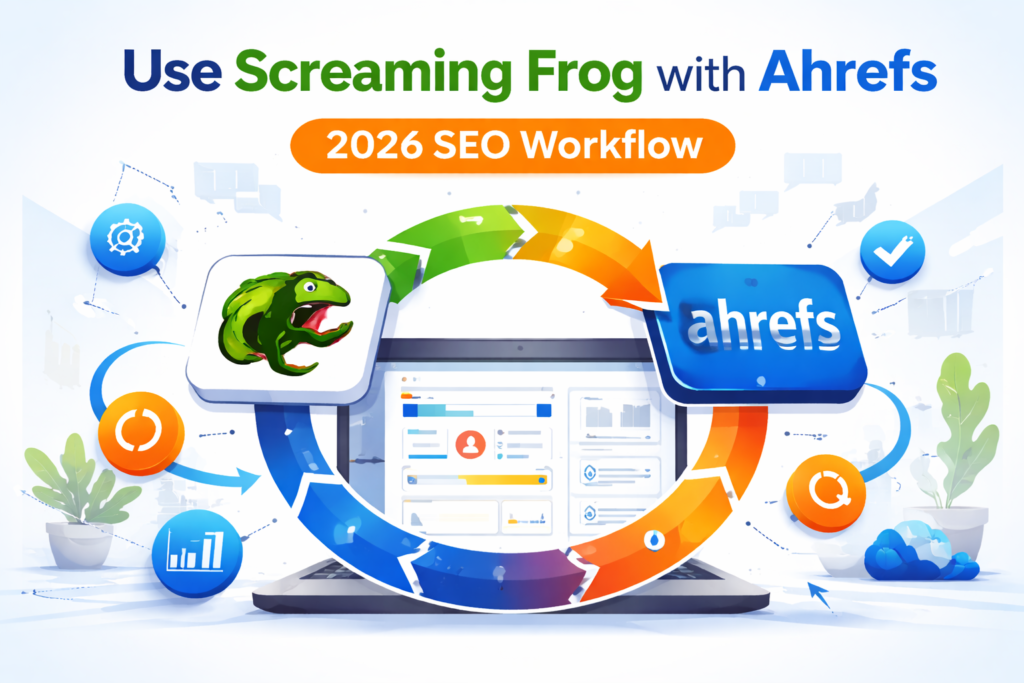
Use Screaming Frog with Ahrefs correctly, and your technical SEO decisions become obvious.
The problem isn’t a lack of data. It’s misalignment. Screaming Frog can expose hundreds of crawl warnings in minutes. Ahrefs can show you which pages actually carry authority. But if you don’t connect those signals, you waste time fixing pages that don’t move rankings.
In 2026, technical SEO is not about running more reports. It’s about prioritizing the pages that matter.
This guide shows you exactly how to connect structure and authority so your fixes translate into measurable ranking gains.
Quick Overview
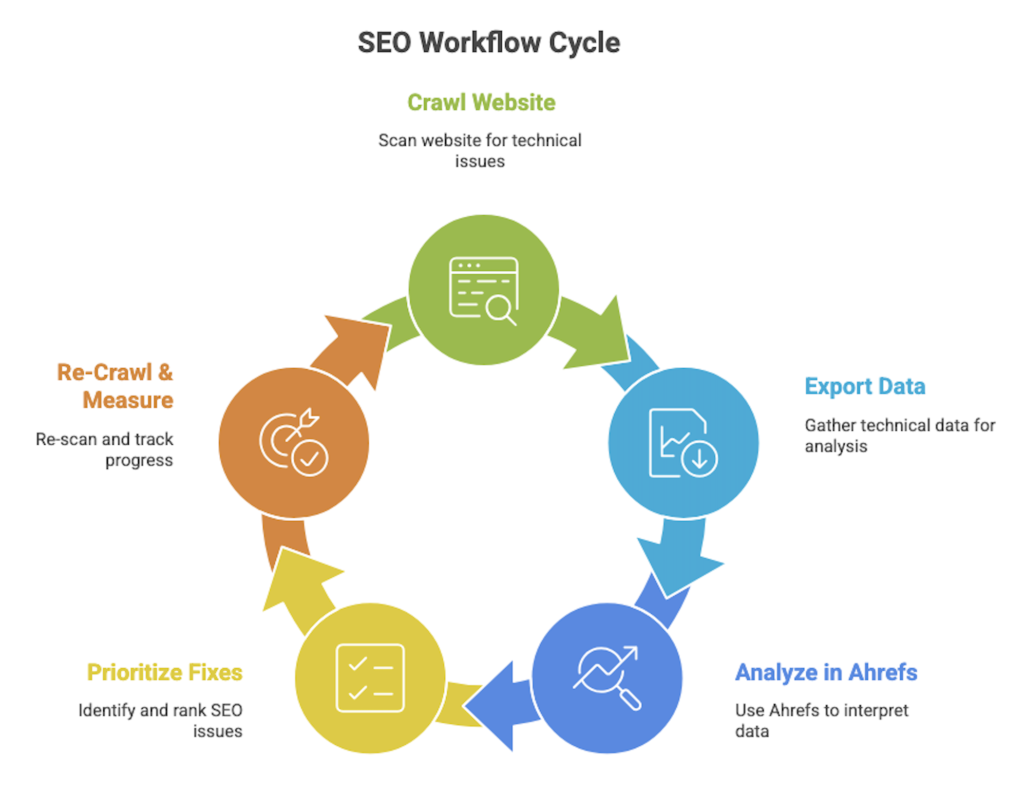
The process is straightforward:
- Crawl the entire website.
- Export structural data.
- Cross-reference important URLs in Ahrefs.
- Prioritize fixes based on authority and ranking position.
- Re-crawl and measure changes.
The objective is not to fix everything. The objective is to fix what moves visibility.
If you are still deciding which platform fits your process better, review Screaming Frog vs Ahrefs 2026 before applying this system.
How to Use Screaming Frog with Ahrefs Step-by-Step
This section outlines the exact execution order.
Step 1: Crawl the Site and Build a Structural Map
Run a full crawl using Screaming Frog.
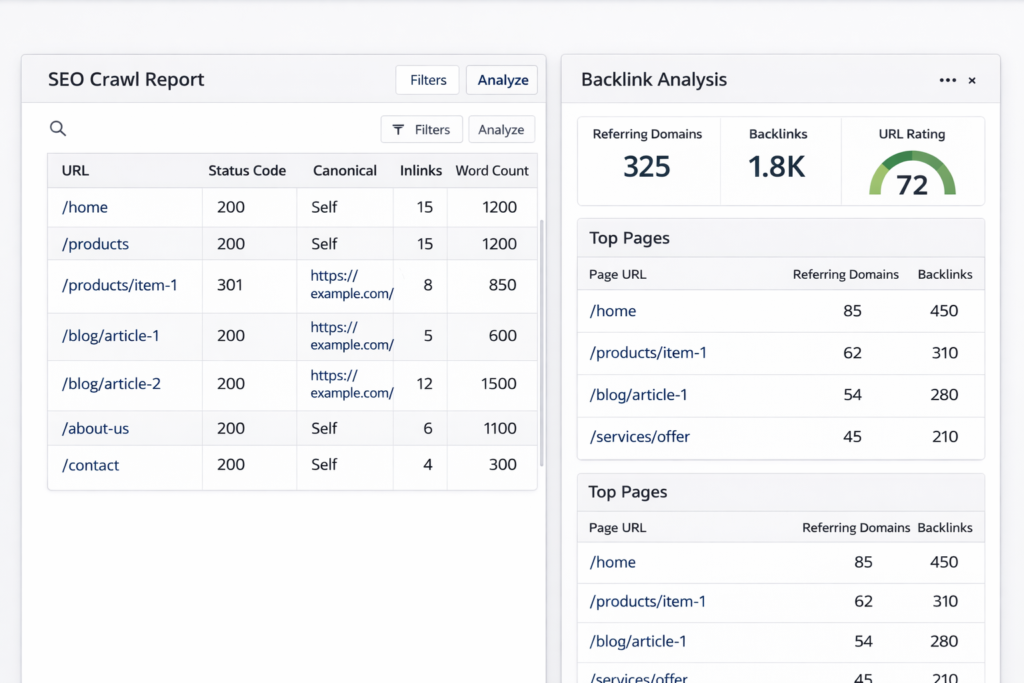
Export the following:
- All HTML URLs
- Status codes
- Canonical tags
- Inlink counts
- Word count
- Indexability
Then filter for:
- 404 errors
- Redirect chains
- Orphan pages
- Duplicate titles
- Thin content
- Accidental noindex tags
At this stage, you are not fixing anything. You are mapping the site.
If you want to simulate how search engines interpret a page before launching a full crawl, test it using your Spider Simulator Tool. That gives you a fast structural preview.
Structure comes first.
Step 2: Identify Authority Pages Inside Ahrefs
Open Ahrefs Site Explorer.
Export:
- Top pages by backlinks
- Pages ranking positions 11–20
- URLs with strong URL Rating
- Pages losing referring domains
This reveals which pages matter most.
A crawl might show hundreds of warnings. But if only a handful of those pages have real backlink authority or ranking potential, those become your priority.
For a quick backlink snapshot before deep filtering, run URLs through your Backlink Checker Tool.
Now you have two data sets:
Structural weaknesses.
Authority signals.
Step 3: Merge Structural Data with Authority Data
This is where most SEO audits break down.
Cross-reference your Screaming Frog export with Ahrefs data.
Look for overlaps:
- High-backlink pages with redirect chains
- Ranking pages marked noindex
- Authority pages buried deep in click depth
- Orphan URLs that actually have backlinks
If a page ranking at position 14 also has thin content issues, that becomes a strategic fix.
If a page with 40 referring domains sits behind two redirects, that is leaking authority.
Use your Website Links Count Checker to confirm whether strong URLs receive enough internal links. If they are isolated, internal linking must be adjusted.
When you use Screaming Frog with Ahrefs properly, prioritization becomes obvious.
Step 4: Fix in Order of Impact
Do not treat all crawl issues equally.
Fix in this order:
- High-authority pages with structural errors
- Page-two ranking pages with crawl weaknesses
- Redirect chains affecting strong URLs
- Orphan pages with backlinks
- Low-impact thin pages
This protects ranking potential first.
If you are auditing backlink quality during this process, refer to your Backlink Analysis Guide to ensure links are not toxic or irrelevant before preserving them.
Authority should guide technical action.
Step 5: Re-Crawl and Measure
After implementing changes:
- Re-run Screaming Frog
- Confirm resolution of errors
- Check keyword movement in Ahrefs
- Monitor impressions and clicks in Google Search Console vs Bing Webmaster Tools
Review official crawling guidelines from Google Search Central Documentation if needed to better understand indexing signals.
Measurement is mandatory. Do not assume improvement.
Practical Applications
For New Websites
New sites often struggle with:
- Weak internal linking
- Crawl inefficiencies
- Limited backlink authority
Start by cleaning structural issues. Then analyze competitor backlink gaps in Ahrefs and build authority deliberately.
If backlinks are not indexing correctly, review Why Backlinks Not Indexed Fix before expanding campaigns.
Never build links toward broken architecture.
For Technical SEO Audits
When running a full audit:
- Crawl every URL
- Validate indexability
- Cross-check backlinks
- Confirm canonical alignment
If important pages appear in search but not in your sitemap, review Indexed Not Submitted in Sitemap 2026.
If crawl waste becomes visible on larger sites, revisit What Is Crawl Budget in SEO to refine prioritization.
A proper technical SEO workflow connects crawl signals with authority signals.
For Recovering Ranking Drops
When rankings decline:
- Crawl affected URLs
- Confirm no accidental noindex or canonical changes
- Review backlink losses in Ahrefs
- Check internal linking consistency
If URLs were renamed or removed, use Broken Link Finder to identify structural gaps affecting authority flow.
Ranking drops are often technical misconfigurations, not algorithm penalties.
Verify before reacting.
When This Workflow Is Not Necessary
You may not need to use Screaming Frog with Ahrefs together if:
- Your site contains fewer than 30 pages
- You do not actively build backlinks
- You are running a small experimental niche project
However, once your site scales beyond 100 indexed URLs, separating crawl analysis from backlink evaluation creates inefficiency.
Integrated analysis becomes essential.
Common Mistakes
- Fixing crawl warnings without checking backlink value
- Ignoring redirect chains on strong pages
- Over-optimizing low-impact URLs
- Running audits without merging data sets
- Treating every error equally
Technical SEO is not about volume. It is about prioritization.
Authority determines importance.
Frequently Asked Questions
1. Why should you use Screaming Frog with Ahrefs together?
Using Screaming Frog with Ahrefs allows you to combine crawl diagnostics with backlink authority data. This helps prioritize technical fixes based on which pages actually influence rankings rather than fixing low-impact warnings.
2. Can Screaming Frog replace Ahrefs?
No. Screaming Frog analyzes technical structure and crawl behavior, while Ahrefs focuses on backlink profiles, keyword rankings, and authority metrics. They serve different roles within a technical SEO workflow.
3. What is the correct order to use Screaming Frog with Ahrefs?
First, crawl the entire website using Screaming Frog to identify structural issues. Then cross-reference important URLs inside Ahrefs to evaluate backlink strength and ranking potential before prioritizing fixes.
4. Is this workflow suitable for large websites?
Yes. Large websites benefit the most from using Screaming Frog with Ahrefs because crawl budget optimization and link equity distribution become more complex as the number of URLs increases.
5. How often should you run this technical SEO workflow?
For active websites, a full crawl and backlink cross-check should be performed monthly. For high-traffic or ecommerce websites, bi-weekly audits may be more appropriate.
Final Perspective
Screaming Frog shows you what exists.
Ahrefs shows you what matters.
When you use Screaming Frog with Ahrefs in a structured workflow, technical SEO becomes strategic instead of reactive.
That alignment is what drives sustainable ranking improvements in 2026.