
Affiliate disclosure: This article may contain affiliate links. If you purchase through them, I may earn a commission at no extra cost to you. I select tools based on their features, pricing, limitations, and suitability for different website owners.
If you’re looking for the best AI visibility tracking tools in 2026, you’ve probably noticed how quickly search is changing. Google rankings still matter, but they’re no longer the only way people discover websites and products.
Today, people use ChatGPT to find software, Perplexity to compare services, and Google AI Overviews to get answers without visiting multiple websites. For website owners like me, that raises an important question: Is my website appearing in AI-generated answers, or are my competitors getting all the attention?
That’s where AI visibility tracking tools come in.
As someone who works on SEO content and website optimization, I’m particularly interested in how this changes the way smaller websites compete for attention.
But I also know how quickly SEO software subscriptions become expensive. Spending $100 or $200 every month on another dashboard doesn’t make sense unless you’re getting information you can actually use.
For this guide, I researched five popular AI search monitoring platforms:
- SE Ranking
- Semrush AI Visibility Toolkit
- Otterly.AI
- Peec AI
- Profound
I’ll compare what they do, what they cost, where they fall short, and which type of user should consider each one.
My goal is simple: help you find an AI visibility tracker that fits your needs, rather than paying for features you’ll never use.
Research transparency: This comparison is based on publicly available product features, pricing information, and documentation reviewed in October 2026. I have not independently tested or benchmarked every platform.
Quick Answer: Which AI Visibility Tracking Tool Is Best?
If you’re comparing AI visibility tracking tools for the first time, I would narrow the decision down to your budget and what you actually need to measure.
| Tool | Best suited for | Entry pricing | Main consideration |
|---|---|---|---|
| SE Ranking | SEO professionals wanting AI and traditional SEO tools together | Subscription plus optional AI add-on | Broader SEO capabilities |
| Semrush | Established marketers and competitor research | From $99/month, annual billing | Detailed AI visibility analysis |
| Otterly.AI | Beginners and smaller websites | From $29/month | Affordable entry, limited prompts |
| Peec AI | Agencies and marketing teams | From $95/month | Dedicated daily monitoring |
| Profound | Brands needing advanced AI search intelligence | Plan-dependent | Advanced workflows and scalability |
If you’re looking for a platform that combines traditional SEO with AI search monitoring, SE Ranking is worth exploring. You can check SE Ranking’s features and pricing to see whether it fits your website’s needs and budget.
Prices are in USD, represent publicly advertised entry options, and may depend on billing terms. Confirm the current prices before subscribing.
My quick recommendations
For traditional SEO plus AI search: I’d shortlist SE Ranking.
For a limited budget: Otterly.AI provides one of the more accessible starting points.
For competitor intelligence: Semrush deserves serious consideration.
For agency reporting: Peec AI has a more specialized tracking approach.
For larger marketing operations: Profound offers broader AI search intelligence and workflow capabilities.
These are recommendations based on published capabilities, not the results of a controlled head-to-head test.
What Is AI Visibility Tracking, and Why Does It Matter in 2026?
AI visibility tracking measures how frequently your brand, products, or website appear in responses generated by AI search systems.
Think about a simple example.
Someone searches Google for:
Best affordable SEO tools for small businesses.
Traditionally, you’d check your Google ranking position to understand whether your article could attract visitors.
Now imagine that person asks ChatGPT the same question.
ChatGPT may suggest several software platforms, summarize their advantages, and occasionally cite relevant webpages.
Your website might appear in that answer even when it doesn’t rank first on Google. Or a competitor could be recommended while your business is never mentioned.
An AI visibility tracker helps you monitor those situations.
What do these tools actually measure?
Most dedicated AI search monitoring tools concentrate on several indicators:
Brand mentions: How frequently your brand appears in monitored AI-generated answers.
AI citations: Whether an AI response references your website or its pages as supporting sources.
Share of voice: Your brand’s relative visibility compared with selected competitors across a monitored set of prompts.
Prompt visibility: Which questions produce answers that mention your business.
Competitor presence: Which other brands appear when people ask relevant questions.
Sentiment or context: How your brand is described, where supported by the platform.
However, an AI citation is not the same thing as an organic website visit.
You still need Google Search Console, analytics, and conversion tracking to understand whether that visibility generates useful results.
For a deeper explanation of the difference, read my AI SEO Tracking Tools vs Traditional SEO Tools guide.
GEO, AEO, and LLM visibility: Are they different?
Three terms appear frequently in discussions about AI-powered search.
GEO — Generative Engine Optimization
This focuses on improving how websites, brands, and content are discovered or referenced by generative search systems.
AEO — Answer Engine Optimization
This focuses on making content easier to discover and useful when systems generate direct answers to questions.
LLM visibility
This describes how a brand or website appears in responses produced by large language model-based platforms.
The terminology overlaps. A business doesn’t necessarily need separate software subscriptions for all three.
What matters is whether the tool tracks the AI platforms, questions, locations, and topics relevant to your audience.
How I Evaluated These AI Search Monitoring Tools
Before comparing prices, I wanted a consistent way to evaluate each product.
Otherwise, it’s easy to be impressed by a dashboard that displays a long list of features but doesn’t solve a practical problem.
I used six criteria.
| Evaluation factor | What I considered |
|---|---|
| AI platform coverage | Which AI search engines can be monitored |
| Citation analysis | Whether the tool identifies source websites |
| Competitor tracking | Whether it compares competing brands |
| Prompt monitoring | Tracking frequency and included limits |
| Pricing and scalability | Starting cost and upgrade restrictions |
| Practical usefulness | Whether the data supports SEO decisions |
I also separated broader SEO platforms from dedicated AI monitoring software.
That distinction matters. SE Ranking and Semrush offer capabilities that extend beyond AI visibility, while Otterly.AI and Peec AI concentrate more heavily on AI search monitoring.
This is a documentation-based comparison. I’m not assigning artificial performance ratings or claiming that one platform captures AI answers more accurately without independent testing evidence.
When comparing the best AI visibility tracking tools, I focused on practical features such as citation monitoring, competitor analysis, supported AI platforms, and pricing rather than marketing claims.
1. SE Ranking: Best for Combining Traditional SEO and AI Visibility
Best for: Website owners, SEO specialists, and marketers who want a broader SEO platform.
Explore SE Ranking’s SEO and AI Visibility Tools
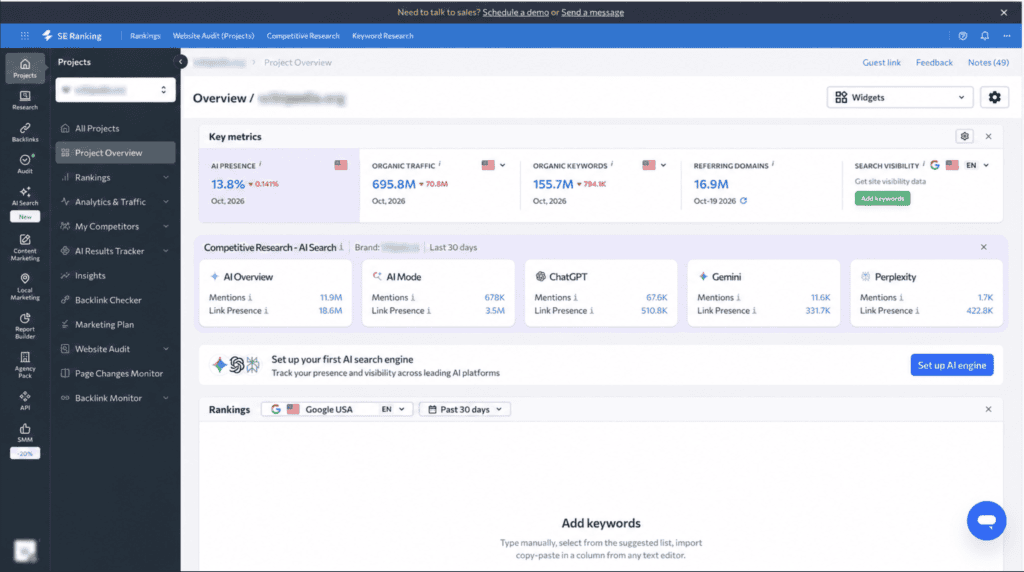
If I were choosing software to handle both everyday SEO work and AI visibility monitoring, SE Ranking would be one of my first options.
Here’s why.
Monitoring ChatGPT mentions can be useful, but most website owners also need to research keywords, improve technical SEO, examine competitors, and monitor traditional search rankings.
SE Ranking brings these activities into one platform.
That makes it particularly relevant for website owners who don’t want to manage several separate subscriptions.
Key AI visibility features
Depending on the subscription and AI search functionality enabled, SE Ranking can help with:
- Monitoring brand visibility across supported AI platforms.
- Tracking relevant prompts.
- Identifying website citations.
- Comparing competitors in AI search.
- Researching visibility changes over time.
- Connecting AI monitoring with conventional SEO tasks.
Alongside these features, its core SEO platform includes keyword rank tracking, competitor research, website auditing, and backlink analysis.
SE Ranking pricing
SE Ranking offers several subscription options. AI search functionality and expanded tracking allowances depend on the chosen plan and any applicable add-ons.
The optional AI Search Add-on has been advertised from approximately $71.20/month with annual billing, but this does not necessarily represent the total subscription cost.
Before buying, I would check the current plan limits, included prompts, and combined monthly expense.
SE Ranking Official Pricing and AI Search Features
What I like
- Combines AI search monitoring with traditional SEO.
- Useful for diagnosing technical and content issues.
- Offers competitive research beyond AI mentions.
- Could reduce the need for several separate SEO subscriptions.
What I would improve or watch out for
- The overall subscription can be expensive for a small website.
- Beginners may not need every available feature.
- Expanded AI monitoring can increase the total price.
- Prompt allowances need to be compared carefully.
Who should choose SE Ranking?
I’d recommend considering SE Ranking if you’re already managing SEO campaigns and need keyword tracking, competitor analysis, audits, and AI visibility research in one place.
For someone who only wants to check a handful of ChatGPT mentions each month, a smaller dedicated product may be more economical.
My verdict: SE Ranking is a strong all-in-one candidate, particularly when traditional SEO remains your main priority.
Check SE Ranking Plans and Features
2. Semrush AI Visibility Toolkit: Best for AI Competitor Research
Best for: SEO professionals, established businesses, and marketing teams investing in AI search analysis.
Explore Semrush AI Visibility Toolkit
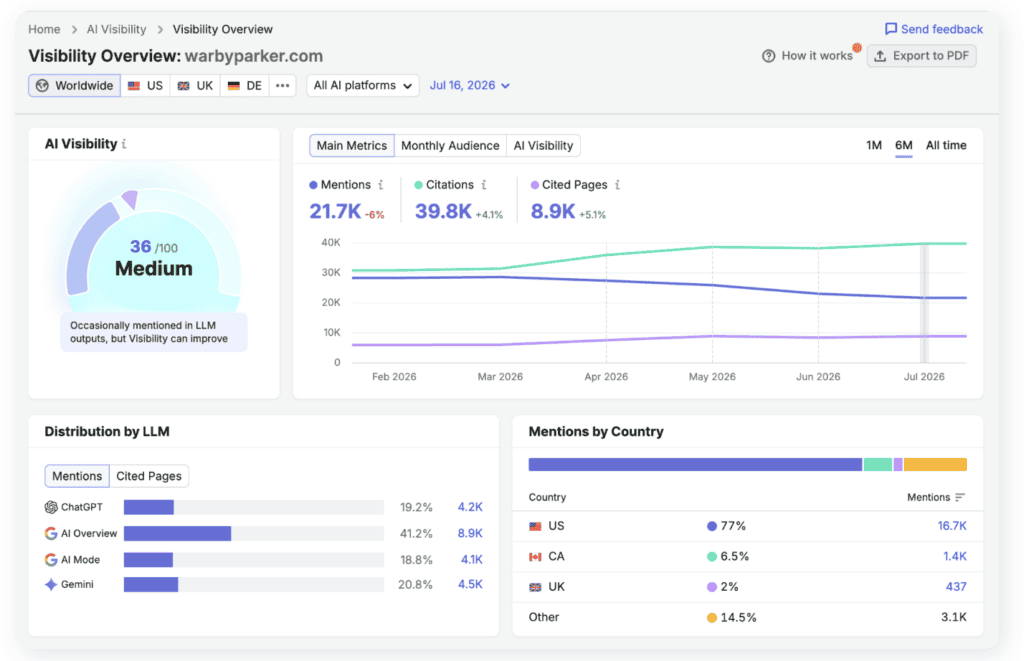
Semrush has long been associated with SEO research, and its AI visibility functionality extends that research into AI-generated search experiences.
What interests me most is its competitive intelligence.
Knowing that your brand appears in an AI answer is helpful. But understanding which competitors appear more frequently, which topics they dominate, and where your brand is missing can be more actionable.
For example, imagine you’re promoting an online project management tool.
You could monitor prompts about remote teams, productivity software, or task management and examine which competitors get recommended.
That provides another perspective on your market.
Key features
The AI Visibility Toolkit includes:
- Brand visibility and AI search analysis.
- Competitor visibility research.
- Prompt research and daily tracking.
- Brand performance analysis.
- AI search readiness checks.
- Monitoring across supported AI search experiences.
Semrush pricing
Semrush’s AI Visibility Base plan is advertised at $99/month per domain when billed annually.
The published configuration includes:
- 25 custom tracked prompts.
- One domain for brand performance analysis.
- Competitive and prompt research features.
- AI search readiness auditing.
Additional Semrush SEO subscriptions and other toolkits should not be assumed to be included.
Semrush AI Visibility Pricing and Plan Details
What I like
- Strong competitor-oriented research.
- Relevant prompt discovery capabilities.
- Integrates AI visibility into a broader marketing ecosystem.
- Useful when an organization already relies on Semrush products.
Potential drawbacks
- $99/month can be significant for a small publisher.
- The entry plan limits custom tracking to 25 prompts.
- Other Semrush capabilities may require additional purchases.
Who should choose Semrush?
I’d consider Semrush if I needed to investigate how a brand compares against several competitors and already had a clear plan for using the data.
I wouldn’t subscribe purely because I was curious whether ChatGPT mentions my website.
My verdict: A compelling option for structured competitive analysis, but the value depends on how regularly you use its research.
View Semrush AI Visibility Toolkit
3. Otterly.AI: Best Affordable AI Visibility Tracker for Beginners
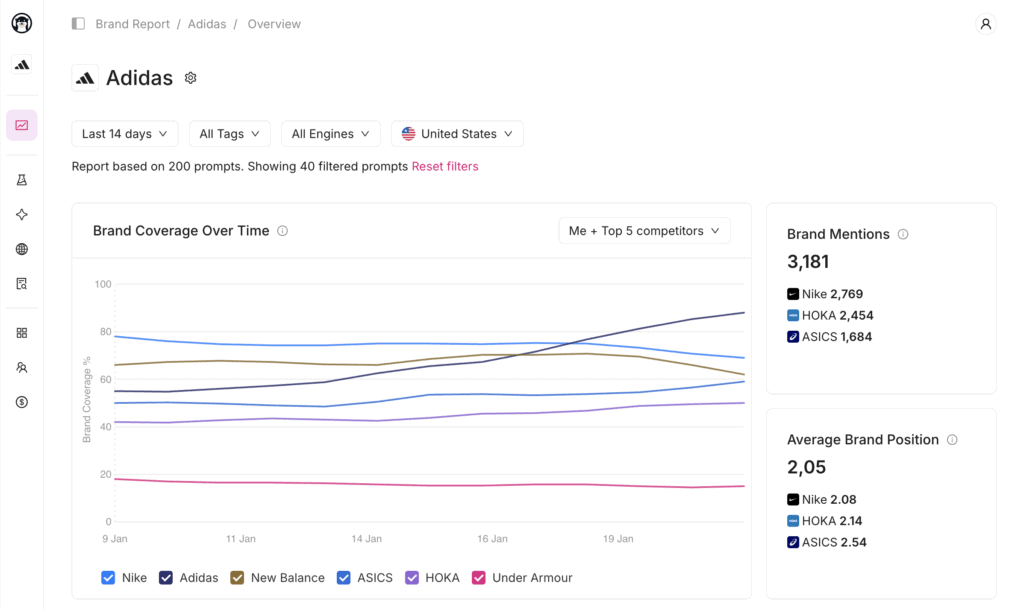
Best for: Independent bloggers, small businesses, and marketers starting with AI search monitoring.
This is the tool I’d investigate first if I wanted to monitor AI search visibility without immediately paying for a large SEO platform.
Otterly.AI focuses specifically on how brands and websites appear in AI-generated answers.
That narrower focus may be enough for smaller websites.
For example, if you already use Google Search Console and free SEO tools, you might not need another full SEO suite just to monitor AI citations.
Key features
Otterly.AI provides:
- Brand mention tracking.
- AI citation monitoring.
- Daily prompt tracking.
- Competitor comparisons.
- Visibility reporting.
- Monitoring across several AI search platforms.
Otterly.AI pricing
Its Lite subscription currently starts at $29/month and includes 15 search prompts.
The core supported engines include:
- ChatGPT.
- Google AI Overviews.
- Perplexity.
- Microsoft Copilot.
Additional engines such as Gemini, Claude, and Google AI Mode are offered through separate add-ons.
Its Standard subscription starts at $189/month with 100 prompts, while Premium starts at $489/month with 400 prompts.
What I like
- Relatively low starting price.
- Dedicated AI monitoring.
- Daily tracking.
- Useful for a controlled, small-scale monitoring project.
Limitations
- Fifteen prompts may not cover a large website.
- Some AI search engines cost extra.
- Higher-tier subscriptions are significantly more expensive.
- It isn’t a replacement for comprehensive SEO research.
Who should choose Otterly.AI?
If you’re running a small website and mainly want to know whether your brand gets mentioned in ChatGPT or cited in Google AI Overviews, the Lite plan may be sufficient.
I’d begin with a carefully selected group of important questions before paying for more prompts.
My verdict: Otterly.AI offers an accessible entry point, provided that its platform coverage and prompt limits meet your needs.
4. Peec AI: Best for Marketing Teams and Agencies
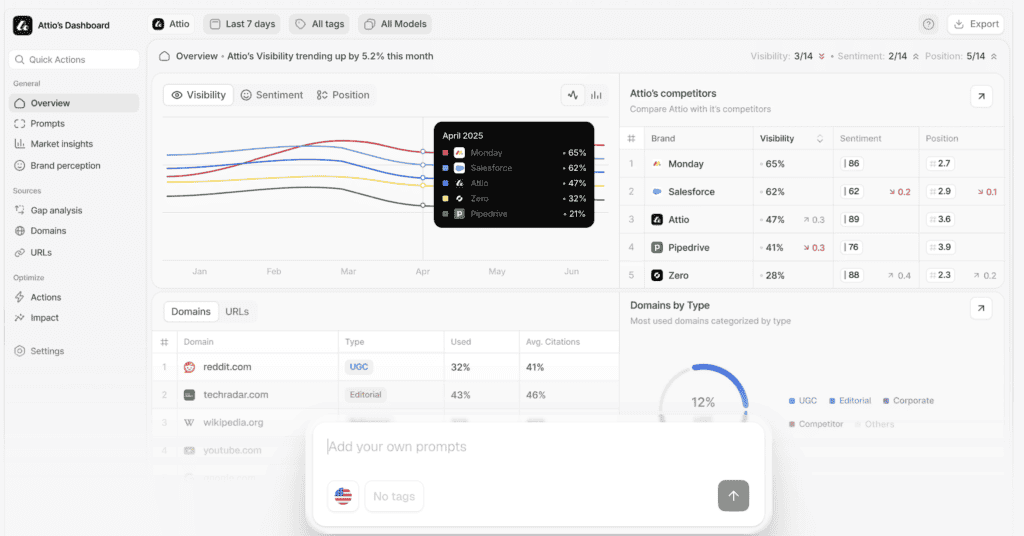
Best for: SEO agencies, content teams, and companies that want ongoing AI search reports.
Peec AI takes a more specialized approach to AI visibility tracking.
Its focus is on helping marketing teams understand where a brand appears across AI search systems and how that presence changes over time.
For an agency managing several clients, consistent reports and competitor comparisons can be especially useful.
Key features
Peec AI offers:
- AI brand visibility monitoring.
- Competitor comparisons.
- Prompt-level tracking.
- Share-of-voice analysis.
- Daily AI search reporting.
- Multiple project and team options.
- Additional AI models depending on the plan.
Peec AI pricing
Its Starter plan has been advertised at approximately $95/month, including 50 prompts, three selected AI models, daily tracking, unlimited users, and one project.
Higher tiers offer additional prompts and project capacity.
However, because prices and available models can change, I recommend confirming the displayed amount at checkout.
Peec AI Pricing and Included Features
What I like
- Focused AI visibility reporting.
- Daily monitoring.
- Multiple team members.
- Useful for structured agency workflows.
Potential drawbacks
- Higher starting cost than Otterly.AI’s Lite plan.
- Model and prompt limits still apply.
- It doesn’t replace broader technical SEO software.
Who should choose Peec AI?
I’d shortlist Peec AI if I were reporting AI search performance to clients or managing multiple marketing initiatives.
For a small personal website, I’d first decide whether that reporting depth is worth the expense.
My verdict: Particularly relevant for collaborative marketing teams and agencies.
5. Profound — Best for Advanced AI Search Intelligence
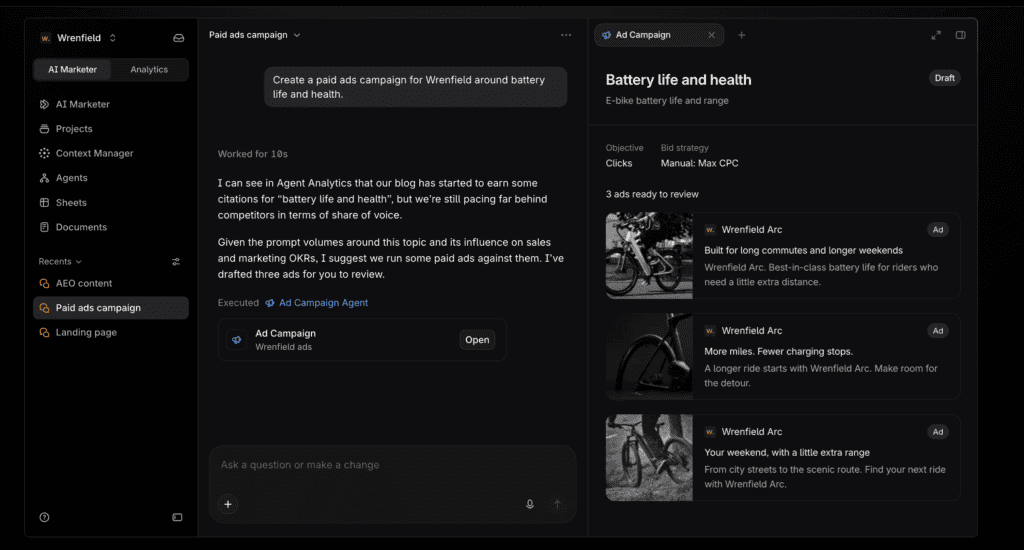
Best for: Established brands, advanced marketing teams, and organizations building extensive AI search workflows.
Profound approaches AI search visibility as part of a broader marketing intelligence problem.
Rather than concentrating only on the number of times a brand appears, the platform also offers tools and workflows designed to help teams interpret AI search data and act on it.
That’s useful for organizations managing large amounts of content, multiple products, or complex competitive markets.
Key features
Depending on the subscription, Profound offers:
- AI search visibility research.
- Competitor and citation analysis.
- Prompt monitoring.
- Analytics across supported AI systems.
- Automated or agent-based marketing workflows.
- Enterprise-level capabilities and integrations.
Profound pricing
Profound offers different subscription categories, including self-service and enterprise options.
Its advanced AI agent functionality uses credits, with different allowances depending on the plan.
Enterprise requirements may involve customized pricing.
Rather than quoting a single entry price that could misrepresent the available features, I’d recommend checking the current plan that includes your required tracking capacity.
Profound Official Plans and Pricing
What I like
- Advanced AI search analytics.
- Broader marketing intelligence functionality.
- Useful for teams that need scalable workflows.
- Relevant to organizations treating AI search as a major marketing channel.
Potential drawbacks
- More complex than beginner-focused tools.
- Some functions depend on plan limits or credits.
- Enterprise-oriented capabilities may be unnecessary for smaller sites.
Who should choose Profound?
I’d evaluate Profound if AI search visibility had become a significant part of an established company’s marketing operations.
For a small affiliate blog, I’d usually begin with a simpler tool.
My verdict: Worth considering for advanced and enterprise-level AI visibility requirements.
Explore Profound’s AI Visibility Platform.
Which AI Visibility Tool Offers the Best Value?
Here’s where I would separate the five products.
| Your situation | My shortlist | Main reason |
|---|---|---|
| Small blog with a limited budget | Otterly.AI | Lower starting cost |
| Website needing traditional SEO as well | SE Ranking | Broad SEO functionality |
| Established business analyzing competitors | Semrush | Competitive intelligence |
| Agency preparing client reports | Peec AI | Dedicated tracking and reporting |
| Large brand with complex requirements | Profound | Scalable analytics and workflows |
The best AI visibility tracking tools aren’t necessarily the most expensive. For smaller websites, affordable monitoring and useful reporting can be more valuable than advanced features you rarely use.
The cheapest option isn’t always the best value
Otterly.AI starts at $29/month with 15 prompts.
Semrush starts at $99/month with 25 tracked prompts.
Peec AI’s Starter plan includes 50 prompts.
Those differences matter, but they don’t tell the entire story.
A prompt monitored across several AI models may generate multiple tracked answers. Some providers charge for additional engines, while others bundle a limited selection of models.
I would compare the full monthly price for the same intended monitoring workflow rather than looking only at the advertised starting price.
That includes tracking frequency, model coverage, reporting, geography, and additional fees.
A Practical Example: Tracking AI Visibility for an SEO Website
Let’s imagine I want to understand how an SEO tools website appears in AI-generated search results.
I wouldn’t start by monitoring 200 random prompts.
Instead, I’d identify the main categories covered by the website.
For MasterSEOTool, those could include keyword research, technical SEO, indexing, and website optimization.
Step 1: Choose 10 important prompts
Here is an example tracking list:
| Category | Example AI search prompt |
|---|---|
| SEO tools | What are the best free SEO tools for beginners? |
| Keyword research | Which tools help find low-competition keywords? |
| Technical SEO | How can I check a website for SEO errors? |
| Indexing | How do I know whether Google indexed my page? |
| Backlinks | What tools can analyze a website’s backlinks? |
| Blog SEO | How can I improve a new blog’s SEO? |
| AI SEO | Which tools track website mentions in ChatGPT? |
| Site structure | How can I improve internal linking? |
| SEO audits | What should a basic SEO audit include? |
| Affiliate SEO | Which SEO tools are best for affiliate bloggers? |
These prompts are examples, not verified high-volume searches.
For better organization, I’d group similar topics together before tracking them.
My AI Keyword Clustering in SEO guide explains how to organize related search questions without creating unnecessary overlap between pages.
Step 2: Monitor brand mentions and citations
Once the prompts are configured, I’d establish a baseline.
The important questions would be:
Does the brand appear?
Does the AI cite the website?
Which competitors are mentioned?
What type of content receives attention?
I’d track the same prompts consistently rather than changing them after every report.
Step 3: Investigate missing visibility
Suppose competitors consistently appear when someone asks about free SEO audit tools, but my website doesn’t.
I would first review the relevant content.
Is the page indexed? Is the information useful? Does it explain the topic clearly? Can search crawlers access it?
I would use my Google Index Checker to investigate conventional Google indexing as one part of that process.
For more complex accessibility issues, I’ve also explained the principles in AI Crawl Optimization.
Google indexing and AI visibility aren’t identical, and I wouldn’t assume that being indexed guarantees inclusion in an AI-generated response.
Step 4: Improve the existing pages
Before writing another article, I’d look at what could be improved.
That might include clearer explanations, stronger examples, original comparisons, updated sources, and useful internal links.
For a page that’s already ranking, I’d also check its position using the Keyword Position Checker.
If the content is relevant but technically weak, I’d investigate its metadata with the Meta Tags Analyzer.
These tools don’t directly measure LLM mentions, but they help review the website’s SEO foundation.
Step 5: Compare results over time
After making meaningful improvements, I’d monitor whether visibility changes across multiple checks.
A single AI response isn’t enough to prove progress.
I’d look for repeated patterns and then compare them with Google Search Console and website analytics.
That’s how I’d avoid mistaking a temporary AI mention for measurable business growth.
How to Track AI Visibility Without Paying for Expensive Software
If your website is new or your budget is limited, you don’t necessarily need a paid AI visibility tracker immediately.
There are a few things you can do manually.
1. Test relevant questions directly
Open ChatGPT, Perplexity, or another AI search interface and ask questions related to your website.
Check whether the response names your business or cites your pages.
Record the exact prompt, platform, date, and observations.
Remember that personal settings, model versions, and repeated runs may produce different results.
2. Record your observations
You can begin with a simple spreadsheet.
| Date | Platform | Prompt | Brand mentioned? | Website cited? |
|---|---|---|---|---|
| Example date | ChatGPT | Best free SEO tools? | Yes/No | Yes/No |
| Example date | Perplexity | Keyword research tools? | Yes/No | Yes/No |
| Example date | Google AI | Technical SEO audit tools? | Yes/No | Yes/No |
This is an illustrative template, not actual testing data.
It won’t match the scale or automation of a paid product, but it can help establish the questions you need answered.
3. Check your existing SEO performance
AI visibility doesn’t eliminate the value of traditional SEO.
Use Google Search Console to review impressions, clicks, and indexing coverage.
You can also compare ordinary keyword rankings with the Keyword Position Checker.
If you notice that important pages are indexed but aren’t generating impressions, read Page Indexed but No Impressions.
4. Review competing websites
Look at the sources repeatedly mentioned in AI answers.
What makes them useful?
Are they publishing original studies, clear comparisons, specialized guides, or updated information?
You can investigate backlinks using the Backlink Checker, while keeping in mind that backlink counts alone do not explain why an AI system cited a particular source.
When should you upgrade to a paid tracker?
I’d consider a subscription when manual checking starts taking too much time or when I need consistent reporting across more prompts, platforms, and competitors.
If you’re still fixing basic indexing issues, it’s reasonable to prioritize those first.
Five Mistakes to Avoid When Tracking AI Search Rankings
AI visibility monitoring is useful, but there are several mistakes I’d avoid.
Mistake 1: Treating every AI mention as traffic
A brand can appear in an AI answer without earning a website visit.
Always distinguish mentions, citations, referrals, and conversions.
Mistake 2: Tracking irrelevant prompts
If your business sells SEO tools, tracking hundreds of unrelated marketing questions won’t necessarily help.
I’d rather monitor 20 commercially relevant prompts than 200 irrelevant ones.
Mistake 3: Ignoring traditional SEO
AI search optimization doesn’t remove the need for a technically accessible, useful website.
For a broader optimization framework, see Google AI Search Optimization Guide.
Mistake 4: Assuming one AI result represents everyone
AI-generated answers can change across regions, models, sessions, and time.
Repeated monitoring provides a better picture than a single screenshot.
Mistake 5: Paying for features you don’t use
A platform may offer hundreds of prompts, advanced exports, and automated reporting.
But if you only need 10 questions monitored once a week, paying for all those capabilities may be unnecessary.
Choose your software according to the work it actually helps you perform.
AI Visibility Tracking vs Traditional SEO: Do You Need Both?
In my view, these two types of tracking should complement each other.
Traditional SEO tools help answer questions such as:
- Where does my page rank on Google?
- Which keywords generate impressions?
- Does my website have technical SEO issues?
- Which websites link to my competitors?
- Are important pages indexed?
AI visibility tools focus on different questions:
- Does ChatGPT mention my brand?
- Which websites appear as citations?
- Are my competitors recommended more frequently?
- Which prompts include my business?
- How is my AI visibility changing?
A platform combining both categories may be valuable for some businesses.
Others may prefer free SEO tools and an inexpensive dedicated AI tracker.
To understand how these approaches work together, see AI SEO Tracking Tools vs Traditional SEO Tools.
Frequently Asked Questions About AI Visibility Tracking Tools
What are the best AI visibility tracking tools in 2026?
SE Ranking, Semrush AI Visibility Toolkit, Otterly.AI, Peec AI, and Profound are five platforms worth comparing. The best choice depends on your budget, required AI platforms, prompt limits, and whether you also need traditional SEO capabilities.
Can I check if my website appears in ChatGPT?
Yes. You can test relevant questions manually or use AI visibility monitoring software to track selected prompts. The results represent the monitored questions and platform conditions, not every possible ChatGPT response.
Can AI visibility tracking improve my Google rankings?
Not directly. Tracking software measures visibility and helps identify opportunities. Ranking improvements require meaningful changes to content, website quality, technical SEO, and other relevant factors.
What is the difference between AI citation tracking and ChatGPT rank tracking?
AI citation tracking examines whether a website is referenced as a source. ChatGPT rank tracking generally measures where a brand or product appears within monitored answers. These are related but different signals.
Are there free AI visibility tracking tools?
Some vendors offer free trials or limited functionality. You can also run manual checks using AI search interfaces, although that won’t provide the same scale or consistency as automated monitoring.
Is GEO replacing traditional SEO?
No. GEO adds another dimension to digital discoverability. Conventional SEO still matters for search engine visibility, website accessibility, content organization, and traffic acquisition.
How often should I monitor AI search visibility?
That depends on how frequently your market changes and how actively you publish content. Daily automated tracking can be useful for marketing teams, while smaller websites may begin with less frequent checks.
Do AI visibility tools guarantee more traffic or sales?
No. They provide data about monitored AI-generated answers. Whether that visibility creates clicks, leads, or sales depends on user behavior and the website’s ability to convert visitors.
Final Verdict: Which AI Visibility Tracking Tool Would I Choose?
After comparing these five platforms, I don’t think there’s a single product that every website owner should buy.
Each tool serves a somewhat different audience.
SE Ranking would be on my shortlist when traditional SEO and AI visibility need to work together.
Otterly.AI is where I’d start looking for lower-cost, dedicated AI search monitoring.
Semrush makes sense when competitor analysis and structured marketing research matter most.
Peec AI deserves consideration for teams that need consistent AI visibility reporting.
Profound is more suitable for organizations exploring advanced AI search intelligence and larger-scale workflows.
My main advice is to avoid purchasing software simply because AI search is a trending topic.
First decide what you want to measure.
Then identify the prompts that matter to your audience, calculate the cost of monitoring them, and choose a platform that helps you make useful decisions.
Choosing among the best AI visibility tracking tools depends on your website’s goals, available budget, and the AI platforms your audience uses most.
For website owners who also want to improve traditional SEO, I’d begin by reviewing the broader functionality offered by SE Ranking.
Explore SE Ranking — SEO and AI Visibility Tools
And if you’re still working on your website’s fundamentals, you can start with the Free SEO Tools at MasterSEOTool before adding another paid subscription.
The goal isn’t to collect more dashboards. It’s to understand where your website is visible, where it isn’t, and what you can realistically do to improve it.
Research Sources and Pricing References
The following official resources were used to check product functionality, subscription limitations, and available features:
- SE Ranking Official Pricing and AI Search Documentation
- Semrush AI Visibility Toolkit Pricing
- Otterly.AI Pricing and Platform Coverage
- Peec AI Plans and Tracking Features
- Profound Pricing and Product Documentation
- Google Search Central — Writing High-Quality Reviews
Last researched: October 19, 2026. Product prices and available features may change. Confirm the latest plan details with the provider before purchasing.