

Most SEO problems don’t start with traffic.
They start with structure.
You can publish 50 articles and still struggle to rank if those articles compete with each other.
That’s the hidden issue most site owners miss.
They assume they need more content.
What they actually need is cleaner architecture.
That’s where AI keyword clustering changes everything.
In 2026, Google doesn’t reward pages that repeat similar keywords.
It rewards pages that satisfy a clear search intent within a structured topic ecosystem.
If your site lacks that structure, optimization tweaks won’t save it.
Let’s break this down properly.
What Is AI Keyword Clustering?
AI keyword clustering is the process of using artificial intelligence to group related search queries based on shared search intent, semantic similarity, and overlapping search results so they can be targeted within a structured content framework.
Instead of creating one page per keyword variation, AI keyword clustering identifies which keywords belong together and which deserve separate supporting pages.
It shifts SEO from “keyword targeting” to “intent structuring.”
That shift is what improves authority and reduces internal competition.
Why AI Keyword Clustering Matters Now
Search engines have evolved.
They interpret meaning, context, and relationships between topics.
Publishing slight variations of the same query across multiple pages no longer strengthens visibility.
It weakens it.
As outlined in Google’s official helpful content documentation, search systems prioritize structured, intent-aligned content rather than fragmented pages targeting similar variations.
When you use AI keyword clustering, you:
- Prevent keyword cannibalization
- Consolidate authority signals
- Clarify page intent
- Improve internal linking logic
- Build topical depth intentionally
If you’ve studied authority models like What Is Topical Authority in SEO (2026), you already know structure compounds over time. Clustering is how you create that structure deliberately.
Without clustering, authority gets diluted.
The Cannibalization Problem Most Sites Ignore
Let’s be direct.
Imagine you publish:
- best ai seo tools
- ai seo software
- top ai tools for seo
- ai tools comparison
Four pages. Same intent.
Google now has to decide which one to rank. Sometimes it rotates them. Sometimes it suppresses all. Rankings become unstable.
This is structural cannibalization.
AI keyword clustering detects this overlap early by analyzing SERP similarity. If ranking results heavily overlap, those keywords should not live on separate pages.
Consolidation strengthens ranking power.
Fragmentation weakens it.
How AI Keyword Clustering Actually Works
There is no magic.
It relies on three primary signals.
1. SERP Overlap
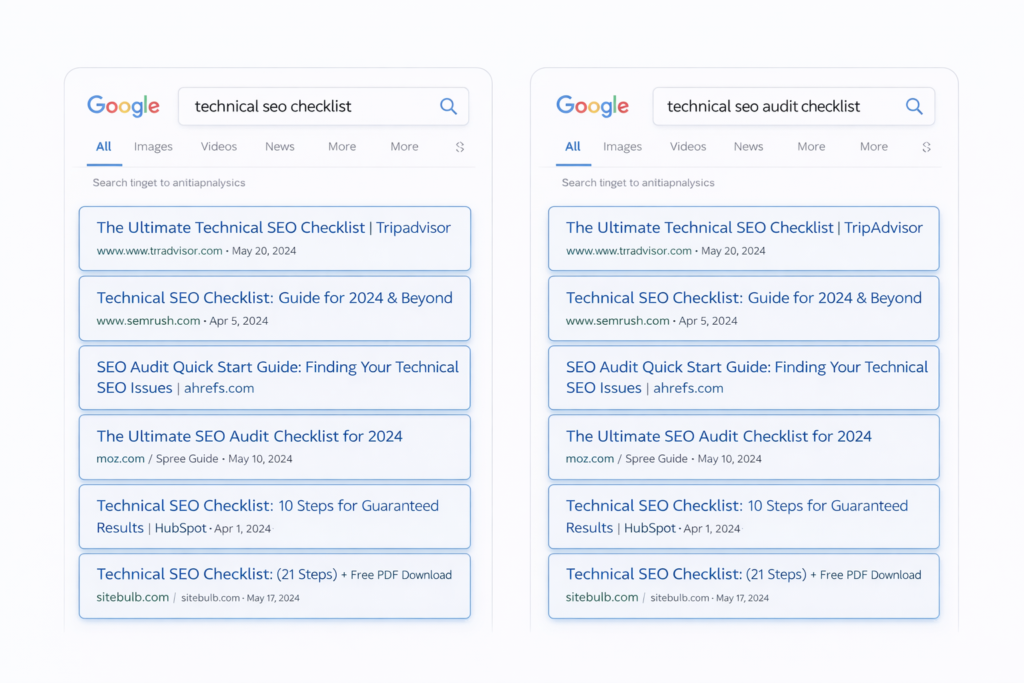
If two keywords return similar ranking pages, they likely share intent. AI analyzes these overlaps at scale.
Example:
“technical seo checklist”
“technical seo audit checklist”
If most ranking URLs match, they belong in the same cluster.
2. Semantic Similarity
AI models analyze contextual meaning.
“seo automation tools”
“tools that automate seo”
Different wording. Same topic.
Manual grouping often misses this.
3. Intent Classification
Every keyword falls into an intent category:
- Informational
- Commercial
- Transactional
Mixing these within one page reduces clarity. AI keyword clustering separates them correctly.
AI Keyword Clustering vs Manual Grouping
Manual clustering works for small lists.
It fails at scale.
| Criteria | Manual Keyword Grouping | AI Keyword Clustering |
|---|---|---|
| Grouping Method | Spreadsheet-based sorting | SERP overlap + semantic analysis |
| Decision Basis | Subjective judgment | Data-driven pattern recognition |
| Scalability | Limited datasets | Handles thousands of keywords |
| Time Efficiency | Slow | Automated and fast |
| Cannibalization Risk | High | Reduced |
| Intent Separation | Often mixed | Structured |
| Entity Reinforcement | Weak | Strong |
| Long-Term Stability | Inconsistent | Structured growth |
Modern SEO requires precision. Guessing is not a strategy.
If you’re analyzing broader automation systems, review AI SEO Tracking Tools vs Traditional SEO Tools for structural context.
AI Keyword Clustering and Entity Reinforcement
Here’s where it gets deeper.
Search engines evaluate entities — concepts and relationships.
When you scatter similar keyword variations across multiple URLs, you fragment entity signals. When you consolidate them using AI keyword clustering, you strengthen the central entity.
Example:
Instead of four weak pages around “AI SEO tools,” one strong page accumulates all relevance signals. Supporting pages reinforce it instead of competing.
Entity reinforcement improves topical authority perception.
Structure matters more than volume.
Topic Clusters vs Random Publishing
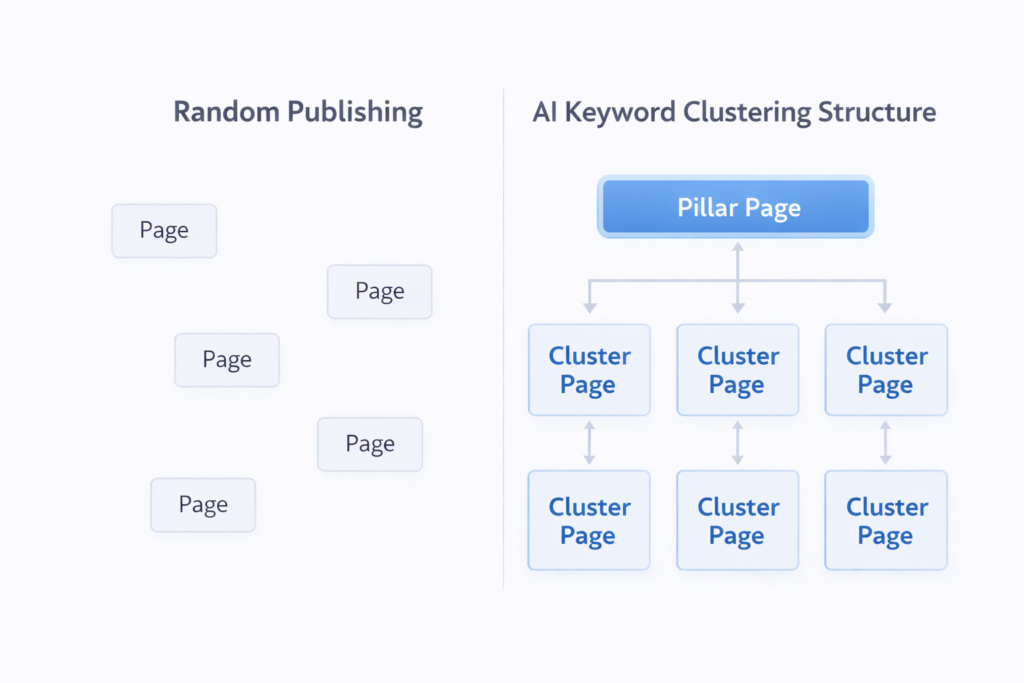
Random publishing creates content noise.
Cluster-based publishing creates ecosystems.
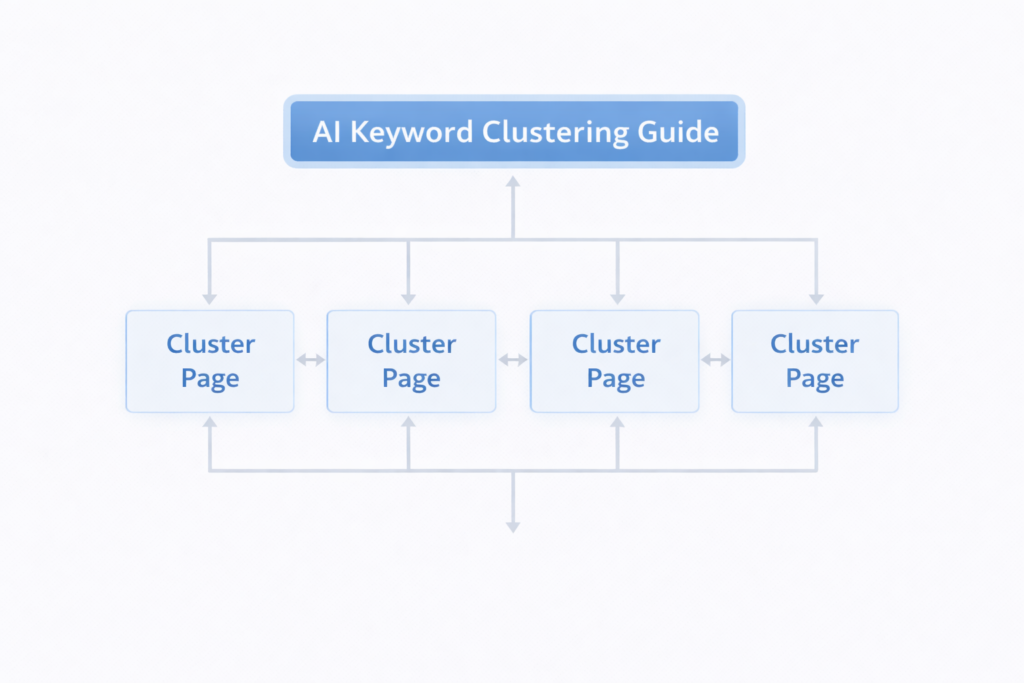
A clean structure looks like this:
Pillar Page → Core topic
Cluster Pages → Intent-specific subtopics
Internal Links → Reinforcement loops
If you build affiliate-driven structures, study Keyword Cluster Ideas for Affiliate Sites and observe how clustering improves monetization clarity.
Publishing randomly increases output.
Clustering increases authority.
The Relationship Between Clustering and Crawl Efficiency
This part is overlooked.
When pages overlap excessively:
- Crawl signals conflict
- Ranking signals split
- Search engines reassess similar URLs repeatedly
With proper AI keyword clustering:
- Each page has defined intent
- Internal linking becomes intentional
- Crawl paths become cleaner
Pair clustering with tools like XML Sitemap Generator and Link Analyzer Tool to validate structure.
Technical clarity strengthens cluster performance.
Realistic Implementation Process
Keep it simple.
- Export keyword dataset.
- Run AI keyword clustering analysis.
- Validate SERP overlap manually for edge cases.
- Separate clusters by intent.
- Map clusters to pillar architecture.
- Build internal links strategically.
If you want automation, use AI Keyword Cluster Ideas Tool to convert raw keyword exports into structured clusters quickly.
But remember:
Tools assist. Structure wins.
Common Mistakes With AI Keyword Clustering
Even strong systems fail when misapplied.
Mistake 1: Over-clustering unrelated topics.
Mistake 2: Creating too many micro-pages.
Mistake 3: Ignoring internal linking.
Mistake 4: Publishing without validating intent alignment.
AI keyword clustering is not about automation volume. It is about structural precision.
AI Keyword Clustering and Click Optimization
Structure builds rankings.
Clicks build traffic.
Once clusters are mapped:
- Write benefit-driven titles
- Avoid repeating identical patterns
- Align title with intent
To refine titles, generate structured variations using AI SEO Meta Title Generator.
Clustering positions you in SERPs. Click optimization pulls users in.
Both are required.
Is AI Keyword Clustering Mandatory?
No.
But scalable SEO without clustering becomes unstable.
Small sites benefit most because early structure prevents future cleanup. Large sites rely on it to manage scale.
If you are serious about building long-term authority, AI keyword clustering is not an optional discipline.
It is infrastructure.
Final Perspective
SEO in 2026 is not about producing more pages.
It is about organizing intent.
AI keyword clustering turns scattered keyword ideas into structured topic ecosystems. It prevents cannibalization, strengthens entity signals, and builds topical authority systematically.
If your rankings fluctuate without clear cause, your structure is likely weak.
If your structure is disciplined, growth compounds.
Infrastructure wins.
Clustering is infrastructure.
FAQs
What is AI keyword clustering?
AI keyword clustering groups related search queries based on shared search intent and SERP similarity. It helps structure content so similar keywords do not compete across multiple pages.
How does AI keyword clustering prevent cannibalization?
It identifies overlapping keywords and consolidates them into one structured page. This prevents multiple URLs from competing for the same search intent.
Is AI keyword clustering better than manual grouping?
Yes. AI keyword clustering uses SERP data and semantic analysis instead of spreadsheet-based judgment. This reduces structural errors at scale.
When should AI keyword clustering be used?
It should be used during content planning or restructuring. It is especially useful when scaling topic-based publishing.
Does Google require keyword clustering?
No. However, structured and intent-aligned content performs better in search results.