

Quick Answer
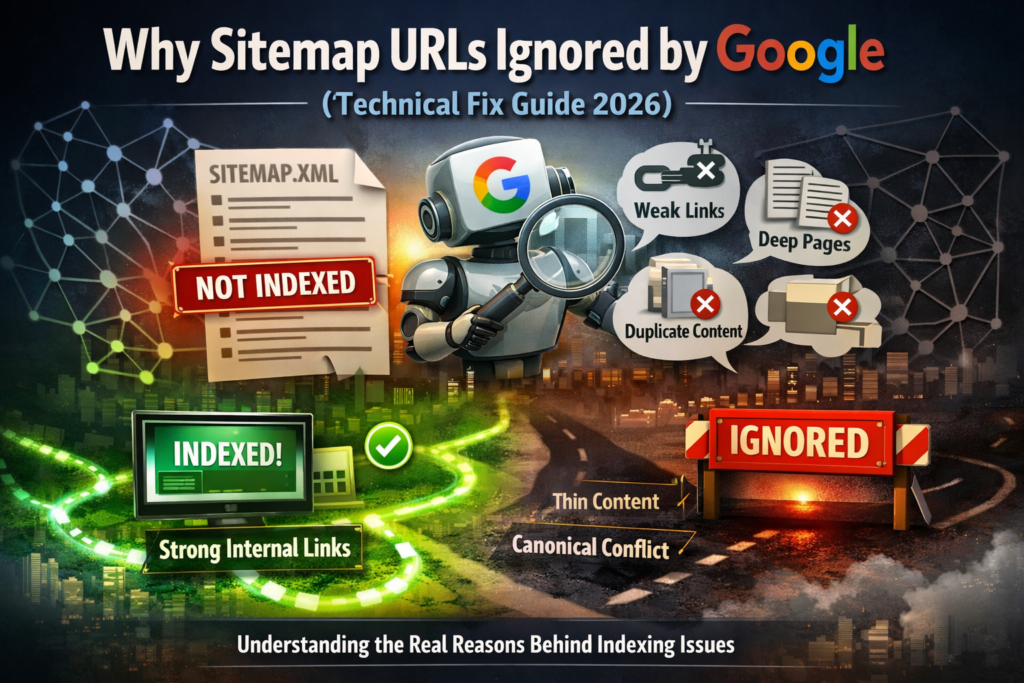
If you are trying to understand why sitemap URLs ignored by Google, the key point is this: a sitemap does not guarantee indexing.
A sitemap only tells Google that URLs exist.
Google still decides whether those pages deserve crawling and indexing based on stronger signals such as:
- internal linking strength
- crawl depth
- canonical consistency
- content value
- crawl demand
When these signals conflict with the sitemap, Google may treat the page as low priority, which results in sitemap URLs not indexed or submitted URL not indexed statuses.
Understanding why sitemap URLs ignored by Google requires analyzing how Google evaluates site structure and crawl signals rather than focusing only on the sitemap file.
Symptoms
When why sitemap URLs ignored by Google becomes a real indexing issue, it usually appears in Google Search Console through several recognizable patterns.
| Search Console Status | Meaning |
|---|---|
| Submitted but not indexed | Google discovered the page but decided not to index it |
| Crawled – currently not indexed | Page was crawled but not considered valuable enough |
| Discovered – currently not indexed | Google knows the page exists but hasn’t crawled it yet |
| Indexed but no impressions | Page indexed but receives very low ranking priority |
These signals often appear alongside other indexing issues such as indexed not submitted in sitemap issues and crawled currently not indexed problems.
When multiple sitemap URLs fall into these statuses, it usually indicates a structural SEO signal imbalance rather than a technical sitemap error.
Decision Block
Before diagnosing why sitemap URLs ignored by Google, it is useful to review the most common structural conditions that cause Google to ignore sitemap entries.
In most cases, ignored sitemap URLs share one or more of the following characteristics:
• The page receives very few internal links, making it weak within the crawl graph.
• The page is located deep in the site architecture (four or more clicks from the homepage).
• The page contains thin or low-value content, reducing indexing priority.
• The sitemap includes URLs that conflict with canonical signals.
• The page exists in the sitemap but is not connected through contextual internal links.
When these conditions appear together, Google may treat the page as low indexing priority, which explains why sitemap URLs ignored by Google becomes a recurring issue.
Search Engine Insight
Google does not index pages simply because they appear in a sitemap, which is why many websites experience discovered currently not indexed pages.
. The crawler first evaluates whether the page deserves crawl attention based on structural signals across the website.
When Google processes a sitemap, it compares the listed URLs with signals such as internal linking patterns, crawl depth, canonical directives, and overall page value. If those signals indicate that a page has low importance within the site structure, Google may delay crawling or skip indexing entirely.
This is why many websites experience situations where sitemap URLs are discovered but remain unindexed for long periods. The sitemap introduces the page to the crawler, but indexing priority is ultimately determined by how strongly the page is connected within the site’s crawl graph.
Understanding this interaction between sitemap discovery and structural signals is essential when diagnosing why sitemap URLs are ignored by Google.
Introduction
Submitting a sitemap is one of the most common technical SEO practices used to help search engines discover website pages faster.
However, many site owners assume that once URLs appear inside a sitemap, those pages will eventually be indexed by Google.
In practice, the situation is more complex.
During technical SEO audits, it is common to encounter websites where dozens of pages appear inside the sitemap but remain unindexed for extended periods.
Search Console may show statuses such as submitted URL not indexed, discovered currently not indexed, or crawled currently not indexed, even though the sitemap appears perfectly valid.
When this happens, the root cause is rarely the sitemap file itself.
Instead, the issue usually lies in the signals Google uses to evaluate page importance within the overall site architecture.
Understanding why sitemap URLs ignored by Google requires analyzing how Google prioritizes crawling and indexing based on structural signals across the website.
Causes
Google Behavior Toward Sitemaps
To understand why sitemap URLs ignored by Google, it is important to first understand how Google actually interprets sitemap files.
A sitemap helps search engines discover URLs more efficiently, particularly on larger websites.
However, according to Google sitemap documentation, sitemaps are treated as hints rather than directives.
This means that even if a page appears in the sitemap, Google still decides whether the page should be:
- crawled frequently
- indexed quickly
- ignored temporarily
Google compares sitemap URLs with signals from the website itself.
If the sitemap lists pages that are weakly connected or lack strong signals, the crawler may assign them lower priority.
Problem Explanation
Signal Conflict
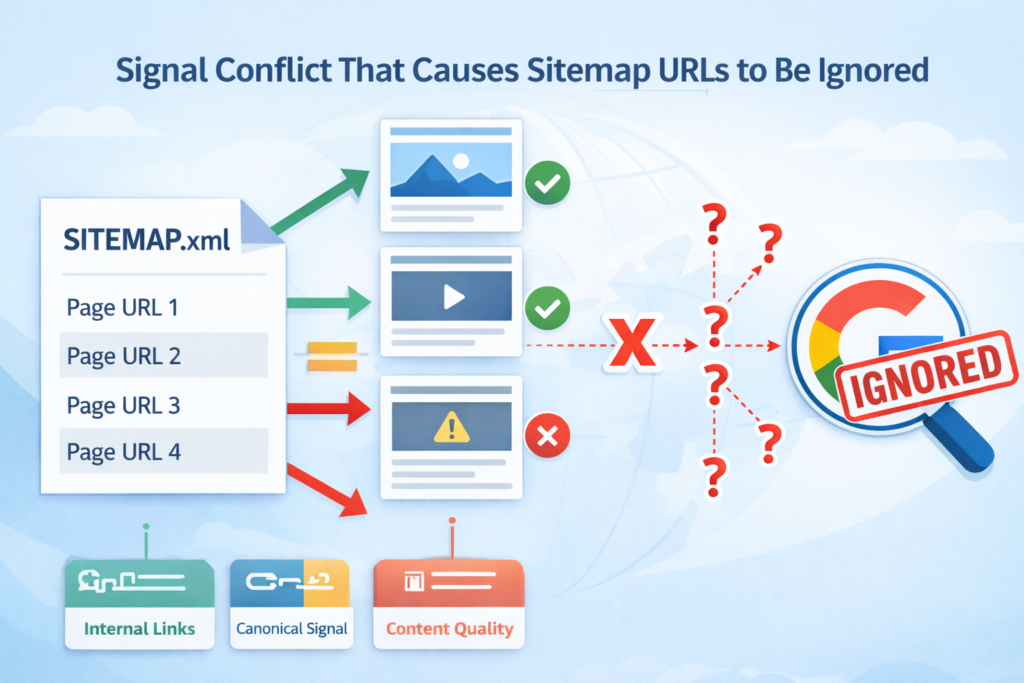
One of the most common reasons why sitemap URLs ignored by Google occurs is signal conflict.
The sitemap indicates that a page should be indexed, but other signals suggest otherwise.
| Signal Conflict | Impact |
|---|---|
| Weak internal linking | Page appears unimportant |
| Canonical mismatch | Google chooses a different URL |
| Deep crawl depth | Crawling frequency decreases |
| Duplicate or thin content | Page may be skipped |
These conflicts often appear together with canonical issues such as duplicate without user selected canonical problems.
When conflicting signals exist, Google typically prioritizes internal link signals and canonical directives over sitemap entries.
Real Scenario
During a technical SEO audit of a small content website with approximately 140 pages, the sitemap listed every article correctly.
However, only around 85 pages were indexed.
A deeper crawl analysis revealed that most non-indexed pages shared several characteristics:
- they received only one internal link
- they were located five clicks away from the homepage
- they contained relatively thin content
After improving internal linking and reducing crawl depth, Google began indexing the previously ignored pages within a few weeks.
The sitemap remained unchanged.
The improvement occurred because the structural signals of the website were strengthened.
Indexing Priority
Google assigns crawl priority based on site structure and link signals, which is part of how Google crawling and indexing works.
Pages located closer to the homepage and connected through multiple internal links receive stronger crawl demand.
| Page Type | Typical Crawl Priority |
|---|---|
| Homepage | Very High |
| Category pages | High |
| Core content pages | Medium |
| Deep pages | Low |
| Isolated pages | Very Low |
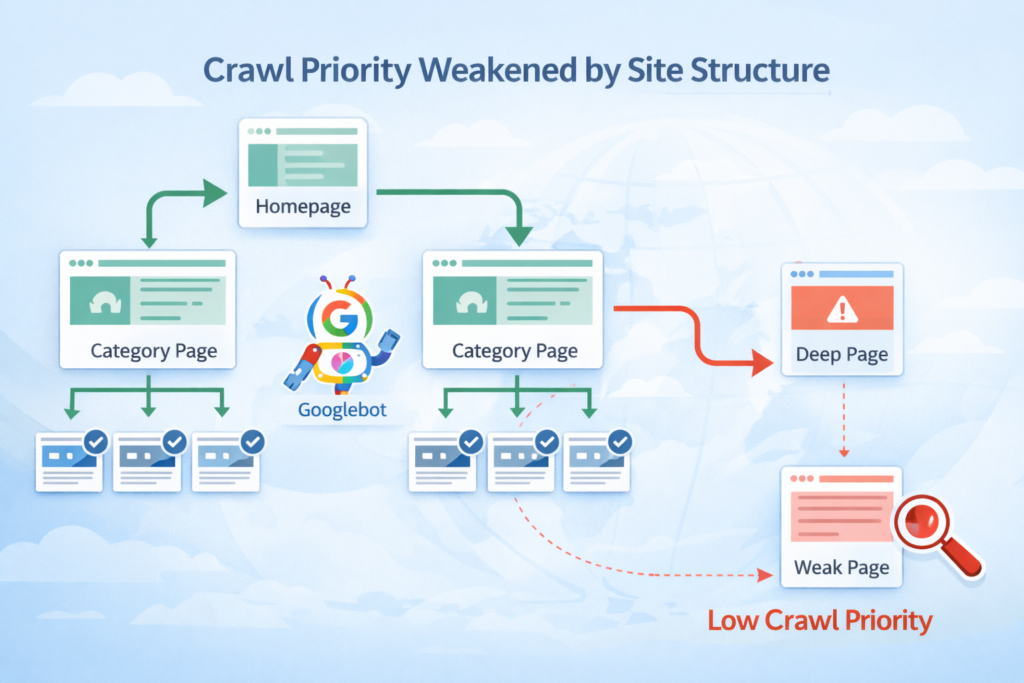
If a page appears only in the sitemap but lacks internal link support, Google may consider it a low discovery priority page.
This explains why sitemap indexing issues frequently appear together with problems like why pages are not indexed by Google.
Step-by-Step Fix Process
Solving why sitemap URLs ignored by Google requires strengthening the signals that influence crawling and indexing.
| Fix Action | Impact |
|---|---|
| Strengthen internal linking | High |
| Reduce crawl depth | High |
| Improve page content | Medium |
| Remove duplicate URLs | Medium |
Step 1 — Strengthen Internal Links
Important pages should receive links from multiple relevant sections of the website.
You can analyze internal link distribution using the internal link analyzer tool.
Step 2 — Validate Sitemap Quality
The sitemap should contain only:
- canonical URLs
- indexable pages
- high-value content
You can rebuild a clean sitemap using the XML sitemap generator.
Step 3 — Check Index Coverage
Before making structural changes, confirm which URLs are currently indexed.
The Google index checker helps identify pages missing from the index.
Step 4 — Simulate Googlebot Crawling
Testing how search engines view a page can reveal crawl accessibility problems.
Using a Googlebot crawl simulation tool allows you to verify that pages can be properly accessed by search engines.
Technical Insight
Google’s crawler builds a structure similar to a crawl graph.
Each page acts as a node, and internal links represent connections between those nodes.
Pages with strong connections receive higher crawl demand and more frequent indexing evaluation.
Pages that appear only inside the sitemap but lack internal link support often behave like isolated nodes within this crawl graph.
This structural imbalance is a primary reason why sitemap URLs ignored by Google appears across many websites.
The sitemap cannot override the crawl graph created by internal linking signals.
Key Takeaways
• A sitemap helps discover pages but does not guarantee indexing.
• Google may ignore sitemap URLs when internal linking signals are weak.
• Pages with high crawl depth receive lower crawl priority.
• Canonical conflicts or duplicate signals can cause sitemap URLs to be skipped.
• Improving internal linking and site structure usually resolves sitemap indexing issues.
FAQs
Why does Google ignore sitemap URLs even after submission?
Google treats sitemaps as discovery hints rather than indexing commands. If a page listed in the sitemap lacks strong internal links, contains thin content, or conflicts with canonical signals, Google may delay crawling or skip indexing entirely.
How long does it take Google to index sitemap URLs?
Indexing time varies depending on crawl demand, site authority, and internal linking strength. Pages that receive strong internal links and high crawl priority may be indexed within days, while weaker pages can remain unindexed for weeks.
Should every page on a website appear in the sitemap?
No. A sitemap should include only important, indexable pages. Listing low-value, duplicate, or thin pages can reduce crawl efficiency and cause Google to ignore multiple sitemap URLs.
Can internal linking affect sitemap indexing?
Yes. Internal links are one of the strongest signals Google uses to determine crawl priority. Pages that receive multiple contextual links are more likely to be crawled and indexed quickly.
What is the difference between discovered and crawled sitemap URLs?
Discovered pages are known to Google but have not yet been crawled. Crawled pages have been visited by Googlebot but may still be excluded from indexing if the page quality or signals are insufficient.
Strategic Takeaway
Understanding why sitemap URLs ignored by Google requires looking beyond the sitemap itself.
Google’s indexing systems evaluate page importance based on structural signals such as internal linking, crawl depth, canonical consistency, and overall content value.
When these signals are weak or conflicting, the sitemap alone cannot push a page into the index.
Improving site architecture, strengthening internal links, and ensuring each page delivers meaningful value will significantly increase the likelihood that sitemap URLs are crawled and indexed.
For most websites, resolving these structural signals leads to gradual but consistent improvements in indexing coverage and crawl efficiency.