

I added 20+ internal links to a page… and nothing changed.
No rankings. No impressions. No movement.
That’s when I realized something most SEO advice ignores:
Internal links are not automatically accepted as ranking signals.
This is why internal links not improving ranking is a more common problem than most SEO advice admits.
Many site owners assume internal linking is a direct ranking lever.
It is not.
I’ve seen pages with decent content, clean site structure, and multiple internal links stay frozen for weeks with no real movement. The links were there. The crawl path existed. The page was indexed. But rankings did not improve.
That is the part most SEO advice skips.
Internal links do not help just because they exist.
They help only when Google accepts them as valid ranking support.
If that validation does not happen, the links may still be crawled and understood, but they will not change visibility in any meaningful way.
Quick Answer
Internal links not improving ranking usually happens when Google crawls and understands the links, but does not treat them as strong ranking support because of weak source-page value, poor anchor-to-intent alignment, topical disconnect, or diluted internal signal flow. Internal links can strengthen pages that already fit the topic and deserve visibility, but they rarely rescue weak pages on their own.
This is the core reason internal links not improving ranking continues to affect many indexed pages.
Symptoms
This problem usually looks like this inside real data:
- page gets indexed but stays stuck around positions 35–90
- impressions remain low even after adding more internal links
- links are added from several pages but rankings do not move after 2–3 weeks
- pages get crawled more often but visibility does not grow
- anchor text changes produce little or no measurable improvement
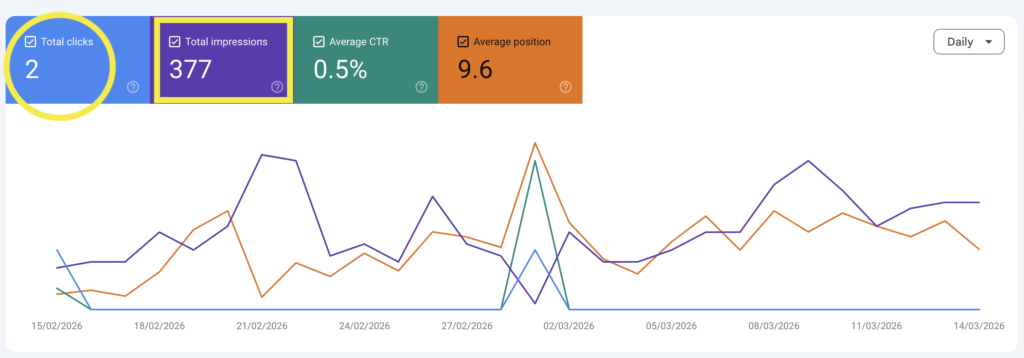
These patterns clearly indicate internal links not improving ranking despite proper crawl activity.
This is also why many site owners confuse crawling progress with ranking progress. A page can be discovered and still fail at the stage that actually matters. I see this often in pages related to why pages get indexed but receive no impressions, where indexing happens but search visibility never really starts.
Decision Block
| Situation | What It Usually Means | What You Need to Fix |
|---|---|---|
| Indexed but no visibility | evaluation weakness | page quality + signal alignment |
| Internal links added, no movement | link signal rejected | anchor intent + source page strength |
| Deep page still invisible | weak internal path | site structure + supporting links |
| Too many links on source pages | diluted signal | reduce noise + improve placement |
| Relevant topic but weak rankings | missing authority support | stronger contextual linking system |
AI Search Summary
- Internal links are evaluated, not rewarded automatically
- Google uses internal links to understand structure, relationship, and priority
- Internal links fail when anchor intent, source quality, and topic alignment do not match
- Adding more links often creates signal dilution, not ranking improvement
- Contextual links inside relevant content carry more weight than repeated structural links
- Internal links work best when they reinforce pages already supported by clear topical signals and useful content
When these signals are weak, internal links not improving ranking becomes the expected outcome, not an exception.
Expectation → What Most People Think Should Happen
Most SEO advice still pushes the same formula:
Add more internal links and rankings will improve.
That sounds logical, but in practice it fails all the time.
I tested this on pages that already had indexing, content, and some crawl activity. I added more internal links, used stronger anchors, and increased the number of supporting pages.
The result was nothing.
No meaningful jump. No stable growth. No real change in search visibility.
The ranking movement started only when I stopped treating internal linking as a quantity game and started treating it as a signal alignment system.
That is the real shift.
Internal links do not create authority from nothing.
They distribute and reinforce signals that already make sense.
If the page is weak, off-topic, or semantically disconnected from the source page, the link will not do much.
Why Internal Links Not Improving Ranking (Hidden Signal Conflict)
This is where internal links usually break.
A page can receive links from inside the site and still fail because the signals around the link do not agree with each other.
Here is a simple example:
- the target page is informational
- the anchor text sounds transactional
- the source page covers a loosely related subtopic
- the linked page itself is thin or poorly differentiated
To a site owner, that still looks like a relevant internal link.
To Google, it can look like a weak or inconsistent signal.
This is one of the main reasons internal links not improving ranking happens even when links look correct on the surface.
Google is not just reading the anchor. It is comparing:
- source page topic
- target page topic
- anchor meaning
- placement inside content
- overall value of both pages
- relationship inside the site’s topical structure
If those signals do not align, the link may be crawled and understood but carry very little ranking weight.
This is also why random internal linking across unrelated pages tends to underperform. It creates structure, but not meaningful reinforcement.
A similar filtering pattern appears when analyzing why backlinks get indexed but still have no ranking impact. In both cases, the signal exists, but it is not trusted enough to influence rankings.
Intent Mismatch
Even perfectly placed internal links fail when the page does not match the search intent.
Google does not rank pages because they are linked.
It ranks pages because they solve the query.
If your page is informational but the query is transactional, internal links will not fix that gap.
I’ve seen pages with strong internal linking structures stay invisible simply because they answered the wrong type of search intent.
Internal links can reinforce relevance.
They cannot replace it.
Internal Link Failure Patterns
| Failure Pattern | What Google Likely Sees | Outcome |
|---|---|---|
| vague or generic anchor | weak semantic clue | low impact |
| source page has no visibility | weak internal authority | minimal transfer |
| unrelated supporting page | topical disconnect | ignored or discounted |
| too many links on page | diluted importance | reduced value |
| footer/sidebar-heavy linking | weak contextual meaning | limited ranking effect |
Ranking Mechanism (What Google Actually Does)
Google does not rank pages better just because they received more internal links.
Google also explains that links must be crawlable and meaningful to pass value, as outlined in Google’s link guidelines.
What actually happens is closer to this:
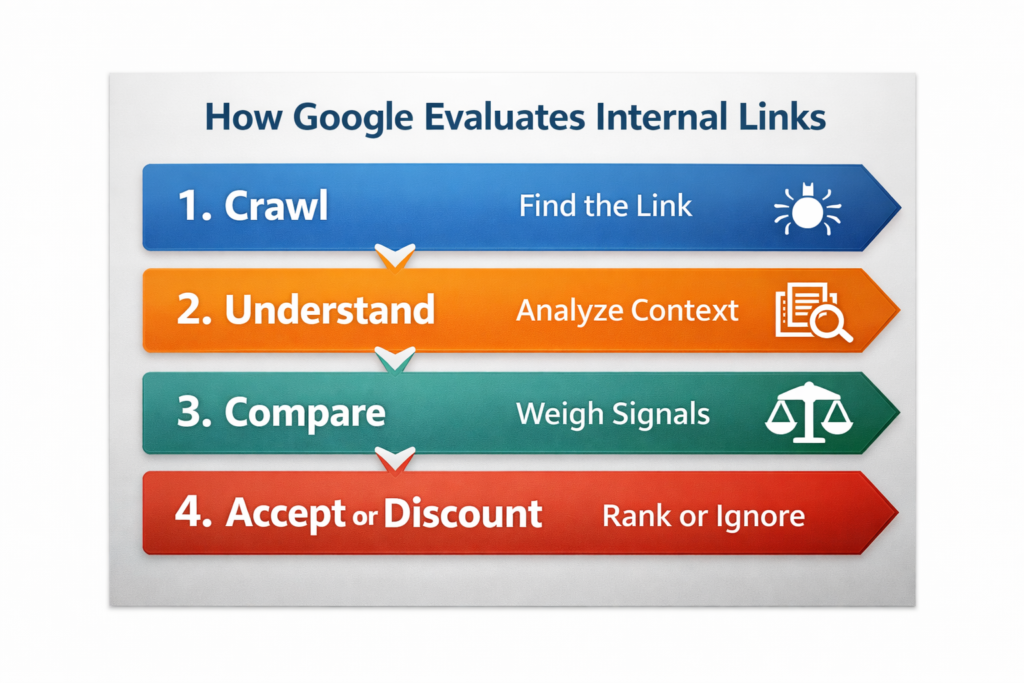
1. Crawl
Google discovers the link and reaches the target page more easily.
2. Understand
Google uses the anchor, surrounding text, and source page topic to interpret what the target page is about.
3. Compare
The link is weighed against stronger signals such as content quality, search intent match, external references, and the target page’s usefulness.
4. Accept or Discount
If the internal link fits the topic, comes from a valuable page, and supports the page’s role inside the site, it may help. If not, it is heavily reduced or effectively ignored.
That is why many internal links fail at the last stage.
They are not missing.
They are being discounted.
This is exactly where internal links not improving ranking happens — at the evaluation stage, not during crawling.
Internal Link Evaluation Model
| Stage | What Happens | Why It Matters |
|---|---|---|
| Crawl | Google finds the link | supports discovery |
| Context Processing | Google reads anchor + surrounding content | defines relationship |
| Signal Comparison | page-level and site-level signals are checked | determines trust |
| Ranking Inclusion | link is accepted or weakened | controls actual impact |
Most people focus only on discovery.
The real issue is inclusion.
Problem Explanation (Why Good-Looking Structures Still Fail)
A page can sit inside a clean structure and still do nothing because internal linking is always competing with stronger ranking inputs.
Those stronger inputs include:
- page usefulness
- intent satisfaction
- topical depth
- search demand match
- external references
- overall site quality around the topic
If those signals are weak, internal links will not compensate for them.
That is why adding more links to a weak page often changes nothing. The internal signals are simply not powerful enough to override the page’s broader limitations.
This becomes even clearer when the site has pages that are disconnected or structurally buried. In those cases, even relevant links lose force because the path itself is weak. That is exactly what happens in pages affected by how orphan pages break internal link authority flow, where signal distribution is limited before rankings can improve.
Real Scenario (What Actually Changed the Outcome)
One page I tested had all the common “SEO looks fine” signs:
- indexed
- technically crawlable
- had multiple internal links
- belonged to the correct category
But it had almost no impressions.
The original setup looked like this:
- 11 internal links pointing to it
- mixed anchor styles
- several links came from low-value pages
- the page was too deep in the structure
- supporting pages were not tightly aligned to the exact query intent
So I changed the system, not just the number of links.
I reduced the internal links to a smaller set of stronger contextual placements. I removed vague anchors. I linked only from pages that already had relevance and some visibility. I also improved the topical relationship between the source pages and the target page.
In this case, impressions started appearing within 7–10 days before rankings began to move, which confirmed the internal link signals were finally being accepted.
The result was not instant, but it was clear.
Within about a week, impressions started appearing. Then the page began moving into competitive positions instead of staying invisible.
That is the difference between internal links that exist and internal links that actually contribute.
What Actually Changed
| Before | After |
|---|---|
| 11 mixed internal links | 4 strong contextual links |
| vague anchors | intent-matched anchors |
| links from weak pages | links from relevant pages with impressions |
| scattered placement | contextual placement inside main content |
Fix Framework (What Actually Moves Rankings)
To fix internal links not improving ranking, you need to correct signal alignment, not just add more links.
1 — Fix Anchor Intent
Anchor text has to match the real search purpose of the page.
That does not mean stuffing the exact keyword everywhere. It means the anchor should help Google understand what the target page solves.
Weak anchors:
- click here
- read more
- this guide
Stronger anchors:
- why internal links fail to improve ranking
- internal linking strategy for better rankings
- why indexed pages stay invisible in Google
The anchor should feel natural, but precise.
2 — Link From Pages That Already Matter
A link from a weak page usually passes weak support.
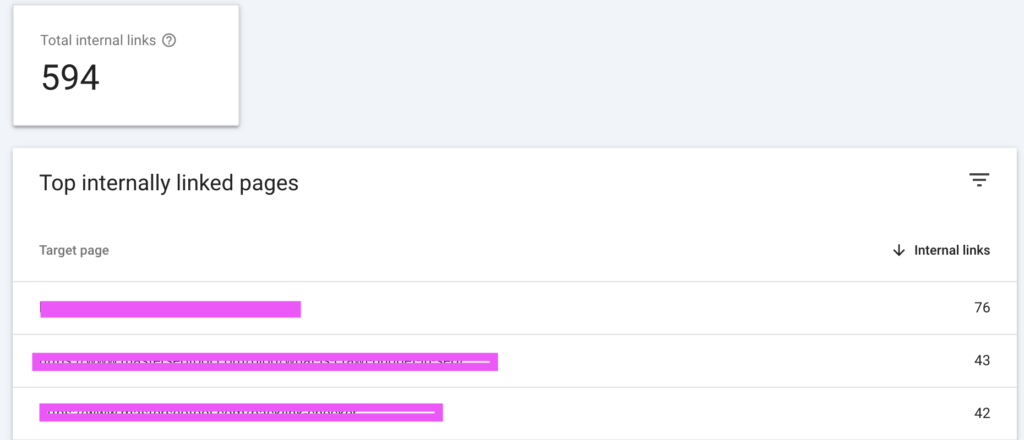
I get better results when internal links come from pages that already have:
- impressions
- topical relevance
- some established visibility
- strong contextual copy around the link
This is why source-page selection matters more than people think. Internal linking from dead pages, thin posts, or barely related content usually adds structure without adding force.
3 — Reduce Link Noise
One of the biggest mistakes is over-linking.
A page with too many internal links weakens the importance of each one. It also makes the hierarchy less clear.
I normally get better results from:
- fewer links
- tighter placement
- clearer source-to-target relationships
- links inserted inside useful explanatory paragraphs
More internal links does not automatically mean more ranking support.
Sometimes it means the opposite.
4 — Build Topic Clusters, Not Random Connections
Internal links work best when they sit inside a real topical framework.
That means the linked pages should not just be “SEO pages.” They should be clearly connected around a subtopic.
For example, a page about internal links not improving ranking becomes stronger when it is surrounded by highly related pages on crawl depth, orphan pages, anchor relevance, topical clusters, and index-vs-evaluation problems.
That is where internal linking becomes more than navigation. It becomes reinforcement.
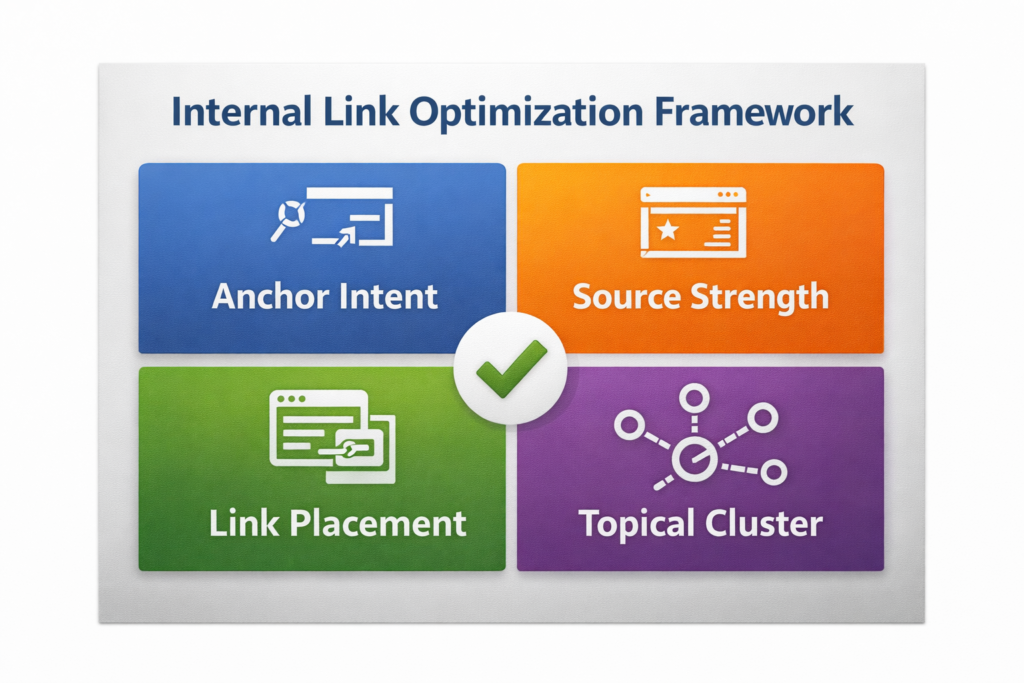
This is also why topical authority strengthens internal linking signals across related pages much better than random cross-linking ever will.
Fix vs Outcome
| Fix | Immediate Effect | Ranking Effect |
|---|---|---|
| sharper anchor intent | clearer semantic clue | better relevance |
| stronger source pages | more trusted support | higher impact |
| reduced link volume | less dilution | stronger individual links |
| tighter topical cluster | cleaner signal alignment | more stable visibility |
Technical Insight
The part most blog posts miss is that internal links live inside a site-level link graph, not as isolated elements.
That matters because signal strength is affected by:
- crawl depth
- distance from strong pages
- number of competing links on the source page
- contextual placement inside the main body content
- semantic closeness between source and target
In simple terms:
- a contextual link inside a relevant paragraph is usually stronger than a repeated sidebar link
- a link from a page with real visibility is usually more useful than one from a weak page
- a page buried deep inside the site often needs better structural support before internal links can have noticeable impact
One detail that consistently makes a difference:
Links placed inside the first 30–40% of the main content tend to carry stronger contextual signals than links buried at the end of the page or repeated in templates.
This is why internal linking is not just an on-page tactic. It is a structural ranking signal that depends on how clearly the whole topic is organized.
It also explains why internal links not improving ranking is often a structural issue, not a linking issue.
Tool-Based Execution
When I audit this problem, I do not start by adding more links. I start by checking whether the page is even in a position to benefit from internal linking in the first place.
First, I use the google index checker to validate indexing status before optimization because if the page is not properly processed or still unstable in search, internal linking will not solve the main problem. That step helps separate indexing issues from ranking-evaluation issues.
Then I review the internal structure using the link analyzer tool to identify internal link flow issues. This helps me see whether the target page is supported by strong, relevant pages or buried inside a weak structure where signal flow breaks before it reaches the page.
After that, I inspect the source pages with the website links count checker to detect link dilution. This matters because pages overloaded with links often weaken the importance of every internal connection they contain.
Used together, these checks turn internal linking from guesswork into a real diagnostic process. Instead of asking, “How many links should I add?” the better question becomes, “Which links are actually strong enough to help this page rank?”
It also explains why internal links not improving ranking is often a structural issue, not a linking issue.
External Validation
According to Google Search Central documentation, internal links help search engines understand site structure, relationships, and page importance — but they do not override content relevance or usefulness.
This aligns with real SEO testing:
Internal links influence rankings only when they reinforce pages that already match search intent and provide value.
FAQs
Why are internal links not improving ranking?
Because Google may crawl and understand the links, but still reduce their ranking effect when the source page is weak, the anchor is vague, or the topical relationship is poor.
Do internal links improve rankings automatically?
No — internal links alone do not improve rankings unless the page already matches search intent and has supporting signals such as relevance, usefulness, and topical alignment.
How long does it take for internal links to affect rankings?
When the signals are aligned, changes can appear within 1 to 3 weeks. If the page has deeper quality or intent problems, internal links may have little visible impact.
What is the biggest internal linking mistake?
The biggest mistake is linking from weak or loosely related pages with anchors that do not clearly match the target page’s purpose.
Can internal links fix a weak page?
No — internal links can strengthen a page that already deserves visibility, but they cannot fix weak content, poor intent matching, or low topical relevance.
What type of internal links work best?
Contextual links inside relevant body content usually work better than repeated sidebar, menu, or footer links because they carry stronger semantic meaning.
Final Perspective
Internal linking is not broken.
But the way many people use it is.
The mistake is expecting internal links to behave like a magic ranking boost. They do not. They behave more like a validation signal. When the context, structure, and source-page value all align, they can move rankings. When they do not, the links sit there and do almost nothing.
So if your internal links are not improving ranking, do not just add more.
If you keep seeing internal links not improving ranking, it is usually a signal problem, not a link quantity problem.
Fix the relationship between the pages.
Fix the anchor intent.
Fix the source-page quality.
Fix the topical structure.
That is when internal links start acting like ranking support instead of decorative SEO.