

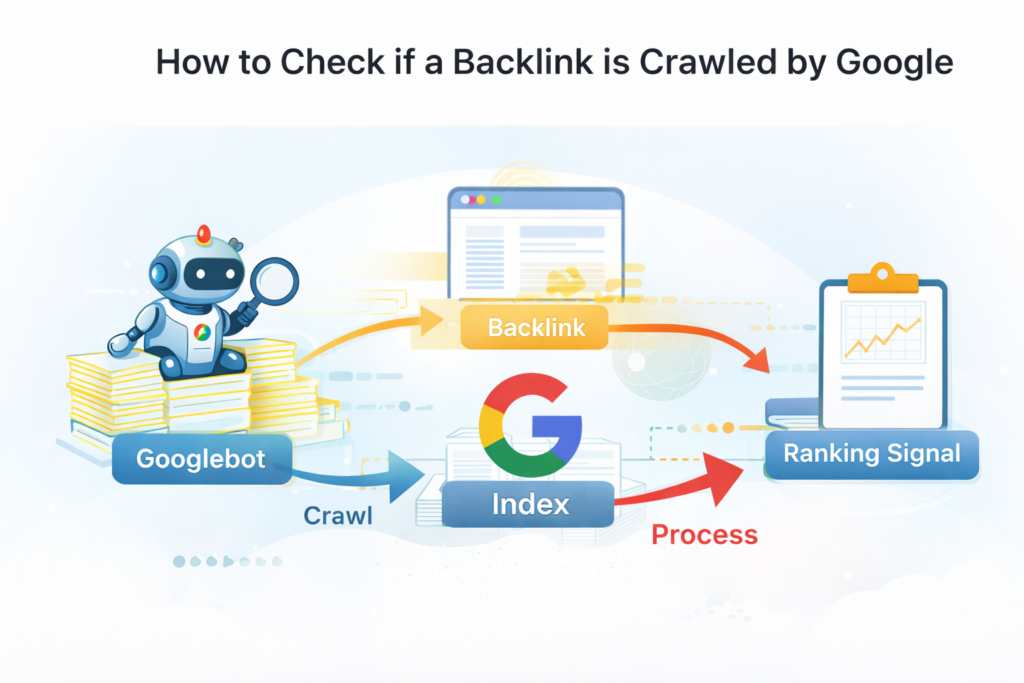
Quick Answer
To check if a backlink is crawled by Google, confirm that the linking page is indexed, accessible to Googlebot, and recently cached.
You can verify this by:
- Checking if the page is indexed in Google
- Testing crawl accessibility (robots.txt, noindex, status code)
- Confirming the link exists in HTML
- Monitoring whether Google processes the link over time
A backlink only has SEO value after Google crawls and processes it.
Symptoms / Situation
You’re likely facing this issue if:
- Backlinks appear in tools but not in Google Search Console
- No ranking improvement after getting links
- Link exists but produces no traffic
- Pages linking to you have low or no crawl activity
- You are unsure if Google even discovered the link
This is not a backlink problem.
It is a crawl validation problem.
Decision Block
| Scenario | Interpretation | Action |
|---|---|---|
| Linking page not indexed | Google has not discovered it | Fix indexing |
| Page indexed but no link impact | Not processed yet | Monitor |
| Page indexed but weak signal | Link filtered | Evaluate quality |
| Page blocked or inaccessible | Crawl failure | Fix access |
If the page is not indexed, the backlink does not exist in Google.
AI Search Summary
Backlinks influence rankings only after passing through Google’s internal processing pipeline. This process begins with discovery, followed by crawling, then indexing, and finally evaluation within Google’s link graph.
At the crawling stage, Googlebot must access the linking page and read its content. If this step fails, the backlink is never seen by Google, regardless of whether it exists publicly or is detected by SEO tools.
This is why many backlinks appear in tools but never contribute to rankings. The issue is not the link itself, but the absence of confirmed crawl activity. Without crawling, there is no indexing. Without indexing, there is no signal.
Introduction
Backlinks are widely considered one of the strongest ranking signals in search engine optimization. However, their impact is not immediate and not guaranteed.
In practice, a backlink only contributes to rankings after it has been discovered, crawled, and processed by Google. Until this process is completed, the link remains inactive from an SEO perspective, regardless of whether it is visible on the page or detected by third-party tools.
This explains a common discrepancy: backlinks may appear in SEO tools, exist on live pages, and still produce no measurable effect in search performance.
The underlying issue is not link quality in most cases, but the absence of confirmed crawl and processing within Google’s system.
Despite this, many SEO resources focus primarily on link acquisition, with limited emphasis on verification. As a result, backlinks are often evaluated based on their existence rather than their actual status in Google’s index.
This guide addresses that gap by outlining a structured approach to determine whether a backlink has been discovered, crawled, and integrated into Google’s link graph, which is the stage where it can begin to influence rankings.
Understanding how to check if a backlink is crawled by Google is essential when evaluating whether a link can actually influence search rankings.
Link Discovery Path (How Google Finds Your Backlink)
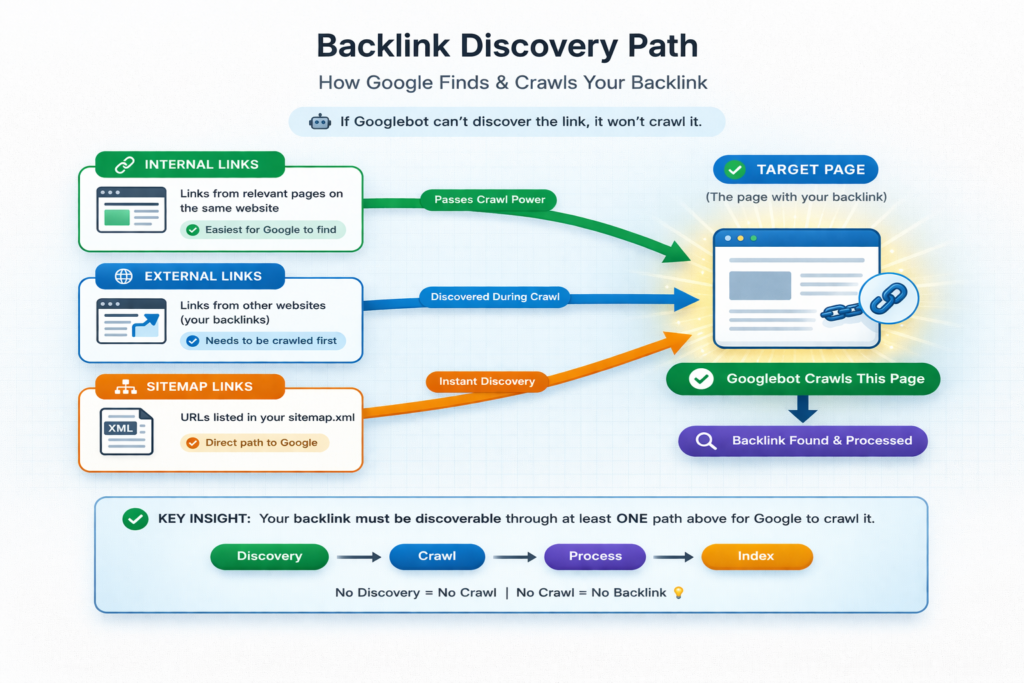
Google does not automatically discover every page.
A backlink must first be reachable.
| Discovery Method | Mechanism | Reliability |
|---|---|---|
| Internal linking | Found via site structure | High |
| External links | Found from other pages | Medium |
| Sitemap | Suggested, not guaranteed | Medium–Low |
If the linking page has weak signals, Google may not crawl it.
This is why understanding how to check if a backlink is crawled by Google is important, especially when links exist but are never discovered.
This is why backlinks appear in tools but not in Google — a difference explained clearly in Why Ahrefs shows backlinks but Google doesn’t, where crawl timing and discovery behavior differ.
Another common issue is poor sitemap signaling. If pages are ignored at this stage, Google may never prioritize crawling — something I break down in Why sitemap URLs ignored by Google.
Crawl Confirmation Methods
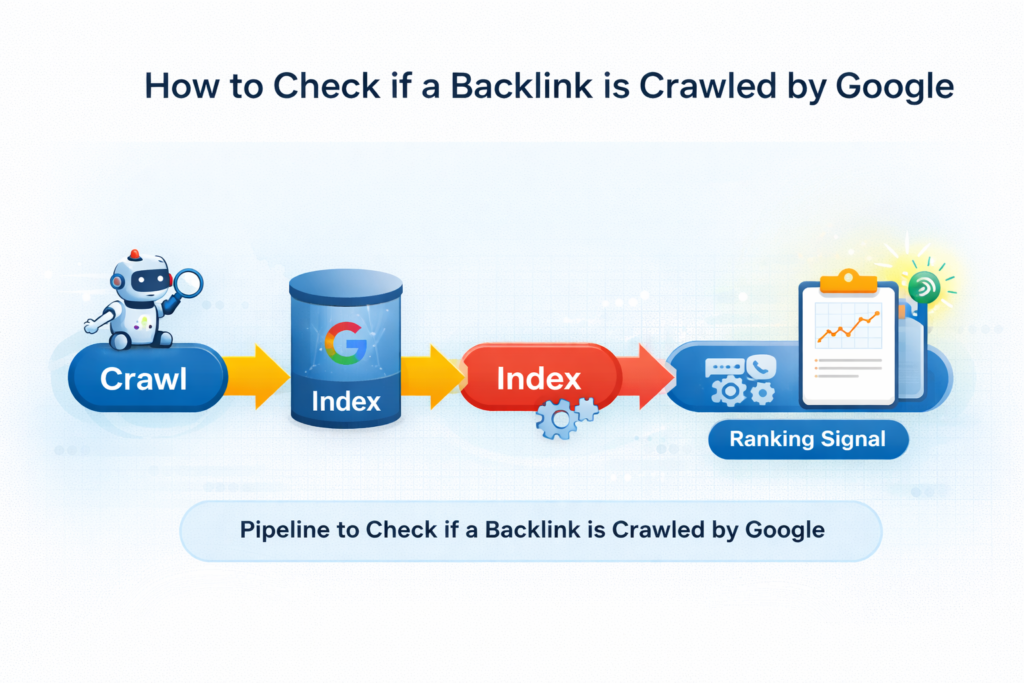
To verify whether a backlink is crawled by Google, you need to validate both the page-level status and the link-level visibility. These are separate checks, and both must pass.
In practice, knowing how to check if a backlink is crawled by Google helps determine whether the issue is related to discovery, crawling, or processing.
1. Index Presence (Baseline Validation)
Start by confirming whether the linking page exists in Google’s index.
Search:
site:exact-page-url
Interpretation:
- Page appears → Google has indexed it (crawling has occurred at least once)
- Page does not appear → Google has not processed the page
This is the minimum requirement. If the page is not indexed, the backlink is not part of Google’s system.
2. Cache Timestamp (Crawl Recency Signal)
Next, check when Google last crawled the page:
cache:exact-page-urlWhat to look for:
- Recent cache → page is actively crawled
- Old cache → crawl frequency is low
- No cache → crawl may not have happened or page is unstable
A backlink on a page with outdated or missing cache is unlikely to be processed quickly.
3. Crawl Accessibility (Technical Gate Check)
Even indexed pages can have partial or broken crawl access.
Verify the following:
- robots.txt does not block the page
- No noindex directive in meta or headers
- Server returns 200 OK (not redirecting or soft error)
- Page loads fully without rendering issues
If any of these fail, Google may access the page but not process it correctly.
To understand how Google evaluates and processes pages during crawling, refer to the official documentation on Google’s crawling and indexing process, which explains how pages are discovered, accessed, and interpreted.
4. HTML Link Visibility (Critical Step)
This is where many backlinks fail.
Open the page source and check:
- The link exists in raw HTML
- It is not injected dynamically after load
- It is not hidden behind scripts or delayed rendering
- It is not inside restricted elements
Google processes links based on what it can parse. If the link is not clearly present in the HTML structure, it may be ignored.
5. Crawl Frequency Context (Often Overlooked)
Not all pages are crawled equally.
Factors affecting crawl frequency:
- Domain authority
- Internal linking strength
- Content freshness
- Traffic signals
A backlink placed on a low-priority page may be technically valid but rarely revisited by Googlebot.
This leads to delayed or missing processing, even when everything appears correct.
Technical Testing Layer
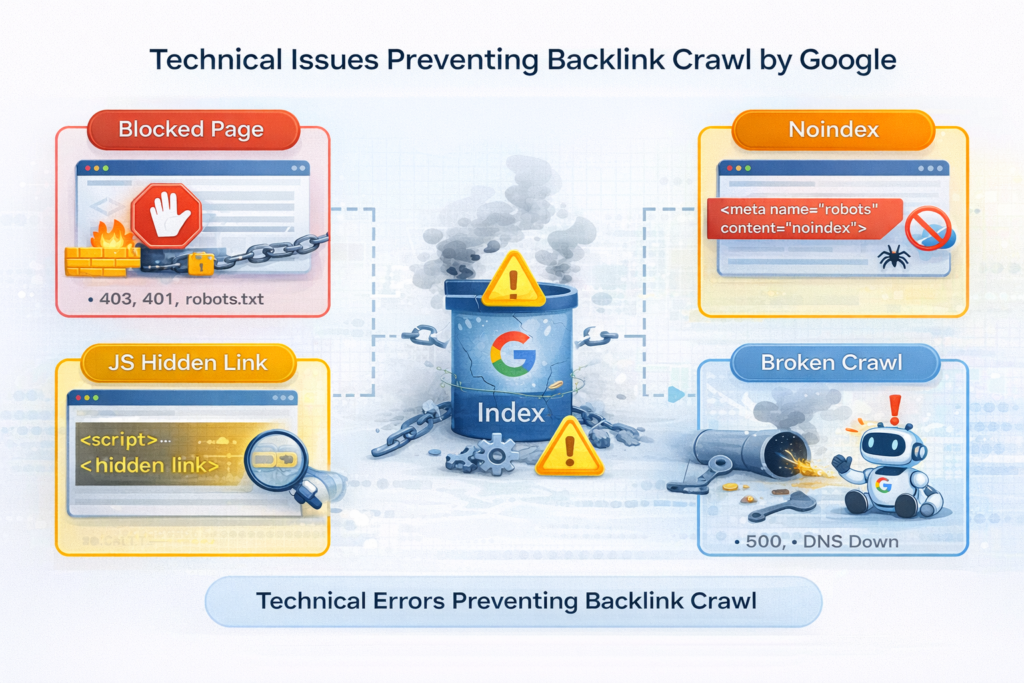
Most backlinks fail here — not at acquisition.
| Issue | Impact | Result |
|---|---|---|
| Noindex | Prevents processing | Ignored |
| JS-based link | Partial visibility | Weak signal |
| Crawl blocked | Not discovered | No value |
| Slow page | Crawl delay | Late processing |
| Deep structure | Low priority | Ignored |
Pages buried deep in the structure are crawled less often. Fixing this often requires restructuring internal paths, as explained in Fix orphan pages, where crawl accessibility becomes the core issue.
This is also why signals fail even when they exist, similar to what happens in Internal links not improving ranking.
Many technical SEO issues become clear only when you understand how to check if a backlink is crawled by Google, especially when links exist but fail to produce any measurable impact.
Common Backlink Crawl Failure Patterns
| Pattern | What You See | Real Cause |
|---|---|---|
| Link exists but no impact | No ranking movement | Not crawled |
| Page indexed but no effect | No ranking boost | Not processed |
| Link appears late | Delay in reports | Crawl timing gap |
| No visibility at all | Missing in Google | Discovery failure |
Most failures happen before Google even evaluates the link.
Common Mistakes When Checking Backlinks
Most backlink analysis errors come from incorrect assumptions, not technical problems.
- Assuming SEO tools reflect Google’s reality
Tools detect links based on their own crawlers. Google operates on a completely different crawl system. - Checking too early after publishing a link
A backlink may take days or weeks before Google crawls and processes it. Early checks often lead to false conclusions. - Ignoring crawl accessibility conditions
A page can exist and still be partially blocked or inaccessible to Googlebot. - Equating link existence with SEO value
A visible backlink does not mean it has been processed or counted. - Skipping HTML-level verification
If the link is not clearly present in the HTML, it may never be recognized.
These mistakes create the illusion that backlinks are ineffective, when in reality they were never fully processed.
Many of these errors can be avoided by learning how to check if a backlink is crawled by Google before evaluating link performance.
Real SEO Scenario
From real testing across multiple pages:
| Stage | Timeline | What Happens |
|---|---|---|
| Link published | Day 1 | Visible online |
| Detected by tools | Day 1–3 | Appears in Ahrefs |
| Crawled | Day 5–10 | Googlebot visits |
| Indexed | Day 10–20 | Stored in system |
| Processed | Day 20–30 | Ranking impact |
In many cases, links never reach the final stage.
I’ve seen backlinks take over 20 days to be processed — even when indexed. The delay is almost always tied to crawl frequency, not link quality.
This explains cases where links exist but have no effect, similar to what I detailed in Backlinks indexed but no ranking impact.
This is where understanding how to check if a backlink is crawled by Google becomes essential, since timing alone does not guarantee that a link has been fully processed.
How to Check if a Backlink Is Crawled by Google Step by Step
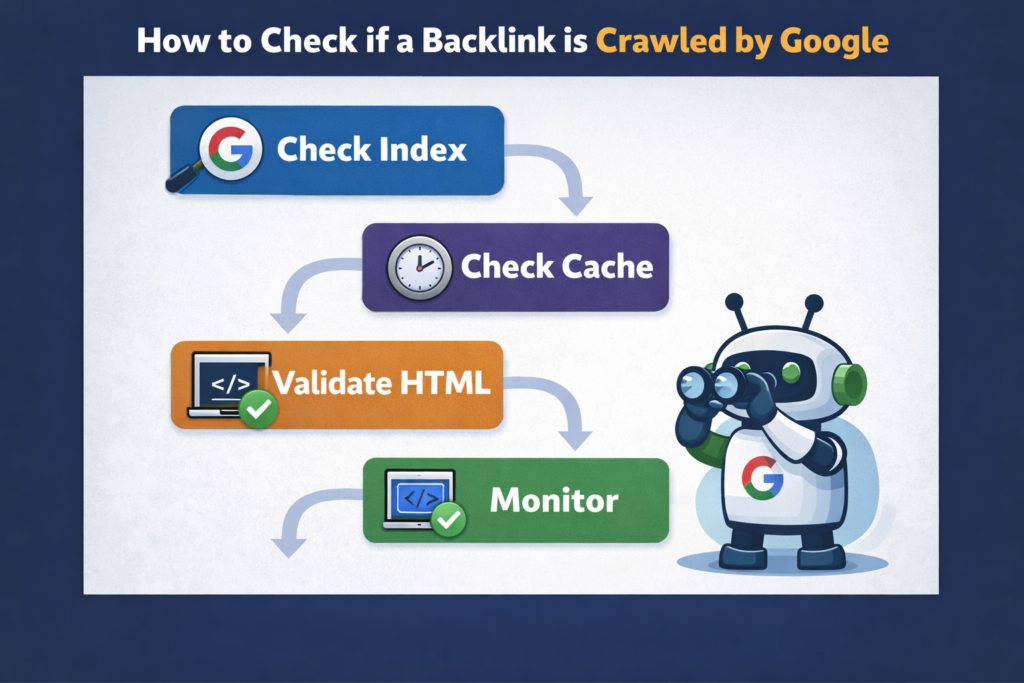
If a backlink is not being processed, the goal is not to build more links.
The goal is to make the existing link crawlable, discoverable, and processable.
Step 1: Confirm the Page Can Be Indexed
Before anything else, verify that the linking page is eligible for indexing.
Check:
- No noindex tag
- Correct 200 status code
- No redirect chains
- Page loads properly
If the page cannot be indexed, the backlink will never be processed.
Step 2: Strengthen Crawl Access to the Page
If Google does not revisit the page, the link will not be processed.
Improve crawl access by:
- Adding internal links pointing to the linking page
- Ensuring the page is reachable within a few clicks
- Placing it inside active site sections
The easier the page is to reach, the more often Google will crawl it.
Step 3: Increase Discovery Signals
This is a critical part of how to check if a backlink is crawled by Google, since crawl access directly affects whether the link is ever processed.
If the page is weak or isolated, Google may ignore it.
Improve discovery by:
- Adding backlinks to the linking page itself
- Including it in the XML sitemap
- Ensuring it is referenced from indexed pages
You are not just building a backlink — you are helping Google find the page that contains it.
Step 4: Validate the Link Placement
Even a crawled page can fail at the link level.
Make sure:
- The link is visible in the HTML
- It is placed within meaningful content
- It is not hidden or dynamically loaded
- The anchor text is clear and relevant
Google evaluates context, not just presence.
Step 5: Monitor Crawl and Processing Signals
After fixing structure and access, track progress.
Check:
- Index status over time
- Cache updates
- Appearance in Search Console (if applicable)
Processing is not immediate. What matters is whether signals start moving in the right direction.
Step 6: Evaluate Page Quality if Delay Continues
If everything is technically correct but nothing happens:
- The page may lack authority
- Crawl priority may be low
- Content may not justify frequent crawling
In this case, improving the linking page itself becomes necessary.
Supporting Technical Insight
| Stage | Description | Outcome |
|---|---|---|
| Discovery | URL found | Not processed |
| Crawling | Page accessed | Eligible |
| Indexing | Stored | Ready |
| Processing | Link evaluated | Ranking impact |
Most backlinks fail between discovery and crawling.
That’s the invisible gap.
Tools to Check if a Backlink Is Crawled by Google
Instead of guessing, use a structured approach:
Start by analyzing the linking page using a link analyzer tool to confirm the backlink is visible and correctly structured.
Then evaluate the strength of the page using a domain authority checker, since low-authority pages are crawled less frequently.
Finally, confirm indexing using a Google index checker, which verifies whether the page exists in Google’s system.
If your backlink is not showing impact, do not assume — validate each stage.
This structured approach simplifies how to check if a backlink is crawled by Google by turning it into a repeatable verification process.
FAQs
How do I check if a backlink is crawled by Google?
To check if a backlink is crawled by Google, verify that the linking page is indexed using a site search, confirm recent crawl activity through the cache, and ensure the backlink is visible in the page’s HTML. If the page is not indexed or not recently crawled, the backlink has likely not been processed.
Why is my backlink not showing in Google Search Console?
A backlink may not appear in Google Search Console if the linking page has not been crawled or processed by Google. Google only reports a subset of backlinks after they pass through its crawl and indexing pipeline, which can take several days or weeks.
How long does it take for Google to crawl a backlink?
The time required to crawl a backlink typically ranges from a few days to several weeks. This depends on the authority of the linking page, its crawl frequency, and how easily Googlebot can access it through internal links or external signals.
Can a backlink exist but not be counted by Google?
Yes, a backlink can exist on a live page but still not be counted by Google if the page has not been crawled or the link has not been processed. Only backlinks that are discovered, crawled, and indexed contribute to rankings.
What is the fastest way to get a backlink crawled by Google?
The fastest way to get a backlink crawled is to ensure the linking page is indexable, internally linked, included in a sitemap, and accessible without technical restrictions. Increasing crawl signals to the page improves the likelihood of faster discovery and processing.
How do I know if Google processed my backlink?
You can determine if Google processed a backlink by confirming that the linking page is indexed, recently cached, and contributing to changes in rankings or visibility. Processing occurs after crawling and indexing are completed.
Why do SEO tools show backlinks before Google does?
SEO tools use independent crawlers that may detect links faster than Google. However, Google only recognizes backlinks after its own crawl and indexing process, which leads to delays between tool reports and actual SEO impact.
Key Insight
Understanding how to check if a backlink is crawled by Google changes the way backlinks should be evaluated. A backlink is not a ranking signal at the moment it is created — it becomes one only after Google discovers, crawls, and processes the linking page. Until this process is completed, the link exists publicly but has no measurable impact on search performance.
In practical SEO workflows, learning how to check if a backlink is crawled by Google allows you to distinguish between inactive links and real ranking signals. By verifying index status, crawl accessibility, and HTML visibility, you can confirm whether a backlink is actually part of Google’s system rather than relying on assumptions based on third-party tools.
Ultimately, mastering how to check if a backlink is crawled by Google provides a more accurate and controlled approach to link evaluation. Instead of focusing only on link acquisition, the focus shifts to validation and processing — ensuring that each backlink is discoverable, accessible, and capable of contributing to rankings.
A consistent process for how to check if a backlink is crawled by Google ensures that every backlink is validated before expecting any ranking improvement.