

Quick Answer
Google reindex time is not controlled by when you update a page—it’s controlled by how strongly your page signals importance after the update.
From real-world SEO testing across multiple sites, the pattern is consistent:
- High-authority, frequently crawled pages → 6 to 48 hours
- Pages with solid internal linking → 3 to 7 days
- Weak, low-priority, or isolated pages → 10 to 14+ days
The critical point most people miss:
Updating content alone does not trigger reindexing.
Google reindexes pages when it detects signals worth reprocessing, not when it sees edits.
Featured Snippet Table
| Page Type | Google Reindex Time |
|---|---|
| High authority pages | 6–48 hours |
| Medium authority pages | 3–7 days |
| Low authority pages | 10–14+ days |
Symptoms / Situation
If you’ve ever updated a page and then kept checking Google expecting movement, you’ve probably seen this pattern:
- The cached version still shows the old content
- Search Console shows no new crawl activity
- Rankings either freeze or drop temporarily
- Impressions decrease even though content improved
- The page is indexed, but behaves like nothing changed
At this point, most people assume something went wrong.
I used to think the same. I would update content, wait a couple of days, see no movement, and assume the update failed.
But that’s not what’s happening.
What you’re actually seeing is what I call the re-evaluation gap.
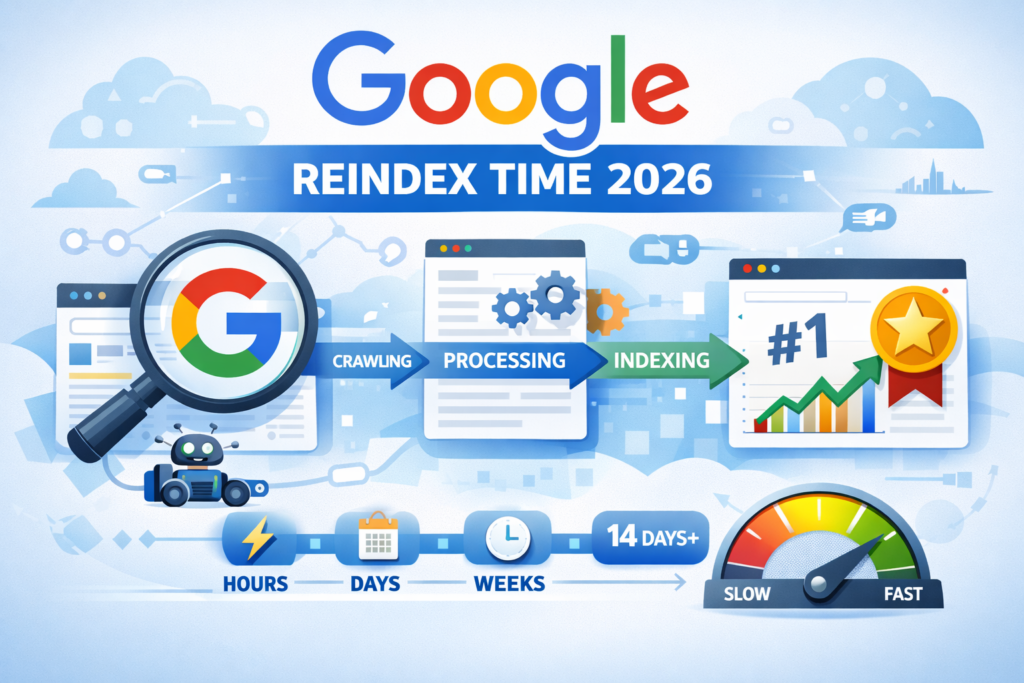
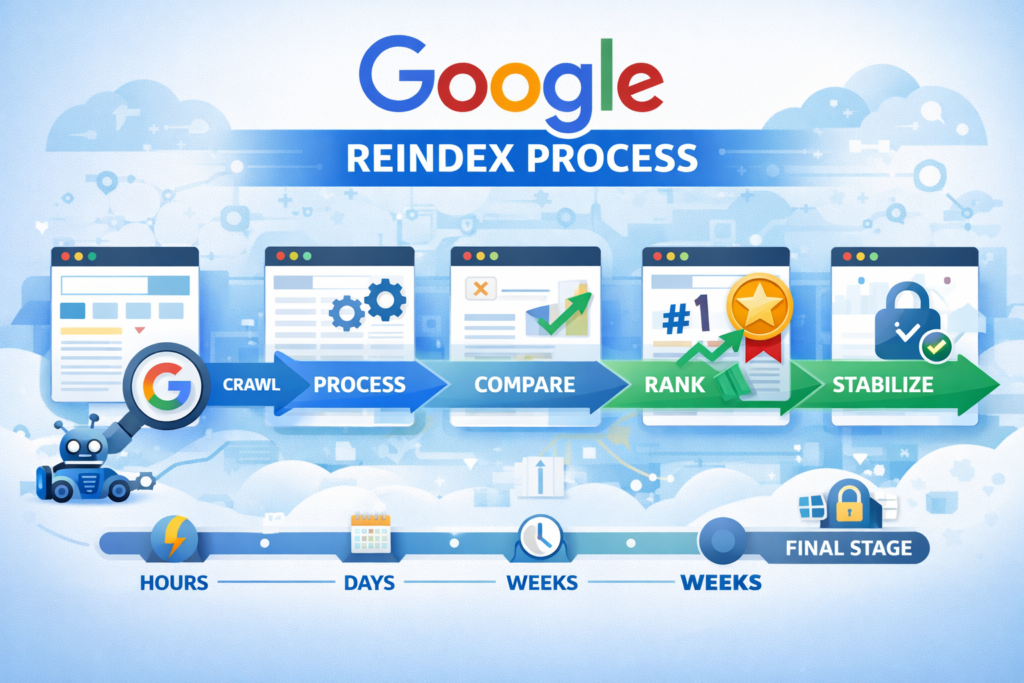
Before your update can impact rankings, Google must complete a full cycle:
- Detect that the page changed
- Crawl the updated version
- Process the new content
- Compare it with historical signals
- Recalculate ranking confidence
Until that process is complete, your update is essentially invisible in the ranking system.
That’s why sometimes rankings drop right after an update—Google is not penalizing you. It’s recalibrating.
Decision Block
| Situation | What It Means | What You Should Do |
|---|---|---|
| No crawl after update | No signals detected | Request indexing + add internal links |
| Crawled but no ranking change | Weak update impact | Expand content depth |
| Ranking dropped | Re-evaluation phase | Wait and stabilize |
| Indexed but no impressions | Low priority | Strengthen internal linking |
| Cache unchanged | Crawl delay | Force re-crawl via GSC |
AI Search Summary
Google reindexing follows a structured pipeline:
- Change detection
- Crawl revisit
- Content processing
- Signal comparison
- Ranking adjustment
Google reindex time depends on:
- Internal linking strength
- Crawl frequency
- Content update depth
- External signals (backlinks)
Without strong signals, Google delays reindexing regardless of content quality.
Introduction
I used to think google reindex time was just about waiting.
Update the page, give it a few days, and expect rankings to move.
That assumption didn’t last long.
I’ve updated pages that were reindexed within 24 hours—and others that stayed unchanged for more than 10 days on the same site. Same structure. Same niche. Same effort.
That’s when it became clear:
Reindexing is not controlled by time—it’s controlled by signals.
Once I stopped treating google reindex time as a passive delay and started treating it as a system I could influence, the results became predictable.
Pages didn’t just “eventually update”—they moved faster when I gave Google a reason to prioritize them.
That shift changed everything.
Because in modern SEO, Google doesn’t respond to updates.
It responds to importance.
And if your page doesn’t send that signal clearly, it doesn’t matter how good the content is—
it will simply wait.
From that point, I stopped guessing and started measuring how google reindex time actually responds to signal changes rather than just waiting for updates to take effect.
Causes / Why It Happens
Google does not crawl the internet randomly.
It operates on a priority-based crawl system, where every page competes for attention.
When you update a page, Google evaluates multiple factors before deciding whether it’s worth revisiting:
- How important the page is within your site
- How often it has been crawled in the past
- Whether new signals indicate increased relevance
- Whether the update meaningfully changes the page
If none of these factors improve, your page doesn’t move up in priority.
And if priority doesn’t increase, crawling doesn’t happen.
This is why many “good updates” fail—they improve content quality but don’t change importance.
Problem Explanation
The real issue is not the update itself.
It’s what happens after the update—or more accurately, what doesn’t happen.
Most pages fail to reindex quickly because:
- They remain buried deep in the site structure
- No new internal links point to them
- No external signals (backlinks) are introduced
- The update doesn’t significantly change value
This leads to one outcome: low crawl priority
That’s exactly why problems like why sitemap URLs are ignored by Google happen.
A sitemap tells Google that a page exists.
It does not tell Google that the page matters.
And Google prioritizes importance—not existence.
Real Timeline
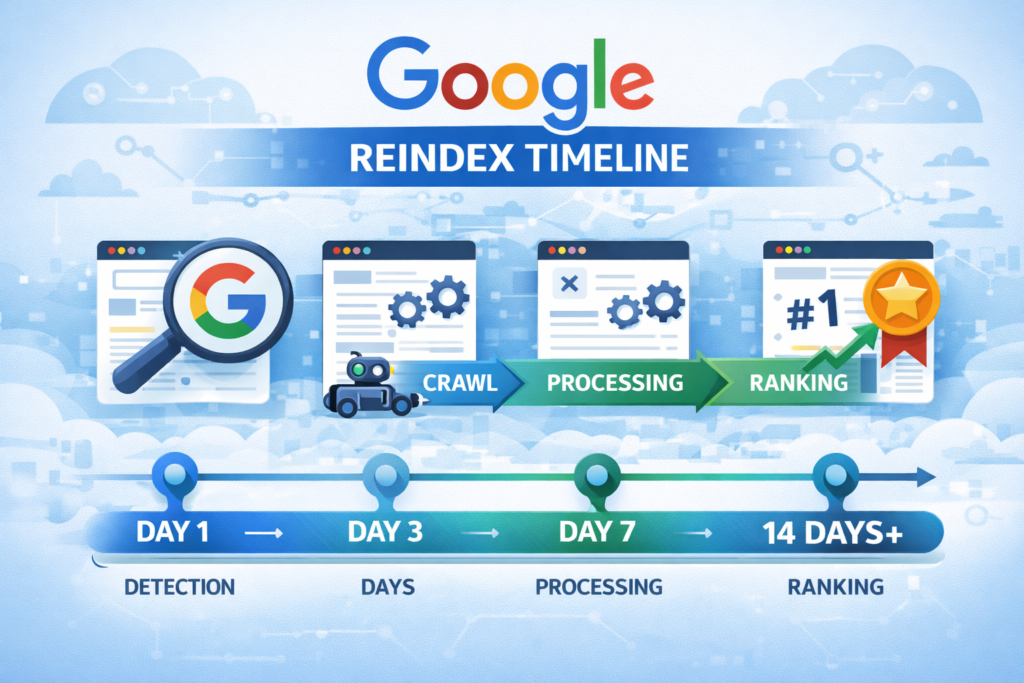
From testing across multiple sites, reindexing follows a predictable lifecycle:
| Stage | Time Range | What Happens |
|---|---|---|
| Detection | 6–48 hours | Google detects change |
| Crawl | 1–5 days | Page is revisited |
| Processing | 2–7 days | Content is analyzed |
| Ranking | 3–14 days | Rankings adjust |
Total time: 1 day to 14+ days
But here’s the key:
This timeline only applies when signals exist.
Without signals, the timeline extends indefinitely.
Crawl Triggers
Google does not react to updates—it reacts to triggers.
| Trigger | Strength | Effect |
|---|---|---|
| Internal link updates | Very High | Immediate crawl priority |
| Backlinks | Very High | External discovery |
| URL inspection request | Medium | Temporary boost |
| Sitemap update | Low | Supporting signal |
| Content update | Very Low | Often ignored |
Before anything, always verify crawl access using test if Googlebot can access a page.
Because if Google can’t crawl your page, nothing else matters.
This aligns with Google’s official guidance on crawl behavior and how Google prioritizes pages based on signals, as explained in Google Search crawling and indexing documentation.
Priority Signals
Google assigns priority based on signals—not content alone.
| Signal | Impact | Explanation |
|---|---|---|
| Internal linking | Very High | Defines importance |
| Authority | Very High | Influences crawl frequency |
| Crawl depth | High | Deep pages are slower |
| Backlinks | High | External validation |
| Content quality | Medium | Needs confirmation |
| Sitemap | Low | Weak signal |
This is why internal links not improving ranking happens—links exist, but they don’t carry enough weight.
Why Google Reindex Time Is Slow (Core Reality)
Google doesn’t delay pages randomly.
It delays pages that don’t compete for attention.
If your page:
- Has weak internal structure
- Is disconnected from important pages
- Has no backlinks
- Shows minimal update impact
Then Google treats it as low priority.
And low-priority pages get crawled late—or not at all.
Reindexing is not delayed.
It is deprioritized.
In practical terms, google reindex time is not delayed randomly—it reflects how your page is positioned within Google’s internal priority system.
Real Scenario (From Testing)
Across multiple updates:
- Pages with strong internal links → reindexed in 2–3 days
- Pages without signals → delayed 10–14 days
- Pages supported by backlinks → under 48 hours
One example:
- Page dropped from position 11 to 19 after update
- Stayed unstable for several days
- Recovered to position 7 after 9 days
That drop was not a penalty.
It was a signal recalibration phase.
Step-by-Step Fix System (Acceleration Methods)
This is where most people fail.
They update content—but don’t support it.
Here’s the correct workflow:
Step 1 — Trigger Immediate Crawl
Use Google Search Console → Request indexing
This increases crawl priority temporarily.
Not guaranteed—but necessary.
Step 2 — Strengthen Internal Signals
Add internal links from relevant, indexed pages.
Not random links—contextual links with intent.
Use a link analyzer tool to identify weak internal structures and fix gaps in linking flow.
Step 3 — Improve Content Depth
Do not just edit wording.
Add:
- New sections
- Deeper explanations
- Supporting examples
- Data or comparisons
Google responds to meaningful updates, not surface changes.
Step 4 — Update Sitemap Signals
Update lastmod and resubmit sitemap.
Use an xml sitemap generator to ensure accuracy and freshness.
Step 5 — Add External Signals
Backlinks are one of the strongest triggers.
Even a single quality link can accelerate crawling.
Use a google index checker to confirm indexing status.
Also, understand timing using how long before backlinks affect ranking.
Technical Insight (What Happens Behind the Scenes)
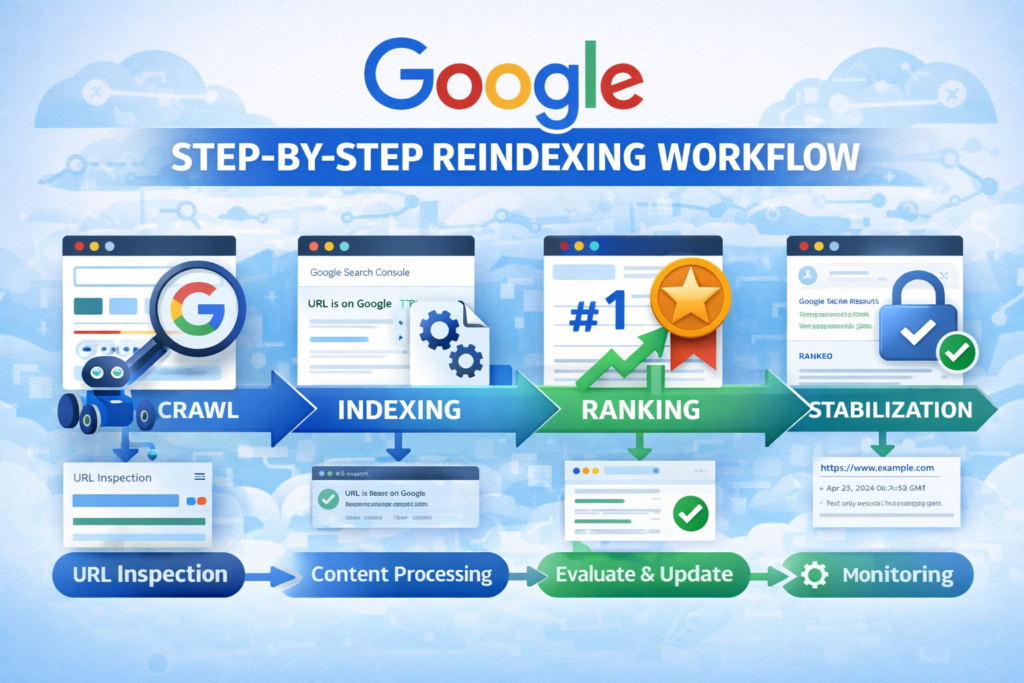
Reindexing is not a simple refresh—it’s a multi-layer system.
| Stage | Function | Outcome |
|---|---|---|
| Crawl | Fetch page | Detect changes |
| Index | Store content | Update database |
| Rank | Evaluate signals | Adjust rankings |
Google may detect your update—but delay trusting it.
That’s why you sometimes see updates reflected but rankings unchanged.
Verification (Critical Final Step)
Reindexing is not complete when you update a page—it’s complete when Google reprocesses and reflects the change in its system.
Relying on assumptions here is a mistake. You need confirmation from multiple layers.
Method 1 — Google Cache (Fastest Signal)
Search:cache:yoururl
If the cache date updates and reflects your new content, Google has successfully re-crawled the page.
However, this only confirms crawling—not full ranking integration.
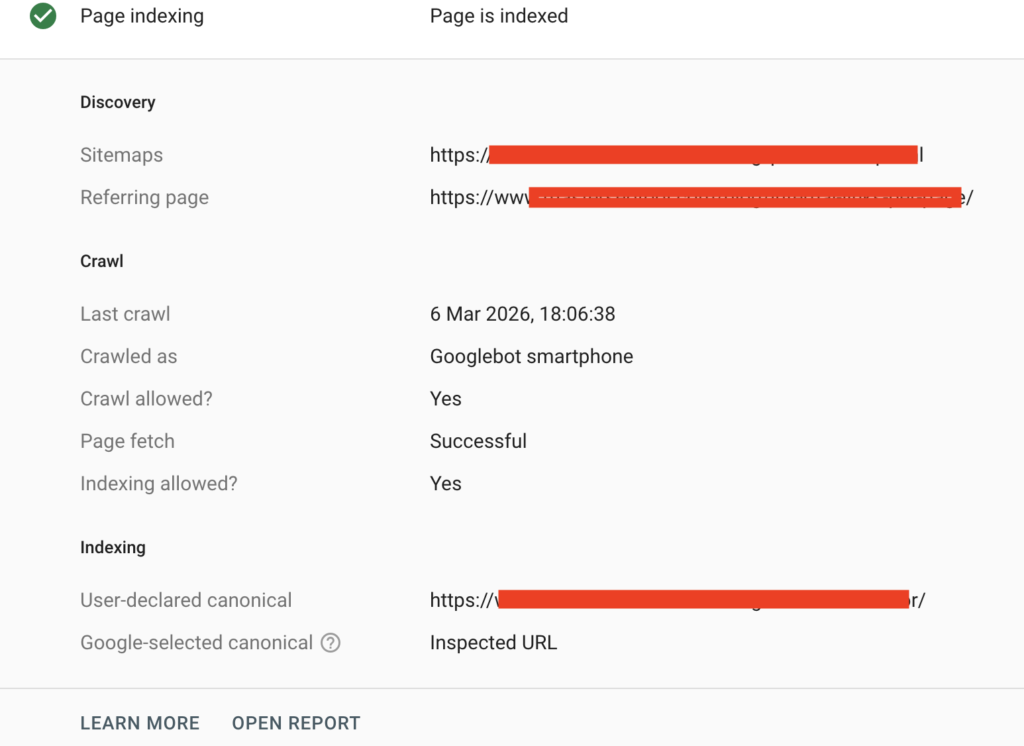
Method 2 — Google Search Console (Most Reliable)
Use the URL Inspection tool and check:
- Last crawled date → confirms revisit
- Indexing status → confirms inclusion
- Page fetch result → confirms accessibility
If the crawl date hasn’t changed, your update has not entered the processing phase yet.
You can verify crawl and indexing status using the URL Inspection tool in Google Search Console, which provides real-time insights into how Google processes your page.
Method 3 — Live Search Results (Final Confirmation)
Search your target keyword and analyze:
- Whether updated content appears in the snippet
- Whether title/description changes are visible
- Whether ranking position shifts
This is the only layer that confirms full reindexing + ranking integration.
Key Insight
Crawl ≠ Index ≠ Ranking
A page can be crawled but not reprocessed.
It can be reprocessed but not trusted yet.
True reindexing is only complete when:
Google reflects your update in live search results
FAQs
How fast does Google reindex updated pages?
Google reindex time can range from a few hours to more than 14 days, depending on crawl priority, internal linking strength, page authority, and external signals.
Why is my page not reindexed after updating?
In most cases, the page is not reindexed because Google has not detected enough meaningful signals to justify revisiting and reprocessing it.
Does requesting indexing in Google Search Console guarantee reindexing?
No. Requesting indexing can encourage a crawl, but it does not guarantee that Google will reindex the page immediately.
Can backlinks speed up Google reindex time?
Yes. Backlinks are one of the strongest external signals and can help Google discover, crawl, and reprocess updated pages faster.
How can I make Google reindex a page faster?
The most effective way is to combine a meaningful content update with stronger internal links, updated sitemap signals, and relevant external backlinks.
Why do rankings drop after updating a page?
Rankings can drop temporarily because Google often re-evaluates the updated page before stabilizing trust and ranking signals again.
Once you understand how google reindex time is influenced by internal signals, crawl behavior, and external validation, it becomes easier to control outcomes instead of reacting to delays.
Final Perspective
Reindexing is often misunderstood as a timing issue.
In reality, it is a priority and signal problem.
Google does not operate on schedules—it operates on importance and confidence.
When a page sends weak or unchanged signals, it remains in the background regardless of how much content is improved.
When a page sends clear, reinforced signals, it moves forward in the crawl and ranking pipeline.
This is the fundamental shift:
Reindexing is not triggered by updating content—it is triggered by changing how Google evaluates the page.
If you approach reindexing as a passive process, results will always feel inconsistent.
If you approach it as a signal-driven system, outcomes become predictable.
The goal is not to update more frequently.
The goal is to increase priority, strengthen signals, and justify reprocessing.
Because in modern SEO, visibility is not granted by effort—
it is earned through clear, measurable importance.