

Quick Answer
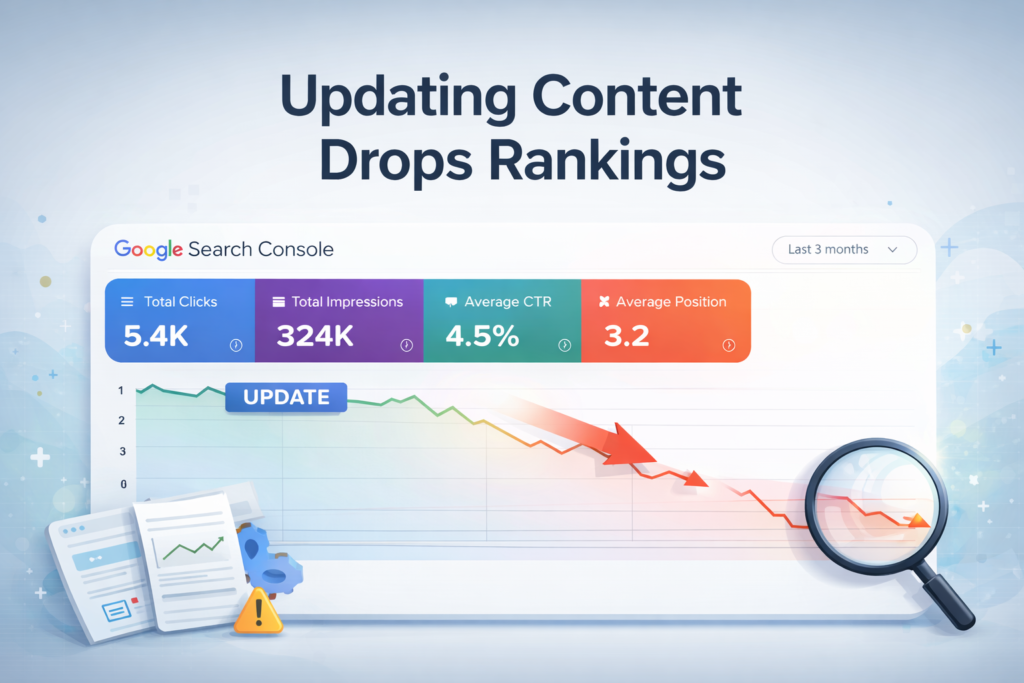
When updating content drops rankings, the cause is usually not the update itself—but how the update changes the page’s established ranking signals.
Every update forces Google to reassess:
- whether the page still matches the original search intent
- whether the topical focus became stronger or weaker
- whether internal and contextual signals remain consistent
- whether the updated version performs better than the previous one
If the new version weakens clarity, shifts intent, or dilutes the core topic, rankings can drop temporarily—or in some cases, permanently.
Symptoms / Situation
In practice, the pattern is very consistent across different websites.
A page that was already ranking is updated to improve performance. The update usually includes adding new content, expanding sections, rewriting headings, or adjusting keywords. Shortly after, performance changes:
- Rankings drop within 24–72 hours
- Impressions increase but average position declines
- The primary keyword loses stability
- Secondary keywords start appearing more frequently
- CTR drops because the page no longer matches the same intent
This behavior clearly indicates that updating content drops rankings due to a shift in how Google interprets the page—not because the page became “bad.”
Decision Block
Before taking action, you need to diagnose the type of impact.
| Situation | Interpretation | Action |
|---|---|---|
| Immediate ranking drop after update | Normal re-evaluation phase | Wait and observe |
| Impressions increase while position drops | Query expansion and intent dilution | Refocus topic |
| CTR decreases with stable position | Title/snippet misalignment | Improve SERP match |
| Page not recrawled | Update not processed yet | Trigger indexing |
| Ranking continues dropping after 10–14 days | Signal weakening or intent mismatch | Start structured recovery |
If you react too early, you risk turning a temporary fluctuation into a permanent ranking loss.
AI Search Summary
When updating content drops rankings, Google is not penalizing the page—it is re-evaluating it. During this process, it compares the old and new versions of the page to determine which better satisfies search intent. Ranking loss occurs when the updated version weakens clarity, shifts topical focus, or disrupts supporting signals. Stabilization typically occurs within 3–14 days, but misaligned updates can lead to sustained ranking decline.
Introduction
I updated a page that was already ranking—and lost its position almost immediately.
The update looked like an improvement:
- more detailed content
- better structure
- expanded explanations
But rankings dropped.
That experience exposed a key principle:
When content updates drop rankings, the issue is rarely content quality.
The issue is signal disruption.
Google had already understood the page in a specific way.
The update changed that understanding.
And once that happens, the page has to earn its position again.
That’s when I realized something most SEO guides never explain clearly.
This behavior aligns with Google’s official guidance on ranking systems, which explains how search results are continuously evaluated and adjusted.
Before Update → After Update (Signal Shift)
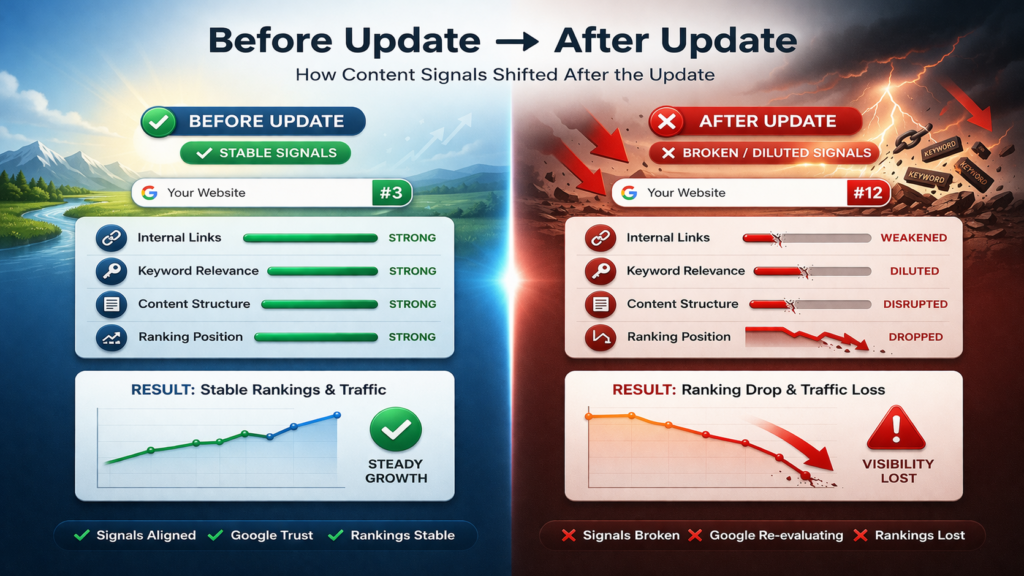
Every content update changes how the page is interpreted.
| Signal | Before Update | After Update Risk |
|---|---|---|
| Search Intent | Clearly aligned with query | Slightly shifted or expanded |
| Keyword Focus | Strong and consistent | Diluted across variations |
| Heading Structure | Predictable hierarchy | Reinterpreted structure |
| Internal Context | Supported by related pages | Partially weakened |
| User Signals | Stable CTR and engagement | Reset or inconsistent |
This transformation explains why updating content drops rankings even when the content appears improved.
The Re-Evaluation Phase
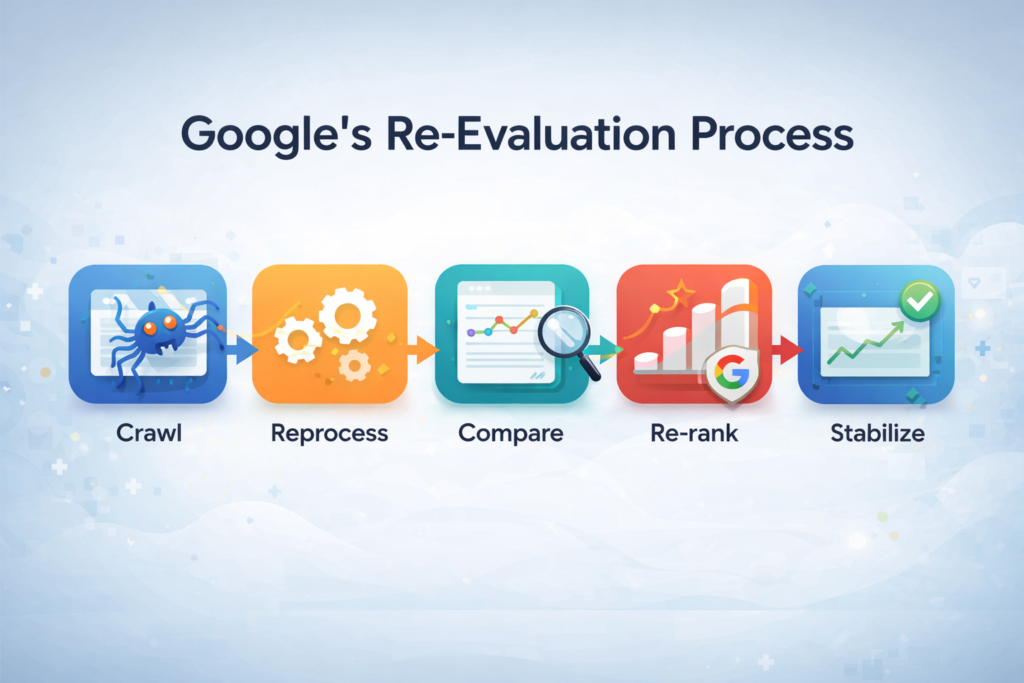
After updating a page, Google does not instantly reward the change. It initiates a structured evaluation process.
| Stage | What Happens |
|---|---|
| Crawl | Google detects updated content |
| Reprocess | Page content is reinterpreted |
| Compare | New version vs old version signals |
| Re-rank | Position recalculated |
| Stabilize | Rankings settle based on performance |
This phase is critical.
If you interfere during this process by making additional changes, you introduce further instability and delay recovery.
Causes (Why Updating Content Drops Rankings)
1. Intent Shift (Most Critical)
This happens when the updated content no longer matches the original query intent precisely.
For example:
- A focused “how-to” page becomes a broader guide
- A solution-based article becomes more informational
- A specific problem page becomes generalized
Even small shifts in wording, structure, or examples can weaken alignment.
2. Keyword Drift
When expanding content, it is common to introduce multiple related terms.
This creates two effects:
- the page appears for more queries
- the main keyword loses dominance
This is a major reason why updating content drops rankings while impressions increase.
3. Structural Disruption
Changes to headings and content hierarchy directly affect how Google understands the topic.
Examples:
- replacing strong H2 sections with broader ones
- changing the order of sections
- merging or removing key subsections
This reduces structural clarity and weakens ranking signals.
4. Internal Signal Weakening
Content updates often unintentionally break internal relationships.
This is especially relevant in cases like internal links not improving ranking, where internal structure determines how value flows.
5. Over-Expansion of Content
Adding too much content without maintaining focus can dilute the page.
Common mistakes:
- adding unrelated sections
- targeting multiple intents in one page
- inserting unnecessary explanations
A longer page is not always a stronger page.
Problem Explanation (What Actually Changed)
Google evaluates performance based on comparison—not isolation.
| Factor | Old Version | New Version Risk |
|---|---|---|
| Query Match | Proven effective | Re-tested |
| Relevance | Stable | Uncertain |
| CTR Pattern | Established | Reset |
| Authority Context | Supported | Recalculated |
| Ranking Position | Earned | Re-evaluated |
If the updated version performs worse in this comparison, rankings drop.
That is the real mechanism behind updating content drops rankings.
Real SEO Scenario
A page ranking at position 15 is updated.
Changes:
- added 800+ words
- expanded keyword targeting
- modified headings
- introduced new sections
Results:
- impressions increase
- average position drops
- CTR declines
The page now ranks for more queries—but performs worse overall.
This is not improvement.
It is signal dilution.
Step-by-Step Fix System {Practical Recovery}
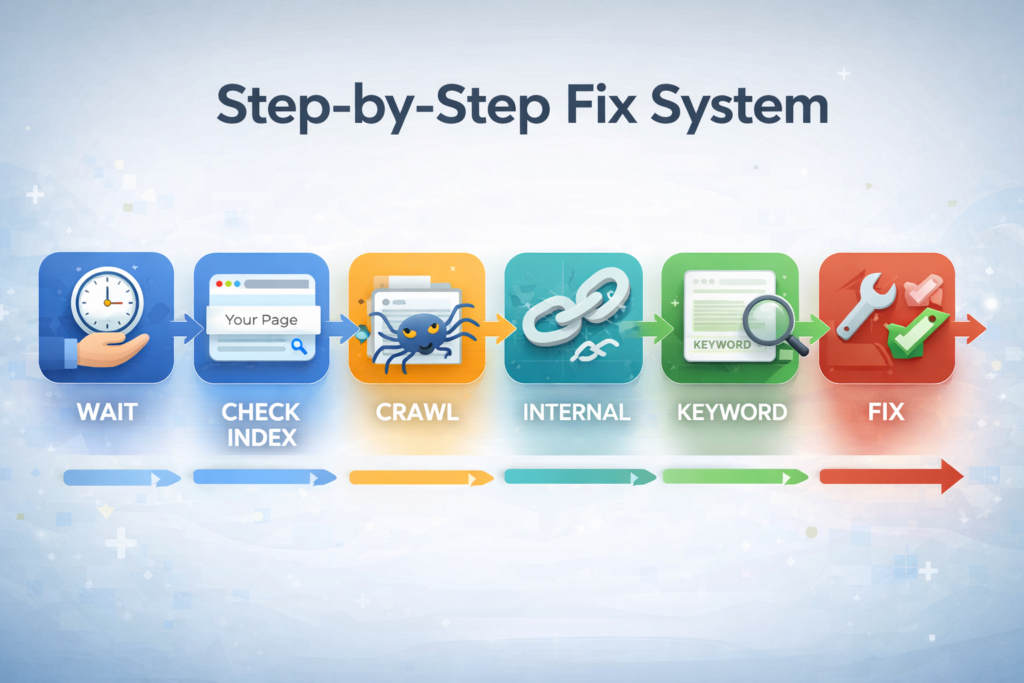
When updating content drops rankings, the goal is not to react quickly—it is to diagnose accurately and restore signal clarity without creating further instability.
This recovery process should be executed in a controlled sequence.
Step 1 — Allow the Re-Evaluation Phase to Complete
Do not make immediate changes after a ranking drop.
After a content update, Google enters a reprocessing cycle where it:
- crawls the updated page
- reinterprets content structure and intent
- compares the new version with the previous one
During this period, ranking volatility is normal.
Premature edits at this stage can:
- confuse signal interpretation
- extend instability
- delay recovery
Recommended approach:
Wait until the page has been recrawled and initial ranking patterns begin to stabilize before taking action.
Step 2 — Confirm That the Updated Version Is Indexed
Before analyzing performance, ensure Google is evaluating the correct version of the page.
If the updated version is not indexed:
- your ranking data reflects the old version
- your conclusions will be inaccurate
Use check if your page is indexed to verify:
- the updated content is visible in search
- no indexing delays are affecting performance
If indexing has not occurred, trigger reindexing before proceeding further.
Step 3 — Validate Crawlability and Rendering
When updating content drops rankings, a hidden technical issue can sometimes be the cause.
Verify that:
- Googlebot can access the page without restriction
- content is fully rendered in HTML (not blocked by scripts)
- no directives (noindex, robots rules) are interfering
Use test if Googlebot can access a page to confirm that the updated version is fully accessible.
Even small technical disruptions can lead to incorrect content interpretation.
Step 4 — Re-Evaluate Search Intent Alignment
This is the most critical step in the recovery process.
Compare the updated page with the original version and identify:
- what query the page was ranking for before
- whether the updated version still targets that query clearly
Common issues:
- content became broader instead of focused
- headings shifted toward different intent
- key problem-solving sections were weakened
If intent has changed, rankings will not recover until alignment is restored.
Action:
Refine the content so the primary intent becomes dominant again.
Step 5 — Analyze Internal Context and Support Signals
A page does not rank independently—it relies on contextual support from the rest of the site.
After an update, verify:
- whether internal links still point using relevant anchors
- whether surrounding pages reinforce the same topic
- whether the page still fits logically within the site structure
Use analyze internal link signals to identify:
- weakened link relevance
- missing contextual support
- structural inconsistencies
If internal signals weaken, the page may lose authority even if the content itself is strong.
Step 6 — Restore Keyword Focus Without Over-Optimization
Content updates often introduce keyword dilution.
Signs of this problem:
- multiple competing keyword variations
- reduced prominence of the main keyword
- inconsistent phrasing across sections
Use optimize keyword density properly to ensure:
- the primary keyword remains clearly dominant
- supporting terms reinforce—not replace—the main topic
The objective is clarity, not keyword stuffing.
Step 7 — Remove or Refine Unnecessary Expansions
One of the most common reasons why updating content drops rankings is over-expansion.
Review the page and identify:
- sections that do not directly support the main intent
- explanations that introduce unrelated subtopics
- content that weakens topical precision
Action:
- remove or simplify non-essential sections
- tighten the structure
- reinforce the core message
A focused page will outperform a broader but diluted one.
Step 8 — Monitor Performance Before Making Further Changes
After adjustments, allow time for stabilization.
Track:
- keyword position trends
- impression patterns
- click-through rate
Avoid making continuous edits unless a clear issue is identified.
SEO recovery is not immediate—it follows a cycle of:
update → re-evaluate → stabilize
Key Principle
When updating content drops rankings, the recovery strategy is not about doing more—it is about doing less, but with precision.
- preserve what was already working
- restore what was unintentionally weakened
- refine without disrupting core signals
That is how rankings recover—and improve sustainably.
What To Do After Ranking Drop
| If this happened after update | Do this |
|---|---|
| Lost main keyword | Restore original intent |
| Gained impressions but lost position | Reduce keyword drift |
| CTR dropped | Fix title + intro |
| No change after 10 days | Re-optimize structure |
Safe vs Risky Updates
| Update Type | Risk Level | Impact |
|---|---|---|
| Updating data or examples | Low | Positive or stable |
| Adding relevant section | Medium | Temporary fluctuation |
| Changing heading structure | High | Signal reset |
| Changing primary keyword | Very High | Ranking loss |
| Removing key content | High | Context loss |
Technical Insight
Google evaluates page versions over time.
Each update creates a new version that must be validated.
- If signals improve → ranking increases
- If signals weaken → ranking decreases
This explains why updating content drops rankings even when updates seem beneficial.
This is also consistent with Google Search Central documentation on helpful content, where Google emphasizes evaluating content based on usefulness, clarity, and intent alignment.
Supporting Insight
The effect of updates depends on the page’s initial strength.
Pages already struggling with issues like
page indexed but no impressions
are more sensitive to updates.
Similarly, structural issues such as
sitemap URLs ignored by Google
can limit how effectively updates are processed.
Recovery Timeline
| Time | Expected Behavior |
|---|---|
| Day 1–2 | Ranking fluctuation |
| Day 3–5 | Reprocessing phase |
| Day 5–10 | Early stabilization |
| Day 10–14 | Stable trend emerges |
FAQs
Does updating content always drop rankings?
No. Updating content does not always drop rankings, but it often causes temporary fluctuations because Google re-evaluates the page after changes.
When major elements like headings, keyword focus, or structure are modified, Google needs to reassess how the page matches search intent. This is why many site owners see ranking drops even after improving content.
How long does it take to recover after updating content?
When updating content drops rankings, recovery usually takes between 3 to 14 days, depending on the size of the update and how often Google crawls your site.
- Small updates → faster stabilization
- Large structural changes → longer re-evaluation
If rankings do not stabilize after this period, it may indicate a deeper issue with intent alignment or page structure.
Should I revert content changes if rankings drop?
No. You should not immediately revert changes when updating content drops rankings.
First, allow Google to complete the re-evaluation process. Then analyze:
- whether the page still matches the original keyword intent
- whether the update introduced keyword drift
- whether structural changes weakened clarity
Reverting too early can create more instability and delay recovery.
Why do impressions increase but rankings drop after updating content?
This happens when the updated page starts ranking for a wider range of queries.
While impressions increase, the average position drops because:
- the page is shown for less relevant keywords
- the main keyword loses dominance
This is a common outcome when updating content drops rankings due to keyword expansion and intent dilution.
Can updating content improve rankings in the long term?
Yes. Updating content can improve rankings if the update:
- strengthens search intent alignment
- improves structure and clarity
- reinforces the main keyword focus
The key is to enhance the page without changing its core topic. Controlled updates tend to perform better than aggressive rewrites.
Final Insights
When updating content drops rankings, the real problem is not the update—it’s the loss of alignment.
Google already understands your page based on:
- its original intent
- its structure
- its historical performance
When you change that structure too aggressively, you force Google to reassess whether the page still deserves its position.
The goal of content updates is not to rewrite everything.
It is to:
- improve clarity without changing intent
- strengthen signals without diluting focus
- enhance performance without resetting trust
That is the difference between pages that recover and pages that disappear after an update.